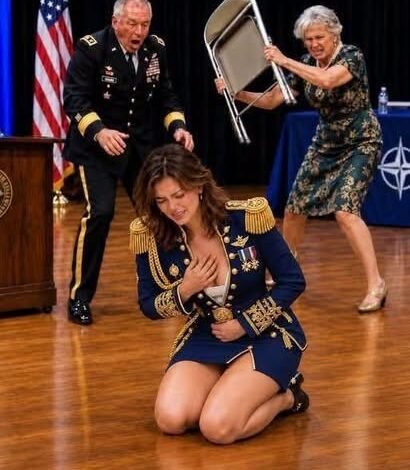
General Hayes heard me.
He turned slightly.
“Medic.”
One word.
That was all.
Two medics who had been standing near the side entrance immediately hurried toward us.
Linda stepped backward.
“You don’t understand,” she said. “She has always been like this. She provokes people. She thinks wearing that uniform makes her special.”
General Hayes looked at her.
“No.”
His voice was quiet.
That somehow made it worse.
“You don’t understand.”
The auditorium went completely silent.
The general gestured toward the medics.
“Take care of her.”
One medic knelt beside me.
“Ma’am, can you move your fingers?”
I tried.
Nothing happened.
My stomach dropped.
“I… I can’t.”
“Don’t force it.”
He carefully supported my arm.
The moment his fingers touched my wrist, pain shot all the way into my shoulder.
I clenched my teeth.
General Hayes remained beside me.
Linda was still talking.
“She always wanted attention,” she said. “Even as a kid. Everything had to be about her.”
My father finally looked up.
“Linda.”
It was the first word he’d spoken.
She turned toward him.
“What?”
He swallowed.
“Stop.”
She stared at him.
Then she gave a bitter little smile.
“Oh, now you want to defend her?”
My father’s face changed.
But before he could answer, one of the Military Police officers stepped between them.
“Ma’am, you need to come with us.”
Linda shook her head.
“No.”
“Please put your hands where we can see them.”
“This is ridiculous.”
The officer’s expression didn’t change.
“You struck a service member with a metal chair during an official military ceremony.”
“I didn’t mean to break her arm!”
That sentence froze the room.
Even Linda seemed to realize what she had just admitted.
General Hayes looked at her.
“You just said you struck her.”
Linda’s face went pale.
“I—”
“You said you didn’t touch her.”
She opened her mouth.
Nothing came out.
My stepbrother stopped laughing.
He looked suddenly terrified.
The second Military Police officer moved toward him.
He raised both hands.
“I didn’t do anything.”
“No one said you did.”
“Then why are you coming over here?”
“Because you’re a witness.”
The word seemed to frighten him more than anything else.
A witness.
That meant there would be questions.
Reports.
Statements.
Consequences.
For years, my family had survived by making sure there were never consequences.
If Linda insulted me, I was too sensitive.
If my father ignored it, he was trying to keep peace.
If my stepbrother mocked my service, it was just a joke.
If I objected, somehow I became the problem.
But this time there were hundreds of witnesses.
And cameras.
And military personnel.
And a three-star general standing less than ten feet away.
There was nowhere for the truth to hide.
The medic carefully cut open the sleeve of my uniform.
When he saw the swelling, his expression tightened.
“Possible fracture.”
I looked down.
My Purple Heart was still pinned to my chest.
There was something almost unbearable about seeing it there.
A small piece of metal.
A symbol of sacrifice.
And underneath it, my arm was broken.
General Hayes noticed me staring at the medal.
He crouched slightly so we were at eye level.
“Don’t worry about the ceremony.”
I shook my head.
“I’m not worried about the ceremony.”
“What are you worried about?”
I looked toward my father.
He was still standing beside Linda.
Still watching.
Still saying nothing.
“I thought my father would stop her.”
General Hayes followed my gaze.
His jaw tightened.
Then he said something I wasn’t expecting.
“He should have.”
My eyes filled with tears.
I looked away quickly.
I didn’t want the crowd to see me cry.
I’d survived things that had made stronger people break.
I’d carried people out of places where the air itself seemed determined to kill us.
I’d learned how to keep moving when every instinct screamed to stop.
But somehow, hearing a stranger say those three words—
He should have.
—hurt more than the chair.
Because someone finally acknowledged what I had spent years pretending didn’t matter.
I wasn’t asking my father to choose me over everyone else.
I had never asked for that.
I only wanted him to notice when someone was hurting me.
The medic touched my shoulder.
“We need to get you to the hospital.”
I nodded.
Then I felt a hand close around mine.
My father’s.
I looked up.
He was crying.
I had never seen him cry before.
Not at my graduation.
Not when I left for deployment.
Not when I came home.
Not even when he learned I had been injured.
But now tears were running down his face.
“I’m sorry,” he whispered.
I stared at him.
Two words.
Two words I’d imagined hearing since I was a little girl.
And yet, standing there with my arm broken and my uniform torn, they didn’t feel like enough.
“Why?” I asked.
He looked confused.
“Why did you let her do this for so long?”
His face crumpled.
“I thought I was protecting the family.”
I almost whispered the next question.
“What about me?”
He had no answer.
Behind him, Linda scoffed.
“This is unbelievable.”
The Military Police officer turned toward her.
“Ma’am.”
She ignored him.
“You’re all falling for this.”
I looked at her.
For the first time, I didn’t feel afraid.
I didn’t feel angry either.
I just felt tired.
“Linda,” I said.
She stopped.
“You won.”
Her eyebrows lifted.
“What?”
“You got what you wanted.”
I looked down at my broken arm.
“You humiliated me.”
Her expression hardened.
“You made sure everyone saw me as weak.”
I swallowed.
“But you made one mistake.”
She stared at me.
“You did it in front of people who knew exactly what that uniform means.”
The room went silent again.
General Hayes slowly stood.
He looked toward the audience.
Then toward the podium.
Then back at me.
There was something in his expression I couldn’t understand.
Something almost personal.
The senior officer near the stage approached him quietly.
“General, should we clear the auditorium?”
Hayes didn’t answer immediately.
He looked at me.
Then he looked at the Purple Heart pinned to my chest.
Finally, he said:
“No.”
The officer nodded.
Hayes turned toward the microphone.
“Ladies and gentlemen.”
His voice filled the auditorium.
“This ceremony is not over.”
A ripple of confusion moved through the crowd.
Linda stared at him.
“What are you doing?” she demanded.
General Hayes ignored her.
He walked back toward the podium.
Every step was deliberate.
The audience slowly settled into their seats.
The medics remained beside me.
The Military Police kept Linda where she was.
And my father stood in the aisle, looking as though he had just realized that the story he had spent years helping hide was about to become public.
General Hayes placed one hand on the podium.
Then he looked directly at me.
“I owe this soldier an explanation.”
My heart began pounding.
I didn’t know what he meant.
Neither did anyone else.
He reached into the inside pocket of his dress uniform.
And pulled out a folded document.
My breath caught.
I recognized the seal immediately.
It was military.
Official.
And judging from the way the officers around him reacted, whatever was written on that paper mattered.
Very much.
Linda suddenly stopped struggling.
My father whispered:
“Robert…”
The general looked at him.
“It’s time.”
My father went completely still.
I stared between them.
“Time for what?”
General Hayes unfolded the document.
His eyes met mine.
And then he said something that made the entire auditorium gasp.
“You’ve spent years believing your father was the only person who knew the truth about what happened to you.”
He paused.
“He wasn’t.”
I couldn’t breathe.
“What truth?”
General Hayes looked toward Linda.
Then toward my father.
Finally, back at me.
“The reason I recognized you today…”
His voice lowered.
“…is because I was there the night your life changed forever.”
My blood ran cold.
I had never met General Robert Hayes before that ceremony.
At least, that’s what I believed.
But the look in his eyes told me otherwise.
He knew me.
Not from today.
Not from my military record.
From somewhere much deeper.
Somewhere buried in the past.
Somewhere my family had spent years making sure I never looked.
I shook my head.
“No.”
General Hayes stepped closer.
“Yes.”
My father closed his eyes.
Linda whispered something I couldn’t hear.
Then the general said the words that shattered whatever was left of the story I had believed about my childhood:
“Your father didn’t tell you why you joined the military.”
He looked at the Purple Heart on my chest.
“He didn’t tell you who saved your life.”
Then he looked directly at my father.
“And he certainly didn’t tell you who ordered me to find you.”
The auditorium seemed to disappear.
I could hear nothing except my own heartbeat.
“Find me?” I whispered.
General Hayes nodded.
“I’ve been trying to find you for sixteen years.”
I stared at him.
Sixteen years.
The number meant nothing.
And everything.
Because sixteen years ago, I had been a child.
A child who remembered one night.
One explosion.
One burning house.
One person carrying me through smoke.
And a voice telling me:
Don’t look back.
I had spent my entire life believing that person was my father.
But General Hayes was looking at me like he knew the truth.
And suddenly, for the first time, I wondered whether the person who had saved me that night…
had been someone else entirely.
Part 3 — The Truth They Buried
For several seconds, I couldn’t speak.
Sixteen years.
General Hayes had been looking for me for sixteen years.
I stared at him, trying to make sense of the words.
Then I looked at my father.
He wouldn’t meet my eyes.
That was when I knew.
The general hadn’t lied.
My father knew exactly what this was about.
“Dad?”
His shoulders dropped.
“I’m sorry.”
“No.”
My voice shook.
“Don’t say that again.”
He finally looked at me.
His eyes were red.
“I was trying to protect you.”
“From what?”
He looked toward Linda.
She had gone completely silent.
“From the truth.”
My chest tightened.
“What truth?”
General Hayes answered for him.
“The fire wasn’t an accident.”
The words hit me harder than the chair.
I stared at him.
“What?”
My father covered his face with one hand.
Linda suddenly stepped forward.
“Robert, don’t.”
The general turned toward her.
“You’ve had sixteen years to tell her.”
Linda’s face had lost all its color.
“You don’t know what happened.”
“I know exactly what happened.”
He unfolded the document in his hands.
“This is the original investigation.”
My eyes moved to the pages.
There were dates.
Names.
Signatures.
Photographs.
I recognized the address immediately.
My childhood home.
The house I had been told was destroyed because of faulty wiring.
The house I had spent years remembering only in fragments.
General Hayes looked at me.
“The fire was deliberately started.”
I felt dizzy.
My father whispered:
“I didn’t start it.”
I looked at him.
“Then who did?”
He couldn’t answer.
General Hayes did.
“Linda.”
The auditorium erupted in whispers.
Linda shook her head violently.
“No.”
“You were there.”
“I was angry.”
“You locked the back door.”
“I didn’t mean for anyone to get hurt!”
My father’s face collapsed.
I stared at Linda.
Suddenly, memories began returning.
A locked door.
Smoke filling the hallway.
My father’s voice screaming my name.
A woman’s silhouette disappearing through the front entrance.
And then—
Someone breaking through a window.
Someone lifting me into their arms.
Someone carrying me through the smoke.
I looked at General Hayes.
“You.”
He nodded.
“I was a young captain then.”
My mouth fell open.
“You saved me.”
“Yes.”
I started crying.
Not quietly this time.
I couldn’t stop.
General Hayes’s expression softened.
“You were unconscious when I carried you out. Your father was injured and trapped on the other side of the house.”
I looked at my father.
He nodded through his tears.
“I thought you were dead.”
“You knew he saved me.”
“I did.”
“Then why did you lie?”
My father’s voice broke.
“Because Linda threatened you.”
I stared at him.
“She said if I told anyone, she’d disappear with your little brother. She knew I couldn’t lose both of you.”
I looked toward Linda.
“You let me believe I wasn’t worth protecting.”
Linda said nothing.
The Military Police officer stepped forward.
“Ma’am, you’re under arrest.”
For once, Linda didn’t fight.
She simply stared at me.
Her expression wasn’t angry anymore.
It was empty.
As they led her away, she passed my father.
He didn’t look at her.
He didn’t follow.
He just stood there.
Watching the woman he had protected for sixteen years finally walk away in handcuffs.
My stepbrother remained in his seat.
The laughter was gone.
He looked ashamed.
Maybe for the first time in his life, he understood that cruelty had consequences.
General Hayes turned toward the audience.
“This soldier didn’t earn her Purple Heart because she was lucky.”
He looked at me.
“She earned it because when others ran, she stayed.”
The room was silent.
“She carried wounded soldiers when she was exhausted. She went back when she could have gone home. She put other people’s lives ahead of her own.”
His voice hardened.
“And today, after everything she has survived, someone tried to convince her that she was trash.”
He paused.
“No.”
His eyes swept across the auditorium.
“She is no trash.”
Then he looked directly at me.
“She is the kind of soldier this country should be proud to have.”
The applause started slowly.
One person.
Then another.
Then dozens.
Within seconds, the entire auditorium was standing.
I couldn’t lift my injured arm.
So I stood there with my good hand against my chest.
For once, I didn’t care what Linda thought.
I didn’t care what my father had failed to do.
I didn’t care what anyone had called me.
I looked at the Purple Heart pinned to my uniform.
And I finally understood something.
That medal didn’t belong to the people who had hurt me.
It belonged to the person who had survived them.
General Hayes stepped toward me.
“There’s one more thing.”
I looked up.
He reached into his pocket and handed me a small, battered photograph.
I stared at it.
A younger General Hayes stood beside a little girl wrapped in a gray blanket.
The little girl was me.
On the back, there were four handwritten words.
“She wouldn’t let go.”
I looked at him.
“What does that mean?”
He smiled sadly.
“When I carried you out of that fire, you were unconscious.”
He pointed to the photograph.
“But when I tried to put you down for the medics…”
He paused.
“You grabbed my uniform.”
I laughed through my tears.
“I did?”
“You wouldn’t let go.”
For the first time that day, I smiled.
Then General Hayes leaned closer.
“You’ve been carrying that little girl inside you for sixteen years.”
He gently tapped the Purple Heart.
“Maybe it’s time you stop carrying everyone else and let someone carry you.”
I looked around the auditorium.
At the people standing.
At the officers.
At the medics.
At my father.
He was crying again.
I walked toward him.
For a moment, neither of us spoke.
Then he opened his arms.
I stepped into them.
Carefully.
Because my arm still hurt.
But I hugged him anyway.
“I forgive you,” I whispered.
He held me tighter.
“But I’ll never forget.”
He nodded.
“I don’t expect you to.”
And somehow, that was enough.
Not because the past had disappeared.
It hadn’t.
Some wounds don’t disappear just because the truth finally comes out.
But the truth changes the weight of them.
For sixteen years, I had believed I was the girl nobody protected.
That I was unwanted.
That every insult was proof that Linda had been right about me.
That my uniform was something I had to use to prove I mattered.
But standing there beneath the lights, with my Purple Heart still pinned to my chest, I finally understood.
I hadn’t survived because I was strong enough to endure being hated.
I survived because, somewhere beneath all the fear and pain, I had always known I deserved better.
The chair had broken my arm.
It hadn’t broken me.
And as the applause continued around me, I looked at General Hayes one last time.
He gave me a small salute.
I returned it with my good hand.
For the first time in my life, I wasn’t saluting because someone ordered me to.
I was saluting because I finally understood what my uniform meant.
Not to Linda.
Not to my father.
Not to the people who had spent years trying to make me feel small.
It meant I had survived.
I had served.
I had carried others.
And after sixteen years of carrying a secret that was never mine to bear…
I was finally free.
The medal on my chest had been awarded for a wound the world could see.
But that day, I finally healed the one nobody could.