Uncategorized
8-Year-Old Girl with Blue Hair and Black Nails Was Kicked Out of Class – The Next Day, She Took off Her Jacket, and Everyone Froze

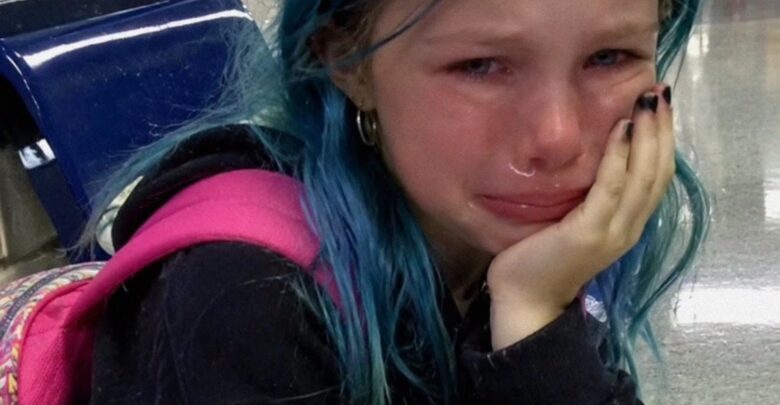
# My Daughter Was Mocked for Her Blue Hair, but Somehow She Was the One Sent Out of Class – Then She Took Matters Into Her Own Hands
Lily pointed at Mrs. Collins.
“She made me feel like monsters look like me.”
Mrs. Collins covered her mouth.
“No, Lily. I didn’t say that.”
Lily’s chin trembled.
“You didn’t stop them.”
The room went quiet.
I looked at my daughter, then at the principal, Mr. Hayes. He was holding a folded sheet of paper.
Something was written across the top in thick black marker.
I stepped closer.
It said, **”THINGS PEOPLE SAID ABOUT ME YESTERDAY.”**
Underneath was a list:
Witch.
Monster.
Weirdo.
Ugly.
And at the bottom:
Mrs. Collins: “Your appearance is becoming a distraction.”
I froze, then looked at Lily.
“Where did you get this?”
“I made it.”
“When?”
“Last night.”
That was when I noticed her shirt.
Under the oversized denim jacket, she was wearing a plain white T-shirt. Except it wasn’t plain anymore.
Across the front, in black fabric marker, she’d written every word from the list:
WITCH.
MONSTER.
WEIRDO.
UGLY.
And across the back, in larger letters:
**”IF THESE WORDS ARE DISTRACTING, WHY WEREN’T THE PEOPLE SAYING THEM?”**
That was why everyone had frozen.
Not because my eight-year-old had blue hair, but because she’d walked into school wearing exactly what people had said to her.
My name is Rachel.
Lily is my only child.
And if I’m being completely truthful, I didn’t know whether to be proud, furious, or terrified.
Probably all three.
Mr. Hayes said, “Mrs. Carter, we need to discuss what happened.”
I looked at him. “Yes. We do.”
Mrs. Collins had tears in her eyes.
Lily stood beside her desk with both fists clenched.
I went straight to her.
“Are you okay?”
She nodded.
That meant nothing.
Eight-year-olds will say they’re okay while actively falling apart.
I crouched.
“Did anyone touch you?”
“No.”
“Did anyone threaten you?”
“No.”
“Did you get in trouble?”
Lily looked toward Mrs. Collins.
“She told me to put my jacket back on.”
Mrs. Collins said quickly, “I asked her to cover the shirt because the language was upsetting the other students.”
I stood.
“The language?”
Mrs. Collins looked at me.
“The words.”
“The words they called her yesterday?”
Her face changed.
“Yes.”
I stared at her.
“So yesterday, those words weren’t enough to remove the children saying them from class. But today, when Lily wrote them on a shirt, suddenly they’re inappropriate?”
Mr. Hayes stepped in.
“Mrs. Carter—”
“No. I want an answer.”
Mrs. Collins wiped her eyes.
“I handled yesterday badly.”
That stopped me.
I hadn’t expected her to admit it.
She continued.
“I thought I was de-escalating the situation by removing Lily from the room.”
“You removed the child being mocked.”
“I know.”
“And told her she was distracting.”
“I know.”
Lily looked at her.
Mrs. Collins crouched slowly so she was at Lily’s height.
“I was wrong.”
Lily didn’t respond.
Mrs. Collins said, “When the other kids started making comments about your hair, I should have stopped them.”
Lily stared at the floor.
“I thought if I gave everyone a few minutes to settle down and sent you to the office, the situation would calm down.”
Lily whispered, “It made them think they were right.”
Mrs. Collins closed her eyes.
“Yes.”
That was the moment she started crying harder.
Not dramatic crying.
Embarrassed crying.
The kind people do when a child says something too accurate to defend against.
Lily continued, “Tyler said, ‘See? Even Mrs. Collins thinks you look bad.’”
Mrs. Collins looked sick.
“I didn’t know he said that.”
“You didn’t ask.”
Nobody spoke.
I looked at Mr. Hayes.
“Why was Lily outside your office when I picked her up yesterday?”
He sighed.
“Because Mrs. Collins sent her there.”
“And what did you do?”
“I spoke to her.”
“About what?”
“About the dress code.”
I actually laughed.
“Her hair?”
“Yes.”
“You have a rule against blue hair?”
He hesitated.
“No.”
“Black nail polish?”
“No.”
“The jacket?”
“No.”
“So she didn’t break any rule.”
“No.”
“Then why was she the one being questioned?”
He looked embarrassed.
“Because the complaint came to me as a classroom-disruption issue.”
I stared at him.
“My daughter’s body isn’t a classroom disruption.”
“I agree.”
“Do you?”
He nodded.
“After reviewing what happened, yes.”
That phrase irritated me.
After reviewing.
As if it had required an investigation to discover that calling an eight-year-old a monster was worse than blue hair.
Mr. Hayes handed me the paper Lily had made.
“She gave this to me when I came into the classroom this morning.”
I looked at Lily.
“What happened exactly?”
Lily took a breath.
Then she told me.
She had gone to class wearing the jacket zipped all the way up.
Mrs. Collins noticed the blue hair immediately. Apparently, she’d looked uncomfortable but didn’t say anything.
For the first hour, nobody mentioned it.
Then Tyler, the same boy who’d called her a witch the day before, whispered something to another kid.
A few children laughed.
Lily ignored them.
At 10:10, Mrs. Collins asked the class to take off their coats and jackets because the room was warm.
Lily raised her hand.
“Do I have to?”
Mrs. Collins said, “Yes, sweetheart. You can’t wear a heavy jacket all day.”
So Lily stood, unzipped it, and took it off.
The entire class went silent.
Mrs. Collins saw the shirt. Then the words.
She said, “Lily, put your jacket back on.”
Lily said, “Why?”
“Because that shirt isn’t appropriate for school.”
Then Lily pulled the paper from inside her sleeve.
The list.
And said, “These were appropriate yesterday.”
That was when another teacher passing in the hallway heard voices and came in.
Then Mr. Hayes was called.
No screaming.
No violence.
No dramatic meltdown.
Just one eight-year-old standing beside her desk, wearing every insult adults had failed to stop.
I looked at the shirt again.
“Lily, did you make this yourself?”
She nodded.
“With what?”
“Your fabric markers.”
Of course.
I kept those in the craft cabinet.
“Why didn’t you tell me?”
She shrugged.
“You were mad already.”
“At you?”
“No. At them.”
“Sweetheart, you can tell me things even if I’m already mad.”
“I know.”
I wasn’t sure she did.
Then I asked the question I should have asked the night before.
“Why did you paint your nails black again?”
Lily looked at me.
“Because they said they were ugly.”
That hurt.
Not because she cared about nail polish, but because she had repainted them deliberately after people mocked her.
I had mistaken that for confidence.
It wasn’t exactly.
It was resistance.
There is a difference.
She had spent the evening proving to herself that she wasn’t going to let other children decide what she was allowed to look like.
And apparently, she’d also decided the adults needed a visual aid.
Mr. Hayes said, “We’ve called the parents of the students involved.”
“Students?”
“Four children made repeated comments yesterday.”
I looked at him.
“Repeated?”
He nodded.
Mrs. Collins sat in one of the tiny classroom chairs.
She looked exhausted.
“I should have documented it immediately.”
“Yes.”
“I didn’t.”
“Why?”
She thought for a moment.
Then said something I respected more than an excuse.
“Because I saw the hair first.”
I frowned.
She continued.
“When Lily walked into class, I thought it would become a distraction.”
Lily looked at her.
Mrs. Collins said, “I expected trouble before anyone had actually done anything.”
There it was.
Not cruelty. Bias.
She had seen bright blue hair, black nails, and an oversized jacket, and mentally marked Lily as the issue before the class ever reacted.
So when the class did react, Mrs. Collins handled Lily like she was the source of the problem.
I said, “Thank you for saying that.”
She nodded.
“It doesn’t make it better.”
“No.”
“But thank you.”
Mr. Hayes asked Lily if she wanted to go home.
She immediately shook her head.
“No.”
I looked at her.
“You sure?”
“Yes.”
“You don’t have to prove anything.”
“I’m not.”
Then she looked at Mrs. Collins.
“I want to stay.”
I understood.
Leaving again would feel like the same thing.
So she stayed.
But not before I asked what consequences the other students were facing.
Nothing dramatic.
No expulsions. No police.
They were eight.
The school contacted their parents.
They lost some privileges.
They had to participate in restorative conversations with the counselor.
Tyler was moved away from Lily’s desk.
The school also arranged for the entire class to have a lesson on appearance, teasing, and what “distraction” actually means.
I worried that would embarrass Lily more.
She wanted it.
“Just don’t make everyone stare at me,” she said.
The counselor, Ms. Patel, handled it better than I expected.
She didn’t turn Lily into an inspirational mascot.
She didn’t ask Lily to stand in front of the class and explain why bullying was bad.
Instead, she wrote two sentences on the board:
“Someone is different. Someone makes fun of the difference.”
Then she asked, “Which action creates the problem?”
Apparently, most of the children understood immediately.
Tyler didn’t.
Or pretended not to.
He said, “But if Lily didn’t have blue hair, nobody would’ve said anything.”
Ms. Patel asked, “If I take your glasses and laugh at you for not being able to read the board, did your eyes cause the problem or did my behavior?”
Tyler went quiet.
Lily told me about that after school.
She was smiling when she did.
“Ms. Patel is scary.”
“Good scary?”
“Very.”
Mrs. Collins called me that evening.
I almost didn’t answer. Then I did.
She said, “I owe you an apology too.”
“You apologized to Lily.”
“Not enough.”
I stayed quiet.
She continued.
“I’ve been teaching for 19 years. I thought that meant I was good at knowing which situations would become disruptive.”
I said, “Sometimes experience just makes you faster at being wrong.”
There was a pause.
Then she said, “That’s fair.”
I felt slightly guilty. Slightly.
She told me she’d spent the afternoon thinking about why Lily’s appearance bothered her.
She grew up in a strict family.
Colored hair meant rebellion.
Black nail polish meant trouble.
Tattoos meant irresponsibility.
None of that had anything to do with Lily.
But those assumptions were still sitting somewhere in Mrs. Collins’s brain.
“I put adult meanings onto an eight-year-old,” she said.
“Yes.”
“And then I punished her for the reaction I expected.”
“Yes.”
Again, she didn’t defend herself.
That mattered.
Then she asked, “Can I tell you something embarrassing?”
“Sure.”
“When Lily took off the jacket, my first thought was that the shirt was disrespectful.”
I laughed once.
“Of course it was.”
“Then I read the back.”
The line, “IF THESE WORDS ARE DISTRACTING, WHY WEREN’T THE PEOPLE SAYING THEM?”
Mrs. Collins said, “I didn’t have an answer.”
Neither did I.
The following morning, Lily asked whether she could wear the shirt again.
I said no.
She looked shocked.
“Why?”
“Because you’ve made your point.”
“But—”
“And because you’re eight, and I don’t actually want you walking around school with ‘ugly’ written across your chest.”
She considered that.
“Can I wear the jacket?”
“Obviously.”
“Black nails?”
“Obviously.”
“Blue hair?”
“That’s attached to you.”
She smiled.
When we reached school, Tyler and his mother were waiting near the office.
I immediately tensed.
His mother walked toward me.
“I’m Melissa.”
“Rachel.”
She looked embarrassed.
“I wanted to apologize.”
I glanced at Tyler.
He was staring at the floor.
Melissa continued.
“He told me what he said.”
I nodded.
She said, “We don’t talk like that at home.”
I almost gave her the standard response.
Kids learn it somewhere.
But honestly, children don’t need adults to teach them every cruel thing.
Sometimes they just discover that getting a laugh feels powerful.
Melissa looked at Lily.
“Tyler has something to say.”
He mumbled, “Sorry.”
His mother said, “Try again.”
He looked at Lily.
“I’m sorry I called you a witch and a monster.”
Lily crossed her arms, then said, “Okay.”
Not “I forgive you.”
Not “It’s fine.”
Just okay.
I liked that.
Melissa asked, “Would you like him to apologize for anything else?”
Lily looked at Tyler.
Then said, “For saying blue is stupid.”
Tyler looked genuinely offended.
“I said blue hair was stupid.”
“Still.”
His mother closed her eyes.
“Tyler.”
“Sorry.”
Lily nodded, then we went inside.
The situation should have ended there.
Mostly, it did.
But something unexpected happened over the next few weeks.
Other kids started changing things about themselves.
Nothing huge.
One girl wore the glasses she’d previously refused to wear.
A boy came to school with pink shoelaces after telling his mother he’d been afraid other boys would laugh.
Another girl stopped hiding a birthmark on her arm with long sleeves.
I was nervous about that.
I didn’t want Lily’s story turning into some “brave blue-haired girl teaches everyone self-love” nonsense.
She was eight.
She liked blue. That was all.
But children watch what adults permit.
And once the school made it clear that different didn’t mean wrong, a few kids apparently relaxed.
Mrs. Collins changed too.
A month later, the class had a “favorite color” day.
Lily wore blue, naturally.
Mrs. Collins showed up with one streak of washable purple in her hair.
Lily came home horrified.
“Mom.”
“What?”
“Mrs. Collins dyed her hair.”
“Okay.”
“Purple.”
“Okay.”
“Purple.”
I started laughing.
“What’s wrong with purple?”
“It doesn’t match her.”
I stared at my daughter.
Then said, “Interesting.”
She immediately understood.
“No.”
“Oh, yes.”
“Mom.”
“So we’re judging people’s hair now?”
“I didn’t say it was bad.”
“You said it didn’t match her.”
“That’s different.”
“Is it?”
Lily rolled her eyes.
“You’re annoying.”
“Correct.”
She eventually decided Mrs. Collins looked “kind of cool.”
I never told Mrs. Collins that the endorsement took several hours.
The blue faded after about six weeks.
I assumed Lily would want to dye it again immediately.
She didn’t.
One morning she said, “I think I want pink next time.”
I said, “Fine.”
Then she said, “Maybe after summer.”
Also fine.
That surprised me.
The blue hair had become such a huge issue for everyone else that I’d forgotten the simplest fact.
To Lily, it was hair.
She wasn’t making a statement.
She wasn’t trying to challenge school authority.
She wasn’t expressing some deep identity crisis.
She was eight years old and liked blue.
Adults and children had attached the rest.
I kept the shirt.
She outgrew it quickly.
It’s folded in a box with school pictures, birthday cards, and drawings I can’t bring myself to throw away.
Every once in a while, I take it out.
The writing is faded now.
Words that seemed enormous when they were aimed at an eight-year-old.
But the line on the back is still darker because Lily went over it twice.
“IF THESE WORDS ARE DISTRACTING, WHY WEREN’T THE PEOPLE SAYING THEM?”
I’ve thought about that sentence more than I’d like to admit.
Because I originally went into the school ready to fight Mrs. Collins.
I expected a villain.
What I found was something harder.
A decent teacher who made a bad decision because she didn’t examine an assumption quickly enough.
A principal who initially treated a child’s appearance as easier to manage than several children’s cruelty.
Parents who were embarrassed by what their kids had said.
And a group of eight-year-olds learning, in real time, that being uncomfortable with someone isn’t permission to punish them for existing.
Mrs. Collins never became Lily’s favorite teacher.
That would make the ending too neat.
But Lily trusted her again. Slowly.
By spring, she was coming home talking about books they read in class and experiments they’d done.
The school became school again.
That mattered more to me than whether everyone learned some perfect lesson.
Because when Lily first came home crying, I thought the biggest problem was that a teacher had sent her out of class.
It wasn’t.
The bigger problem was that Lily had started to believe being accepted depended on making herself easier for other people to look at.
So she did something I never would have thought to do.
She took every ugly word they’d given her.
Put it where everyone could see it.
And made the adults decide which was actually more distracting: the blue hair, or the cruelty.
**What impressed you most about Lily’s response: her courage to stand up for herself, her refusal to change her appearance, or the way she made the adults question their own behavior?**