News
Woman’s Mom Passed Away While Serving in Afghanistan – Years Later, Her Army Friend Came to the Woman’s Wedding in a Red Dress with an Envelope
Woman’s Mom Passed Away While Serving in Afghanistan – Years Later, Her Army Friend Came to the Woman’s Wedding in a Red Dress with an Envelope

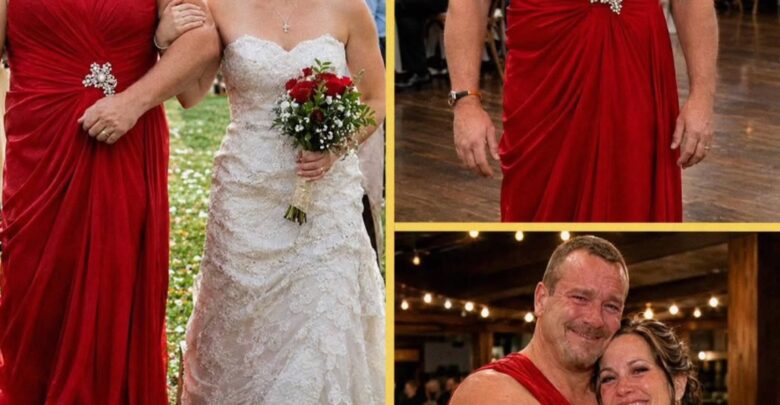
My Mother Promised to Wear Red at My Wedding—Years Later, Her Army Friend Kept That Promise
A fictional story about loss, a promise, and the family that grew around it.
The Promise Beside the Suitcase
“Mom, what if you don’t come back?”
My mother stopped folding her uniforms.
I was twelve. Old enough to understand that serving in Afghanistan could be dangerous, but not old enough to imagine a life in which she never walked through our door again.
She sat beside me.
“Being frightened is normal, Lily.”
“Are you frightened?”
“Sometimes.”
“Then why do you have to go?”
She considered her answer.
“There are people who need medical care. That’s the work I’m trained to do.”
My mother, Sarah, was an Army medic.
At home, she could manage a scraped knee and a terrible school day with the same patient attention. But she could not make that conversation painless.
“Promise you’ll come home.”
She put her arm around me.
“I promise I’ll do everything I can.”
Then she tried to make me smile.
“Besides, I have plans. I’m supposed to wear a bright red dress to your wedding.”
“Why red?”
“So you can find me immediately.”
“I’ll know where you are.”
“Not if you’re busy being a bride.”
I leaned against her.
“And I’m going to dance terribly,” she added.
“You already do.”
“Then I won’t need lessons.”
Pancakes on Fridays
Mom raised me alone.
When I asked about my father, she explained that he had not become part of our lives.
“But you knew how to be a parent?”
She laughed.
“Not at first.”
“What changed?”
“I kept learning.”
We lived in a small apartment where the kitchen table served as my homework desk.
Friday evenings were ours whenever her schedule allowed.
We made pancakes for dinner and watched old films.
She sometimes burned the first pancake. I usually added more sugar than the recipe required.
Neither of us considered these serious mistakes.
She listened when I was upset, although listening did not always mean agreeing with me.
Once, after an argument with a friend, she asked what I had said before explaining what the other girl had done.
I found that deeply unfair.
Years later, I understood why she asked.
Living With Grandma
During Mom’s deployment, I stayed with Grandma.
She made familiar meals, helped me settle into a routine, and kept a photograph of Mom beside my bed.
I loved her.
I still missed the sound of my mother’s keys in the door.
Calls came when they could.
Sometimes we had time for a proper conversation. Sometimes the connection lasted only long enough to say we loved each other.
“How’s my favorite girl?”
“You only have one.”
“Then you’re doing very well.”
I told her about school, guitar practice, and the small problems that felt enormous at twelve.
She told me ordinary things when she could.
A meal she missed.
A joke somebody had told.
A song she wanted me to learn.
Those details helped me picture her as somewhere real, rather than simply far away.
The Voice in the Background
That was how I first met Daniel.
He was another medic, younger than Mom, and apparently convinced that every conversation improved with a bad joke.
One evening, I heard him in the background.
“Tell Lily that was funny.”
Mom sighed.
“Do you hear what I put up with?”
Daniel briefly came to the phone.
“Your mother has very high standards.”
“She says you’re annoying.”
“That’s encouraging. She’s starting to like me.”
Afterward, I sometimes asked whether he was nearby.
He remembered that I was learning guitar.
Mom described him as the younger brother she had never had.
Later, Daniel was seriously wounded.
Mom helped care for him, and I learned afterward that her actions had helped save his life.
When I asked whether she was all right, she said she was tired.
She also said Daniel would be receiving the care he needed.
I was glad she had a friend.
I had no idea how much that friendship would eventually matter to me.
Our Last Conversation
The last time Mom called, I complained about a math test.
I had studied and still done badly.
“Then we’ll work out where you got stuck,” she said.
“You always say that.”
“Because getting stuck isn’t the end.”
Daniel called something from nearby about his own school marks.
Mom told him he was not helping.
I laughed.
Then she asked about the guitar.
“Will you play something for me when I get home?”
“Only if you don’t sing.”
“You’re becoming very demanding.”
We talked until she had to go.
“Love you, Mom.”
“Love you more.”
“Impossible.”
“Want to bet?”
For years afterward, I wished I had said something different.
Something larger.
Eventually, I became grateful that our last conversation had sounded like us.
The Knock at Grandma’s Door
The officers arrived several days later.
I remember their uniforms and the way Grandma’s hand closed around mine.
Mom had died while serving in Afghanistan.
At the funeral, people spoke about courage and service.
I believed them.
I was proud of her.
I also wanted her back.
I wanted another argument about homework. I wanted to hear her complain that I had left my shoes in the hallway.
At night, I held one of her sweaters.
“She said she’d come home,” I told Grandma.
Grandma sat on the floor beside me.
She did not correct my memory of the promise or explain what I should feel.
She held me.
I needed that more than an answer.
Daniel on the Porch
Daniel visited a few weeks later.
He wore ordinary clothes, and there was a scar near his jaw.
I recognized his voice before he introduced himself.
“I wanted to come sooner.”
Grandma invited him inside.
He brought a photograph of Mom standing beside him.
Her arm rested around his shoulders.
I looked at it for a long time.
He told us a little about the photograph and waited while I asked questions.
Some he could answer.
Others were harder.
He did not invent reassuring details simply because I wanted them.
When I cried, he stayed.
Before leaving, he asked Grandma whether another visit would be welcome.
She said yes.
I was not sure what I wanted.
His presence reminded me of Mom, and remembering hurt.
One Guitar Chord
Daniel returned.
Sometimes he brought groceries. Sometimes he helped Grandma with a small repair.
One afternoon, he noticed my guitar.
“Still practicing?”
“No.”
He sat nearby.
“Could you show me one chord?”
“You don’t know any?”
“Not one worth hearing.”
I demonstrated.
He put his fingers in the wrong places.
I corrected him.
He tried again and produced an unpleasant sound.
For the first time in weeks, I laughed without immediately feeling guilty.
He looked offended.
“I’m clearly a natural.”
“You’re clearly not.”
He grinned.
He had not persuaded me to stop missing Mom.
He had given me something else to do while I missed her.
That was different.
Becoming Uncle Daniel
Over the years, Daniel became part of our ordinary life.
He attended school events when he could.
He helped with homework and bicycle repairs.
His pancakes improved slightly.
When I asked about Mom, he shared memories that did not sound like formal tributes.
She had borrowed somebody’s pen and spent two days insisting she would return it.
She had scolded him for pretending he did not need rest.
Once, she laughed so hard that she spilled coffee.
Those stories helped me remember her as a person.
Not only a photograph.
Not only the soldier people praised.
My mother.
Daniel never asked to replace her or to be called Dad.
Eventually, I began calling him Uncle Daniel.
Nobody held a meeting about it.
The name simply became true.
Introducing Ethan
When I brought Ethan to meet the family, Daniel shook his hand.
“I should warn you,” he said. “Grandma is the one you need to impress.”
Grandma looked up.
“He’s already offered to help with the dishes.”
“Strong opening.”
Ethan laughed.
I relaxed.
Two years later, he proposed.
I said yes before he finished the question.
Grandma cried when we told her.
Daniel hugged us.
“I’m happy for you.”
I was happy too.
Later, alone with the ring, I thought about Mom.
There would be no dress-shopping argument with her. No teasing about flowers. No familiar voice reminding me to eat something before the ceremony.
The happiness was real.
So was the space beside it.
Asking Daniel
During the preparations, Daniel helped carry decorations and collect relatives.
One afternoon, he found me looking at the photograph he had brought after Mom’s funeral.
“She always said she’d wear red,” I told him.
He became quiet.
“To your wedding?”
“Yes.”
He nodded.
“She mentioned that.”
I smiled.
“She was determined to embarrass me.”
“She took certain duties seriously.”
We laughed.
Then I asked whether he would walk with me down the aisle.
He looked surprised.
“Are you sure?”
“You’re my family.”
For a moment, he could not answer.
Then he nodded.
“I’d be honored.”
The Red Dress at the Door
On my wedding morning, Grandma helped fasten my dress.
Mom’s photograph stood on the dresser.
“I wish she were here,” I whispered.
“So do I.”
A little later, someone knocked.
Daniel entered wearing a bright red dress and black shoes.
I stared.
He stood awkwardly in the doorway, suddenly looking less certain than I had ever seen him.
“I hope this is all right.”
I began laughing and crying at the same time.
“Uncle Daniel.”
“I thought you should be able to spot me.”
The words sounded so familiar that I covered my face.
He came closer.
We hugged.
For a moment, I could almost hear Mom laughing with us.
Walking Beside Me
Daniel stayed in the red dress for the ceremony.
When we reached the aisle, he offered his arm.
I took it.
Some guests smiled through tears. Others watched quietly as we passed.
At the front, Ethan looked at Daniel, then at me.
His eyes filled.
The ceremony did not erase the person missing from it.
It gave us a way to remember her while continuing with something joyful.
Later, Daniel danced with Grandma.
His movements were enthusiastic and poorly coordinated.
I laughed until my cheeks hurt.
Mom had predicted that part accurately.
I believed he had created the gesture himself.
Near the end of the evening, I learned otherwise.
The Envelope
Daniel approached holding an old envelope.
My name appeared across the front.
I knew the handwriting.
“Where did you get this?”
“Your mother asked me to keep it for you.”
“For all these years?”
He nodded.
“For today, if she couldn’t be here.”
Inside were a letter and a photograph of Mom in a red dress.
I held the picture carefully.
Then I unfolded the pages.
Daniel remained beside me while I read.
What Mom Had Written
My beautiful Lily,
If you’re reading this on your wedding day, I hope you’re surrounded by people who make you feel loved without asking you to become smaller.
I hope the person beside you listens when you speak, laughs with you, and treats ordinary kindness as something worth practicing.
And I hope Daniel has kept his promise about the red dress.
I looked up.
“You promised her?”
He nodded, smiling through tears.
I continued.
There is something I want you to understand about him.
After he was wounded, Daniel had a difficult time imagining where he would belong when he went home.
I told him about you and Grandma.
I told him that if he needed somewhere to start, he could start with us.
I pressed my fingers against the edge of the page.
That invitation was not meant to depend on me standing in the room.
I am not asking him to replace me.
I am asking you both to leave room for the possibility that caring can travel in more than one direction.
“Tell Him He Belongs”
The letter continued.
If Daniel is beside you today, please remember that he is not there only because he made a promise.
He is allowed to need you too.
So thank him for the dress, if he has been brave enough to wear it.
Then tell him he belongs.
I love you, Lily.
Mom.
I lowered the letter.
For years, I had assumed Daniel’s visits began and continued because he owed Mom something.
I had rarely considered what those visits meant to him.
The school performances.
The dinners.
The arguments over burnt pancakes.
He had been building a life with us while helping us rebuild ours.
A Family He Had Already Joined
“Did you know what she wrote?” I asked.
“Most of it.”
“Why did you never tell me?”
“She wanted you to have those words today. I didn’t know how to explain my part without giving away hers.”
I looked at him.
“Did you really think you were intruding?”
“Sometimes.”
“You taught me to drive.”
“That may count against me.”
“You came to my graduation. You helped Grandma when she wouldn’t admit she needed help.”
He looked down.
“You’ve been family for years.”
His face crumpled.
I hugged him.
“You belong with us, Uncle Daniel.”
This time, when he held me, I understood that he needed to hear it.
Sunday Dinner
Ethan found us a little later.
He saw the letter and waited while I explained.
Then he put a hand on Daniel’s shoulder.
“We’re having dinner with Grandma next Sunday.”
Daniel looked between us.
“I am?”
“Yes,” I said. “And you’re coming.”
“Am I cooking?”
“Absolutely not.”
He laughed.
I returned Mom’s letter to its envelope.
She had not attended my wedding.
No gesture could change that.
But the room around me held people who had stayed through ordinary years, not only this important day.
Daniel had kept her promise.
He had also done much more than fulfill an instruction.
As we gathered our things, he asked whether Grandma needed help to the car.
She said she was perfectly capable.
Then she took his arm anyway.
I watched them go ahead of us.
Red fabric, her careful steps, and an argument about who had danced worse.
It sounded like my family.