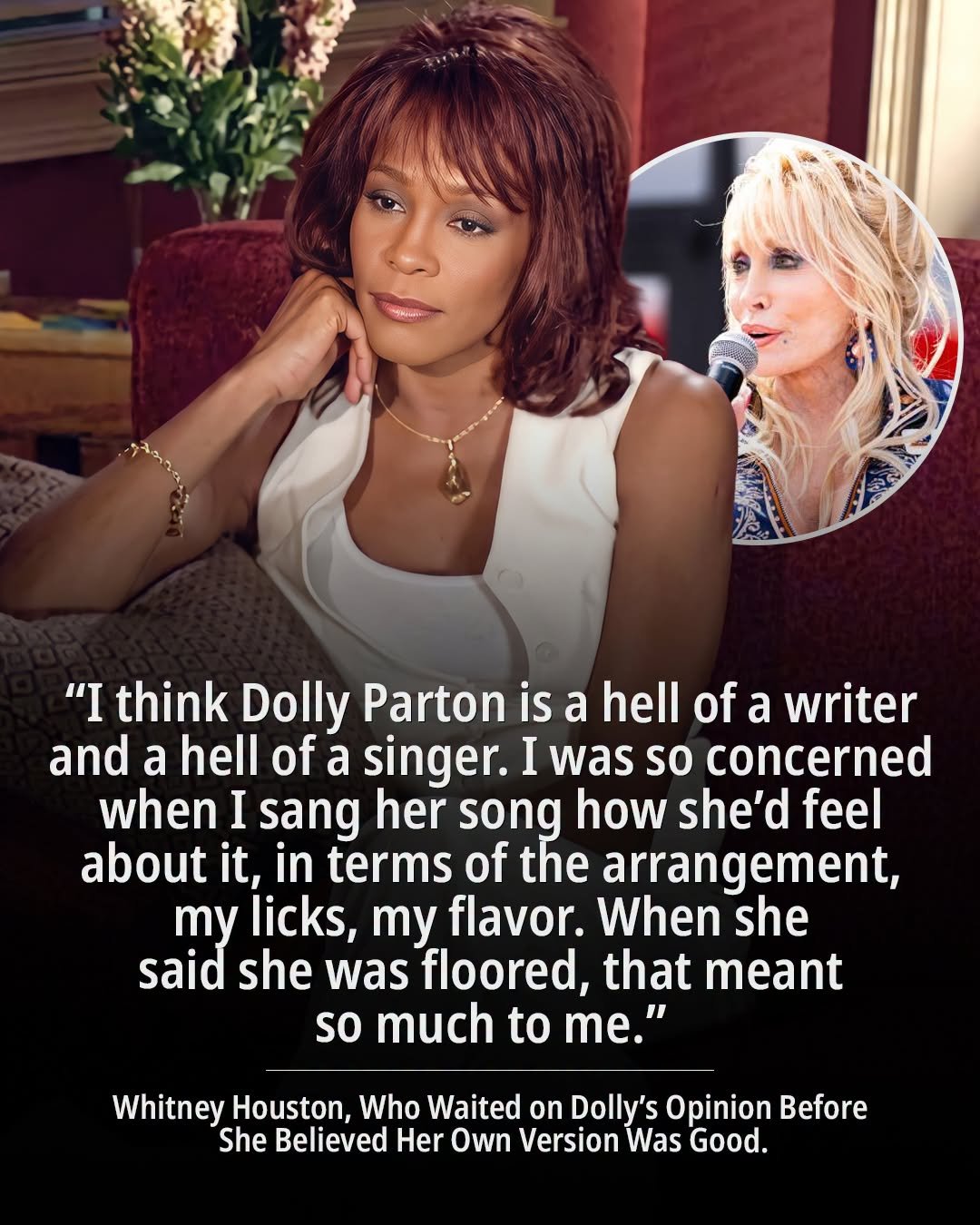
Whitney Houston Once Sought Dolly Parton’s Approval for “I Will Always Love You”
Whitney Houston’s version of “I Will Always Love You” became one of the defining recordings of her career, but the singer once revealed that she was initially unsure about her interpretation of the song.
The song had originally been written and recorded by Dolly Parton. When Houston decided to record her own version for The Bodyguard soundtrack, she knew she was taking on a song that already had a strong connection to its creator.
That made Dolly’s opinion especially meaningful to her.
Whitney Houston Wanted to Know What Dolly Thought
In a 1993 interview with Rolling Stone, Houston discussed the uncertainty she felt while recording the song.
She was thinking carefully about the arrangement and the vocal choices she was making. The song gave her plenty of room to showcase her voice, but that also meant there were many decisions to make.
Houston wanted to know whether Dolly Parton approved of what she had done with the song.
For Houston, Parton’s reaction mattered because she was not simply another listener. She was the songwriter who had created “I Will Always Love You.”
Dolly Parton Heard the Recording on the Radio
Dolly eventually heard Houston’s recording unexpectedly while she was in her car.
According to the story, Parton was so surprised by what she heard that the moment became unforgettable.
She immediately recognized that Houston had transformed the song into something very different from Parton’s original recording.
Parton’s reaction was overwhelmingly positive, and she soon contacted Houston to tell her what she thought.
Dolly Gave Whitney the Encouragement She Needed
Parton told Houston that the song had not achieved the same level of success when Parton herself had recorded it.
But she also recognized why Houston’s version connected so strongly with listeners.
Houston had brought her own vocal power, emotion and interpretation to the song.
Rather than trying to imitate Parton’s recording, Houston had made the song her own.
That distinction became an important part of the story behind one of the most successful recordings of Houston’s career.
Whitney’s Response to Dolly
Houston’s response to Parton’s praise was simple and gracious.
She told Dolly that she had written a beautiful song.
The exchange reflected the respect between the two singers and songwriters. Houston recognized that the foundation of the recording came from Parton’s songwriting, while Parton recognized what Houston had added through her extraordinary vocal performance.
A Song Written by Dolly Parton
“I Will Always Love You” was written by Dolly Parton in the 1970s.
Parton originally recorded the song herself, and it became an important part of her musical catalog.
Years later, Houston’s interpretation introduced the composition to an enormous new audience.
The two recordings are dramatically different in style, but both are connected by the same songwriting foundation.
Whitney’s Version Became a Global Success
Houston recorded “I Will Always Love You” for The Bodyguard, the 1992 film in which she starred alongside Kevin Costner.
The soundtrack and single became major successes, with Houston’s recording eventually becoming one of the most recognizable songs associated with her career.
The scale of the success was remarkable, especially considering that the song had already existed for years before Houston recorded it.
Her performance gave it a new identity for a different generation of listeners.
Dolly Appreciated What Whitney Added
Rather than viewing Houston’s version as a replacement for her own, Parton embraced the new interpretation.
She understood that Houston had taken the song in a different musical direction.
That is one of the most interesting aspects of the story: the original songwriter was able to appreciate another artist’s interpretation without losing sight of her own connection to the composition.
For Houston, receiving that approval from Parton was particularly meaningful.
The Importance of a Songwriter’s Approval
When a performer records another artist’s composition, there can be an understandable desire to respect the original.
Houston had already achieved considerable success by the early 1990s, but she still cared about what Dolly thought of her interpretation.
That speaks to the level of respect she had for Parton as a songwriter.
Dolly’s encouragement also gave Houston reassurance that she had not simply copied the original. She had created a new interpretation that honored the writing while bringing her own artistry to it.
Two Different Interpretations of the Same Song
Parton’s original recording and Houston’s version demonstrate how much a performer can change the character of a song.
Parton’s approach was rooted in country music and storytelling.
Houston’s recording built toward a powerful pop and R&B-influenced vocal performance, showcasing her remarkable range and control.
The lyrics remained the same, but the musical experience was dramatically different.
That helped demonstrate the strength of Parton’s songwriting: the composition could work across very different musical styles.
A Memorable Moment in Music History
The story of Parton hearing Houston’s version on the radio has become one of the memorable moments associated with the song.
It also provides a human side to what eventually became a massive commercial and cultural success.
Before audiences around the world embraced Houston’s recording, there was a songwriter listening to another singer reinterpret her work and realizing how powerful the new version had become.
Whitney Was Still Looking for Reassurance
Although Houston was already an accomplished performer, her concern about the recording showed that even major artists can have moments of uncertainty.
She wanted to know whether the person who wrote the song believed she had done it justice.
Dolly’s response provided that reassurance.
Her praise recognized both the quality of Houston’s performance and the fact that the singer had made the song personal.
Dolly’s Songwriting Legacy
The success of Houston’s recording also helped highlight Parton’s songwriting legacy.
Many people who first encountered “I Will Always Love You” through The Bodyguard later learned that Dolly Parton had written the song.
That connection became an important part of the song’s history.
It showed that a strong composition can continue to find new audiences long after its original recording.
A Shared Moment of Respect
The exchange between Houston and Parton was ultimately about mutual appreciation.
Houston respected Parton’s work enough to seek her opinion.
Parton respected Houston’s artistry enough to recognize that the new version had taken the song somewhere different and special.
Neither artist needed to diminish the other.
The songwriter could celebrate the performer, while the performer could acknowledge the songwriter.
Why the Story Still Matters
Decades later, “I Will Always Love You” remains closely associated with Whitney Houston’s voice, while Dolly Parton’s role as the songwriter remains essential to its history.
The story behind their interaction adds another layer to that legacy.
Houston’s uncertainty, Parton’s encouragement and the success that followed demonstrate how one song can take on a completely new life when another artist brings a different perspective to it.
Final Thoughts
Whitney Houston’s recording of “I Will Always Love You” became one of the most memorable performances of her career, but the singer once admitted that she wanted reassurance from Dolly Parton before fully trusting her own interpretation.
That reassurance came from the person who had written the song.
After hearing Houston’s version, Parton recognized that the younger singer had brought something uniquely her own to the composition. Houston, in turn, gave credit to Parton for creating a beautiful song in the first place.
Their exchange remains a powerful example of how songwriting and performance can complement each other.
Dolly Parton created the song. Whitney Houston gave it a remarkable new interpretation. And the mutual respect between the two artists became part of the story behind one of music’s most enduring recordings.