News
This Simple Math Puzzle Is Tricking Thousands of People — The Answer Is NOT 15!
This Simple Math Puzzle Is Tricking Thousands of People — The Answer Is NOT 15!

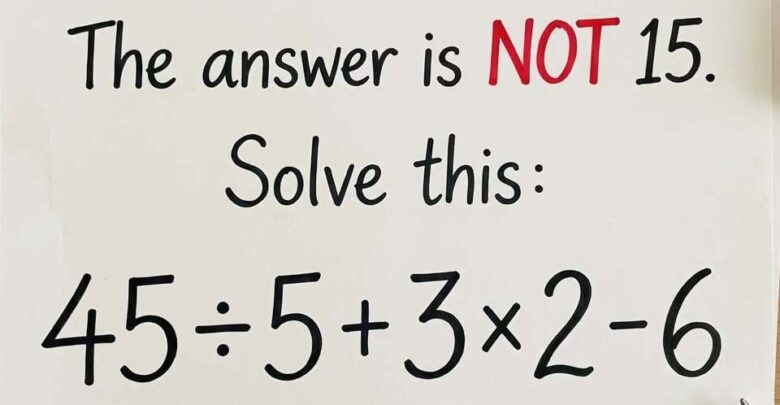
Can You Solve This Arithmetic Puzzle? One Small Rule Makes the Difference
Some arithmetic puzzles attract attention because they look familiar. There are no complicated formulas, unusual symbols, or large numbers. At first glance, the answer seems only a few seconds away.
Then two people compare their results and discover that they disagree.
Consider this expression:
45 ÷ 5 + 3 × 2 − 6 = ?
Before reading further, take a moment to work through it.
Did you get 9, 15, or 18?
Each of those numbers can appear during an attempt to solve the puzzle. However, only one is the final answer when standard arithmetic rules are followed.
The challenge is to apply the operations in the correct order and continue until the expression is complete.
Let’s examine the solution carefully, including the steps that can lead to the other answers.
Start by Reading the Entire Expression
Before calculating, look at every operation in the problem:
45 ÷ 5 + 3 × 2 − 6
There is division, addition, multiplication, and subtraction. There are no parentheses or exponents.
That observation tells us which parts of the order of operations are relevant.
It also prevents a common mistake: beginning immediately at the left and carrying out every operation as it appears.
Reading from left to right is natural. However, calculating an expression requires attention to the priority of its operations.
A brief pause at the beginning can save time later. First identify what is present, then decide which calculations belong together.
What Does “Order of Operations” Mean?
The order of operations is the convention that tells us how to evaluate mathematical expressions consistently.
Without a shared convention, the same written expression could produce different answers depending on which calculation someone chose first.
For this puzzle, the essential rule is:
Multiplication and division are completed before addition and subtraction.
There is another important detail:
Operations at the same priority level are evaluated from left to right.
Therefore, multiplication does not automatically come before division. Likewise, addition does not automatically come before subtraction.
These pairs share equal priority. Remembering that distinction is more useful than recalling a list of letters without understanding how they work.
Understanding PEMDAS and BODMAS
Many readers learned the rule through the memory aid PEMDAS:
- P: Parentheses.
- E: Exponents.
- M and D: Multiplication and division.
- A and S: Addition and subtraction.
Others learned BODMAS, using brackets and orders for the first two stages.
For the expression in this article, both approaches lead to the same result.
However, the letters can create confusion if they are read as six completely separate steps. PEMDAS does not mean that every multiplication must be finished before any division.
Instead, think of multiplication and division as one level. Addition and subtraction form another level below them.
That understanding will help with far more than this single puzzle.
Step One: Complete the Division
Return to the original expression:
45 ÷ 5 + 3 × 2 − 6
The division is:
45 ÷ 5 = 9
Replace that part of the expression with its result:
9 + 3 × 2 − 6
At this point, it may be tempting to add 9 and 3 because they appear next to each other.
However, the multiplication has not yet been completed.
The expression still contains operations at different priority levels, so we must deal with the multiplication before moving to addition and subtraction.
This is the point where a careful solution separates from a simple left-to-right calculation.
Step Two: Complete the Multiplication
The remaining multiplication is:
3 × 2 = 6
Substitute that result into the expression:
9 + 6 − 6
Now the division and multiplication have both been completed.
Only addition and subtraction remain, so the calculation becomes straightforward.
Notice that every other part of the expression has stayed in place. We have not dropped the final subtraction or changed any signs.
Keeping those remaining symbols visible is useful. It makes the next step clear and reduces the chance of stopping before the calculation is finished.
The original expression has become shorter, but it still needs to be evaluated.
Step Three: Finish the Addition and Subtraction
We now have:
9 + 6 − 6
Addition and subtraction share equal priority, so evaluate them from left to right.
First:
9 + 6 = 15
Then:
15 − 6 = 9
Therefore, the correct answer is:
45 ÷ 5 + 3 × 2 − 6 = 9
The number 15 appears during the solution, but it is only an intermediate result.
That distinction matters. Reaching a correct number in the middle of a calculation does not mean the entire expression has been completed.
Always check whether an operation remains before announcing the final answer.
The Complete Solution at a Glance
Here is the calculation in a compact form:
| Stage | Expression or calculation | Result |
|---|---|---|
| Original expression | 45 ÷ 5 + 3 × 2 − 6 | Begin with division and multiplication |
| Division | 45 ÷ 5 | 9 |
| Multiplication | 3 × 2 | 6 |
| Simplified expression | 9 + 6 − 6 | Evaluate the remaining operations |
| Addition | 9 + 6 | 15 |
| Final subtraction | 15 − 6 | 9 |
The table also shows why keeping track of each stage helps.
Instead of trying to remember several unfinished operations, you replace completed parts with their results and continue from the simpler expression.
Why Someone Might Answer 15
The answer 15 usually comes from a solution that begins correctly but ends too soon.
A person may calculate:
45 ÷ 5 = 9
Then:
3 × 2 = 6
Finally, they add the two results:
9 + 6 = 15
Everything so far is correct. However, the final − 6 from the original expression is still waiting.
The mistake is incomplete calculation rather than incorrect multiplication or division.
If this was your answer, there is no need to restart the entire problem. Simply return to the original expression and check which operation has not yet been used.
Here, one final subtraction changes 15 to 9.
Why Someone Might Answer 18
The answer 18 can result from carrying out every operation from left to right without respecting priority.
That approach looks like this:
45 ÷ 5 = 9
Then:
9 + 3 = 12
Next:
12 × 2 = 24
Finally:
24 − 6 = 18
The individual calculations are correct. The problem is the sequence.
Adding 9 and 3 before completing 3 × 2 changes the structure of the original expression.
This is why accurate arithmetic alone is not enough. You must also identify which quantities belong to each operation before calculating them.
The order determines what is being evaluated.
A Quick Way to Check the Answer
After the division and multiplication, the expression becomes:
9 + 6 − 6
At that stage, you can notice that adding 6 and subtracting 6 have a net effect of zero.
Therefore:
9 + 0 = 9
This provides a useful check on the longer solution.
However, make sure the two sixes are identified correctly. One comes from 3 × 2, while the other is the final number already present in the original expression.
Once those parts are clear, the cancellation is easy to understand.
It confirms the result without requiring you to repeat every earlier calculation.
Why Equal Priority Deserves Attention
The original puzzle is a useful reminder of operation priority, but another short example highlights the left-to-right rule:
24 ÷ 6 × 2
Division and multiplication share equal priority. Therefore:
24 ÷ 6 = 4
Then:
4 × 2 = 8
Multiplying 6 and 2 first would produce a different result, but it would not follow the standard evaluation of the expression as written.
The same principle applies to addition and subtraction.
For example:
18 − 6 + 3
First subtract 6 from 18, then add 3:
12 + 3 = 15
Understanding the paired priority levels prevents the memory aid itself from becoming a source of mistakes.
Parentheses Would Create a Different Problem
Parentheses tell us to evaluate the expression inside them first.
For example:
(45 ÷ 5 + 3) × 2 − 6
Inside the parentheses, division still comes before addition:
45 ÷ 5 + 3 = 9 + 3 = 12
Then:
12 × 2 − 6 = 24 − 6 = 18
That answer is correct for this altered expression.
However, it does not change the answer to the original puzzle, which contains no parentheses.
This comparison explains something important: the same numbers and symbols can produce a different result when grouping changes.
Therefore, pay attention to the written structure rather than assuming that similar-looking expressions must have the same answer.
Write One Clear Line at a Time
When a calculation feels confusing, write down the stages instead of holding every unfinished part in your head.
For this puzzle, the working can be:
45 ÷ 5 + 3 × 2 − 6
= 9 + 6 − 6
= 15 − 6
= 9
Each line represents the same value, expressed more simply.
This method also makes errors easier to find. If the answer seems wrong, compare one line with the line immediately above it.
Look for a missing number, changed sign, or operation completed too early.
Clear working is useful even when the arithmetic itself is easy.
A Simple Routine for Similar Puzzles
You can approach future arithmetic expressions with the same short routine.
First, read the entire expression and identify any parentheses or exponents.
Next, locate multiplication and division. Evaluate operations at that level from left to right where they form a sequence.
Then complete addition and subtraction, again respecting their equal priority.
Finally, return to the original expression and check that every part has been accounted for.
This last review is especially useful when a result appears halfway through that looks convincing.
The aim is consistency. A routine gives you a dependable way to work through both familiar and unfamiliar expressions without relying on a quick first impression.
The Correct Answer Is 9
The original expression is:
45 ÷ 5 + 3 × 2 − 6
Division gives 9, and multiplication gives 6. That leaves:
9 + 6 − 6
Complete the addition and subtraction, and the final result is:
9
If you initially answered 15, you may have stopped before the last subtraction. If you answered 18, you may have evaluated every operation from left to right.
Either way, the useful takeaway is the same: identify the priority of the operations and finish the entire expression.
🧠 Did you get 9 on your first attempt, or did one of the other answers catch your attention? Share your reasoning in the comments!