Why Are Some Electrical Outlets Upside Down? What Homeowners Should Know
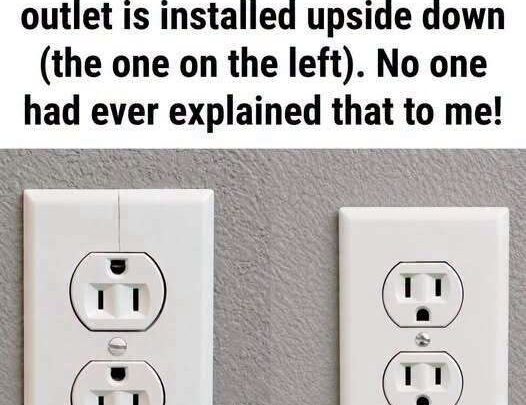
You move a side table closer to the living room window, position your favorite reading lamp, and reach down to plug it in. That is when you notice something unusual: the electrical outlet looks upside down.
Instead of having the rounded grounding opening beneath the two straight slots, it has the grounding opening at the top. Compared with the other outlets in the room, it seems to have been installed the wrong way.
However, a ground-up electrical outlet does not automatically indicate a mistake. Its orientation may reflect an installer’s preference, a building specification, a practical choice for a particular plug, or a convention used to identify a switch-controlled receptacle.
Understanding the possible explanations can help you use your room more conveniently and recognize when an electrical issue deserves professional attention.
This guide focuses on common North American grounded wall receptacles. Electrical accessories and installation requirements differ in other countries.
What Does an Upside-Down Outlet Mean?
An upside-down outlet usually refers to a receptacle installed with its grounding opening above the hot and neutral slots.
The phrase describes its appearance rather than a confirmed installation defect. Rotating a properly wired receptacle does not, by itself, change its electrical function.
There is also no universal message encoded in that orientation. A ground-up outlet does not automatically mean that it is switched, connected to a separate circuit, or intended for a particular appliance.
NEMA’s wiring-device guidance explains that functionality, local convention, appearance, and cord configuration can influence orientation. It also states that the National Electrical Code does not distinguish between ground-up and ground-down device installation.
For a homeowner, the useful distinction is between what an outlet looks like and what it actually does. Appearance offers a possible clue. Observing its behavior provides a more reliable answer.
Why a Switched Outlet May Be Installed Upside Down
One explanation for an inverted receptacle in a living room or bedroom is that a wall switch controls it.
Some installers use a different orientation to make a switched receptacle easier to recognize. If most outlets in a room have their grounding openings at the bottom, placing one ground-up can create a convenient visual marker.
Imagine entering a room after sunset. A table lamp is plugged into the switched receptacle, with the lamp’s own switch left on. Operating the wall switch near the doorway turns the lamp on without requiring you to cross the dark room.
That arrangement can be useful beside a sofa, behind a reading chair, or near a bedside table.
However, this identification practice is not universal. A switched receptacle may face the same direction as every other outlet, and an inverted receptacle may remain powered continuously.
Treat the orientation as a reason to investigate, rather than proof of how the outlet is wired.
How a Half-Switched Receptacle Works
A standard duplex receptacle provides two places to insert a plug. In a half-switched arrangement, one socket is controlled by a wall switch while the other remains powered when that switch is off.
This allows a single wall location to serve two different purposes. A reading lamp can respond to the room switch while a phone charger continues operating independently.
Suitable conventional duplex receptacles have connecting tabs between their terminals. Manufacturer diagrams show how separating the hot-side connection allows the two sockets to receive separate feeds. The precise wiring arrangement depends on the installation and device.
The term “half-switched” does not necessarily mean that two separate branch circuits supply the receptacle. Separate control and separate circuits are different concepts.
There is also no dependable rule that the upper socket must be switched or that the lower socket must remain continuously energized. Either arrangement is possible.
On an ordinary duplex device, the two sockets are part of the same assembly and rotate together. You cannot identify the switched half by assuming that only one socket has been individually turned upside down.
How to Identify a Switched Outlet Without Opening It
If the receptacle appears intact and undamaged, a working table lamp can help you identify whether a nearby wall switch controls it.
First, confirm that the lamp works in a known working outlet. Leave the lamp’s own switch in the on position.
Then follow this simple sequence:
- Plug the lamp into one socket of the suspected receptacle.
- Operate the nearby wall switch.
- Observe whether the lamp turns on and off.
- Move the lamp to the other socket.
- Repeat the switch test.
If only one socket responds, you have identified a half-switched arrangement. If both respond, the entire duplex receptacle may be switched.
If neither responds, the switch may control another location, or an additional issue may need investigation. A lamp that stays off does not establish that the wiring is safe to touch.
Avoid carrying out this check on an outlet that is cracked, scorched, loose, wet, or producing unusual sounds. Those conditions call for attention before ordinary use continues.
Create a Simple Outlet Map for Your Home
Once you identify a switched receptacle, write down its location and which socket responds.
A short note such as “living room, window wall, upper socket controlled by entry switch” can prevent repeated guessing when you rearrange furniture.
An outlet map is especially useful in rooms with several switches near the door. One may control a ceiling fixture, another a porch light, and another a receptacle behind furniture.
Use the map when planning where to place lamps and devices that need uninterrupted power. It can also help someone caring for your home understand why a particular lamp should remain plugged into a specific socket.
For a rental property, a clear explanation from the landlord or property manager is more useful than relying on outlet orientation alone.
Is Ground-Up Installation Safer?
There is a specific safety argument for installing grounded receptacles with the grounding opening at the top.
Consider a three-prong plug that has pulled partly out of the wall. If a conductive object falls into the gap, a ground-up arrangement may make it more likely that the object contacts the grounding pin before contacting an energized blade.
Hubbell describes this possibility in its explanation of receptacle orientation. The reasoning concerns a particular accidental-contact scenario; it does not establish that every ground-up outlet is safer under every condition.
Several limitations matter. A two-prong plug has no grounding pin to intercept a falling object. The object’s shape and direction also affect what it touches.
Most importantly, orientation should never be used to justify leaving a plug partially inserted. A loose connection deserves attention regardless of which direction the receptacle faces.
Why Offices and Other Buildings May Use Ground-Up Outlets
If every receptacle in a building faces ground-up, the explanation may be a consistent installation standard rather than a lighting-control signal.
A project designer, facilities team, or electrical contractor may specify a particular orientation throughout the property. Consistency can simplify installation and create a uniform appearance.
It would be misleading to assume that all hospitals, offices, workshops, or commercial kitchens follow the same practice. The requirements and specifications for a particular building need to be checked individually.
Likewise, seeing ground-up receptacles in a professional setting does not prove that the ground-down receptacles in a house were installed incorrectly.
The surrounding pattern can help explain the choice. One differently oriented outlet may invite a switched-outlet check. An entire building with matching orientation may reflect a broader design decision.
What Does the Electrical Code Say About Outlet Orientation?
For ordinary wall-mounted straight-blade receptacles, manufacturer guidance explains that the NEC does not specify whether the grounding opening must face up or down. Hubbell also notes that local code enforcement may affect the choice.
That does not mean every receptacle can be installed in any position, in any location, without restrictions.
Ground-up versus ground-down placement on a vertical wall is a different question from installing a receptacle facing upward on a horizontal surface. Device listings, location-specific rules, manufacturer instructions, and locally adopted requirements can all matter.
Homeowners planning alterations should ask about the requirements that apply to their property. An article about outlet orientation cannot determine whether a particular installation complies with the electrical rules enforced in that jurisdiction.
What a Plug-In Outlet Tester Can Tell You
A compatible plug-in receptacle tester can indicate certain common wiring conditions. Depending on the model, it may flag an open ground, an open neutral, or some reversed connections.
However, a normal-looking result is not a complete safety certification.
Klein Tools explains that its receptacle-testing equipment has limitations, including an inability to determine ground quality or identify certain combinations of faults. Its instructions also warn that some wiring conditions can produce misleading indications.
Always interpret a tester according to its own instructions. Do not assume that every model uses the same indicator colors or light patterns.
For simply finding a switched socket, a working lamp provides an easy visual check. For diagnosing abnormal wiring, an appropriately qualified electrician can interpret the findings and investigate beyond what a basic tester reveals.
Smart Plugs and Switched Outlets: Avoiding Unexpected Shutdowns
A switched receptacle can be convenient for a traditional lamp but confusing when it powers a connected device.
For example, a smart plug cannot maintain its normal powered operation after someone turns off the wall switch supplying it. The same practical problem applies to a smart speaker, streaming device, or network accessory plugged into that socket.
Once you have mapped the receptacle, choose the continuously powered socket for equipment that needs an uninterrupted supply.
For lighting, decide which control method you want household members to use. A conventional lamp can work well with the existing wall switch. A smart bulb may be easier to manage when its power remains on and lighting commands come from its app or a compatible controller.
Device behavior after power returns varies. Do not assume that every smart product will forget its settings or resume operation in the same way.
Can You Turn an Upside-Down Outlet Around?
A receptacle’s orientation can often be changed, but doing so involves the electrical device and its wiring connections. Turning the decorative cover plate alone will not rotate the sockets.
Before arranging a change, consider whether there is a practical reason for it. If the outlet works properly and its position suits the connected plug, rotating it may offer little benefit.
It may also remove a useful visual marker if the original installer used orientation to distinguish a switched location.
If a change is needed, an electrician can evaluate the receptacle, wiring condition, available space, and any split-feed arrangement before repositioning it.
Do not treat an off wall switch as proof that the entire receptacle is de-energized. Avoid relying on a single non-contact detector reading as complete verification before touching wiring.
Renters should report concerns to the property manager and follow the property’s repair process.
Outlet Problems That Matter More Than Orientation
An unusual-looking orientation is less informative than the actual condition of the receptacle.
Pay attention to changes during normal use, especially a plug that no longer fits securely, visible damage, or unexpected loss of power. Describe those observations when arranging an inspection.
A useful report is specific: identify the room, the socket involved, what was connected, and whether operating a wall switch affected the problem.
A household check also has limits. The Electrical Safety Foundation International states that its home safety exercises do not replace an inspection by a qualified electrician. It recommends inspections in circumstances including purchasing a previously owned home, major renovations, and homes that are at least 40 years old.
That broader assessment can be more valuable than changing an outlet simply because its appearance differs from the others.
Frequently Asked Questions About Upside-Down Outlets
Does an upside-down outlet always mean it is switched?
No. Some installers use orientation as an identifying convention, but it is not a universal label. Check both sockets with a working lamp if the receptacle appears safe for ordinary use.
Is the bottom socket always continuously powered?
No. The upper socket, lower socket, both sockets, or neither may respond to a particular wall switch. Test each one rather than choosing based on position.
Does rotating an outlet change its voltage?
Physical orientation does not determine voltage. Turning a device around does not convert its electrical rating or make it suitable for a different supply.
Should every ground-down outlet be replaced?
Appearance alone is not a reason to replace a receptacle. Its condition, suitability, wiring, and applicable installation requirements are more useful considerations.
Why does my lamp work only when a wall switch is on?
It may be plugged into a switched socket. If the receptacle is half-switched, the other socket may remain powered independently. Confirm the behavior before rearranging your devices.
What should I do when I find an inverted outlet?
Start by observing its condition and checking whether a wall switch controls it. Record what you learn so the location is easier to use. If anything seems damaged or abnormal, arrange professional assessment before continuing to use it.