News
The Head Nurse Froze When She Noticed His Hand!!
The Head Nurse Froze When She Noticed His Hand!!

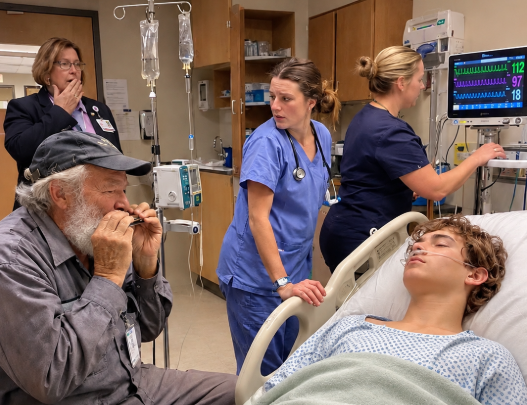
For 437 Nights, a Hospital Janitor Played His Harmonica for a Young Patient — A Story of Kindness, Hope and Human Connection
For 437 nights, a seventy-two-year-old hospital janitor named Umberto carried a small harmonica into the room of a young patient named Benicio.
He never expected recognition, financial rewards, or even a simple thank-you. He only wanted to make the long, quiet nights a little less lonely for someone who rarely had company.
But on the 438th night, something unexpected happened that would change their lives and bring an entire community closer together.
This is a story about two people from different generations, an unforgettable melody, and the extraordinary meaning behind an ordinary act of kindness.
The Night Everything Changed
The medical monitor sounded halfway through my father’s river song.
I immediately stopped playing.
My harmonica was still in my hands when I heard footsteps approaching from the hallway.
Two nurses entered the room, followed closely by my supervisor, Ms. Verity.
She noticed me sitting beside Benicio’s bed.
“Umberto, we already discussed this,” she said firmly. “Please step outside and let the medical team work.”
I stood up and moved away from the bed.
But something had caught my attention.
Benicio’s fingers appeared to be moving gently against the white bedsheet.
Tap.
Tap.
Tap.
It was a small movement that could easily have gone unnoticed.
Yet there was something familiar about it.
I had been playing my father’s melody since I was ten years old, and the movement seemed to follow its rhythm.
“Ms. Verity,” I said quietly.
“Please look at his hand.”
She turned toward the bed.
For a moment, the room became unusually quiet.
The nurses continued evaluating Benicio, carefully observing his movements and checking the medical equipment.
Nobody knew exactly what those movements meant.
But after 437 nights of sitting beside him, I had never witnessed anything quite like it.
And to understand why that moment meant so much to me, I need to tell you how everything began.
An Ordinary Man With an Extraordinary Memory
My name is Umberto Ferrante.
At the beginning of this story, I was seventy-two years old and had worked as a night janitor at a hospital in Providence, Rhode Island, for twenty-eight years.
My shift began at eleven in the evening and ended at seven the following morning.
I cleaned floors, emptied trash cans, disinfected surfaces, and prepared rooms for new patients.
It was honest work.
Most people barely noticed me, but I had grown comfortable with that.
Working quietly gave me time to observe the little things happening around me.
I saw families arriving with flowers.
I watched nurses comforting worried patients.
I noticed people celebrating good news and others simply sitting beside someone they loved.
Hospitals are filled with stories.
Some are joyful.
Some are difficult.
And some are never told.
For nearly three decades, I had been a quiet witness to those stories.
I never imagined that one day I would become part of one myself.
Remembering the Woman Who Shared My Life
My wife, Carmela, passed away nine years before I met Benicio.
We had been married for forty-one wonderful years.
We never had children, although we had once dreamed of having a large family.
Carmela used to tell me that perhaps our greatest gift was having found each other.
For forty-one years, that was enough.
After she passed away following a serious illness, I continued living in our little apartment above a neighborhood bakery.
The apartment still contained photographs from our younger years, books she loved, and the kitchen table where we had shared countless meals.
Sometimes, when I returned from work in the morning, the smell of freshly baked bread reminded me of our happiest days.
But the apartment was much quieter without her.
There was one possession that always brought me comfort.
My father’s old harmonica.
It was small enough to carry in my shirt pocket, yet it held more memories than anything else I owned.
The Story Behind My Father’s Harmonica
My father grew up in a small community in Calabria, southern Italy.
He came to America in 1948 carrying a suitcase, a few personal belongings, and his beloved harmonica.
For many years, he worked in a jewelry factory.
His days were long, but on Sunday evenings, he would sit outside our home and play traditional melodies from his childhood.
My favorite was a gentle song about a river.
He never told me its official name.
He simply called it the river song.
According to my father, the melody represented a river traveling from the mountains toward the sea.
Sometimes, the river encountered obstacles.
Sometimes, its journey became slower.
But it continued moving forward.
“The river never stops, Umberto,” my father would tell me. “It always finds another way.”
When I turned ten, he handed me his harmonica and began teaching me the melody.
It took me nearly an entire summer to learn it.
Years later, I played the song while remembering my father after his passing.
I played it again when I said goodbye to Carmela.
Over time, that simple melody became a connection to the people I loved most.
Wherever life took me, I carried it with me.
The Young Patient in Room 412
One spring evening, I was assigned to clean the hospital’s long-term care ward.
It was usually one of the quietest areas of the building.
Many patients had been receiving medical care for extended periods, and the nurses worked patiently throughout the night.
Inside room 412, I discovered a sixteen-year-old boy named Benicio.
He had experienced a serious bicycle accident several months earlier and remained unconscious while receiving medical care.
On a whiteboard beside his bed, someone had written that he loved baseball and supported the Boston Red Sox.
That small detail made him feel less like an unfamiliar patient and more like an ordinary teenager with interests, dreams, and a life waiting outside the hospital.
Every night, I cleaned his room.
I emptied the trash, wiped the surfaces, and carefully completed my work without interfering with the medical equipment.
Over time, I noticed something.
Whenever I arrived during the night, Benicio was usually alone.
There were few personal belongings in his room and little indication that anyone had recently visited.
I began wondering about his family.
One evening, I decided to ask Glenda, an experienced nurse who worked on the same floor.
A Mother’s Difficult Circumstances
Glenda explained that Benicio’s mother, Marisol, was raising four children on her own.
She worked two jobs to support her family.
One job involved cleaning offices, while the other was at a neighborhood laundromat.
Between working, caring for her younger children, and paying household expenses, she had very little free time.
She visited Benicio whenever her schedule allowed, usually on Sunday afternoons.
“She loves him very much,” Glenda explained.
“She wishes she could spend every day here, but she’s trying to keep the rest of her family going too.”
I understood.
Life sometimes asks people to carry responsibilities that others cannot fully see.
Marisol was not absent because she did not care.
She was doing everything she could to support the people who depended on her.
That conversation stayed with me throughout my shift.
When I returned to room 412, I looked at Benicio and thought about how different his life must have been before the accident.
School.
Baseball.
Friends.
Family dinners.
Ordinary moments that most people rarely stop to appreciate.
I wished there were something small I could do to make his surroundings feel a little more welcoming.
The First Evening I Played My Harmonica
After finishing my work that night, I sat in a chair beside Benicio’s bed during my break.
For a moment, I simply enjoyed the quiet.
Then I reached into my shirt pocket and took out my father’s harmonica.
I played the river song very softly.
It was the same melody my father had taught me many decades earlier.
When I finished, there was no noticeable response.
I had not expected one.
I was not a medical professional, and I understood that playing music was not a substitute for treatment.
I simply wanted to offer a peaceful moment of companionship.
The following evening, I returned and played another melody.
Then I came back the next night.
Soon, visiting Benicio during my break became part of my routine.
Sometimes, I played traditional Italian songs.
Other times, I played familiar baseball melodies.
I always finished with my father’s river song.
The music brought comfort to me as well.
For the first time in years, I had someone with whom I could share the memories that had been quietly living inside me.
Small Conversations During the Quiet Hours
Eventually, I started talking to Benicio between songs.
I told him about the weather.
I shared baseball results and occasionally complained about the Red Sox losing another game.
I told him about my father and the neighborhood where I had grown up.
And, most importantly, I told him about Carmela.
I described how we first met at a community dance in 1980.
She was wearing a yellow dress.
During our first dance, she accidentally stepped on my foot and laughed.
That was the beginning of forty-one years together.
I told Benicio about her homemade lemon cake.
She always used fresh lemons, and whenever she baked one, our entire apartment smelled wonderful.
I remembered the songs she sang while preparing dinner and the way she could start conversations with complete strangers.
I never knew whether Benicio could hear or understand any of those stories.
But sharing them gave me a sense of peace.
It reminded me that the memories of someone we love can remain meaningful long after they are gone.
The Nurses Discover Our Evening Tradition
Several members of the nursing staff eventually noticed my visits.
One evening, Glenda stopped outside the room while I was playing.
When I finished, she smiled.
“Umberto, I had no idea you played music.”
“My father taught me when I was ten,” I replied.
She asked how long I had been visiting Benicio.
I explained that I sometimes spent part of my break sitting beside him.
Another nurse, Kayla, later mentioned that a patient in a nearby room had enjoyed hearing the gentle music from the hallway.
He was an elderly man who rarely spoke.
The harmonica reminded him of someone he had known many years earlier.
It was a simple reminder that music can carry personal memories and emotional meaning.
Still, I understood that a hospital was a place with important safety procedures.
Any activity involving patients needed to respect their privacy, comfort, and medical care.
At the time, however, my informal visits had not been established as part of an official hospital volunteer program.
That would become an important part of our story later.
Meeting Benicio’s Mother
Several months after I began visiting Benicio, I was asked to cover a Sunday shift.
As I pushed my cleaning cart past room 412, I noticed a woman sitting beside his bed.
A little girl was coloring quietly near her feet.
I immediately realized that this must be Benicio’s mother and younger sister.
The woman looked up.
“I’m sorry,” she said. “Do you need to clean the room?”
“No,” I replied. “Please take your time. I’ll come back later.”
Before I could leave, the little girl looked at me.
“Are you the music man?” she asked.
Her mother appeared surprised.
“What music man, Isabel?”
“The nurse told me somebody plays music for Beni at night.”
I smiled and touched the harmonica in my pocket.
Marisol looked at me.
“You play music for my son?”
“Sometimes during my break,” I explained. “Just a few quiet songs.”
“How long have you been doing that?”
“Since spring.”
She sat silently for a moment.
Then her eyes filled with tears.
“I always worry about him being alone,” she said. “When I get home from work, I think about how much I wish I could be here.”
I looked toward Benicio.
“He has company during part of the night,” I told her.
That simple conversation marked the beginning of a friendship that would eventually become important to both of us.
Learning More About Benicio’s Life
After meeting Marisol, I began learning more about Benicio.
She occasionally left handwritten notes for me with the nurses.
One explained that he had loved watching Star Wars when he was younger.
Another mentioned that his favorite meal was his grandmother’s arroz con pollo, a traditional chicken and rice dish.
She also told me about his dog, Chancla, who apparently still slept on his bed at home.
These little details gave me new things to talk about during my visits.
“Your mother says she’s going to make your favorite dinner when you come home,” I would tell him.
“She says you’d better appreciate it because she’s not making it twice.”
I also decided to learn a melody from Star Wars.
It was considerably more challenging than my father’s traditional songs.
It took nearly two weeks of practice before I felt comfortable playing it.
When I finally performed it beside Benicio’s bed, Glenda happened to be standing in the doorway.
She laughed when she recognized the melody.
For a brief moment, the hospital room felt less like a place of uncertainty and more like a room filled with ordinary human warmth.
Four Hundred and Thirty-Seven Nights of Companionship
As the months passed, my visits continued.
There were long stretches when Benicio’s condition showed no noticeable changes.
His healthcare team continued providing treatment, conducting assessments, and discussing his progress with his family.
Nobody could predict what the future would bring.
I understood that uncertainty was part of his situation.
Still, I kept returning.
Not because I believed my music would produce a particular medical outcome, but because I had come to care about the boy and his family.
My visits gave me something meaningful to look forward to.
I would finish my work, take my break, and share a few melodies or stories.
Night after night.
Season after season.
Eventually, I had counted 437 nights of music and quiet companionship.
By then, Benicio’s room had become a place where I could remember my father, celebrate Carmela’s life, and offer a little kindness to someone facing circumstances beyond his control.
Then a new supervisor arrived.
The Supervisor Who Questioned My Visits
Ms. Verity took hospital procedures very seriously.
She was responsible for helping ensure that staff members followed the appropriate rules and that patients received care in a safe environment.
One evening, she discovered me sitting in Benicio’s room.
“Umberto, what are you doing here?”
“I’m on my break,” I explained. “I’ve been playing a little music for him.”
She looked concerned.
“You’re part of the environmental services team. You’re not authorized to provide patient activities independently.”
“I understand,” I said.
“I only wanted to keep him company.”
She explained that infection prevention, patient privacy, rest schedules, and professional responsibilities were important considerations.
She instructed me not to continue the visits without proper authorization.
“If you return without permission, your employment could be affected,” she said.
I quietly returned the harmonica to my pocket.
Her concerns were understandable.
Hospitals have procedures for good reasons, and patients deserve to receive care in an environment that protects their safety.
Nevertheless, leaving the room that night was difficult.
I had grown attached to my routine and to the family I had come to know.
When I returned home the following morning, I spent hours thinking about Benicio.
The 438th Night
The following evening, I made a decision that I would later have to explain to hospital management.
I returned to Benicio’s room without having obtained the required authorization.
I wanted to play my father’s melody one more time.
Looking back, I recognize that I should have requested formal permission and discussed my concerns with the care team.
But that night, my emotions influenced my judgment.
I sat beside the bed and began playing quietly.
Halfway through the river song, the medical monitor sounded an alert.
The nurses arrived immediately, followed by Ms. Verity.
I stopped playing and moved away so they could attend to Benicio.
Then I noticed his hand.
His fingers appeared to be moving gently against the bedsheet.
The movements seemed familiar to me.
Tap.
Tap-tap.
Tap.
I asked Ms. Verity to look.
She turned toward the bed, and her expression changed.
Glenda also noticed the movement.
The medical team continued its assessment, making sure Benicio was receiving appropriate attention.
For me, it was an unforgettable moment.
But nobody attempted to determine its medical significance based solely on what we had observed.
That responsibility belonged to the qualified professionals caring for him.
A Mother’s Unforgettable Morning
Dr. Rao, a neurologist involved in Benicio’s care, arranged additional assessments.
Marisol arrived at the hospital as soon as she could.
She was still wearing her work clothes and carrying Isabel, who had fallen asleep against her shoulder.
She looked worried when she entered the room.
The medical team explained what had been observed and reassured her that they would continue evaluating her son’s condition.
With the doctor’s permission, I played the river song again.
Marisol watched Benicio closely.
His fingers moved slightly against the sheet.
She approached the bed and gently took his hand.
Her eyes filled with tears.
“I’m here, Beni,” she whispered.
“Mami’s here.”
Nobody made promises about what would happen next.
There were still many unanswered questions.
But for a mother who had spent so many months hoping for encouraging news, the opportunity to experience that moment meant a great deal.
I remained quietly in the background while the family spent time together.
A Gradual Journey Toward Recovery
Benicio’s progress was not sudden or dramatic.
His journey continued under the supervision of his medical team.
During the following weeks, the doctors and nurses observed changes in his responses.
Some days brought encouraging developments.
Other days were more difficult.
There were moments when he appeared to respond to his mother’s voice or gentle requests, but his reactions were not always consistent.
Later, his eyes began opening for short periods.
His healthcare professionals continued assessing these developments as part of his ongoing care.
For Marisol, each small change carried emotional significance.
She spent more time beside him whenever possible.
Family members helped with her younger children, and she worked to reorganize her responsibilities.
The experience reminded all of us that recovery is rarely a straightforward journey.
It requires patience, professional support, and realistic expectations.
While the music remained a meaningful part of our relationship, we did not know whether it had influenced his medical progress.
His recovery involved many factors and the continuous work of qualified healthcare professionals.
The Meeting That Changed My Role
Several days later, I was invited to attend a meeting with hospital administrators.
I expected to discuss my unauthorized visits and the instructions I had failed to follow.
I put on my best shirt and arrived early.
Ms. Verity was there, along with Dr. Rao and several representatives from hospital management.
The conversation began with a review of the hospital’s procedures.
I acknowledged that I should have requested authorization before continuing my visits.
Then Ms. Verity spoke.
She explained that the experience had encouraged her to consider whether patients might benefit emotionally from properly organized companionship activities.
“Safety remains our responsibility,” she said.
“But perhaps we can find a way to support patients’ emotional needs while maintaining the standards required in a hospital.”
Dr. Rao agreed that any organized music or companionship activity should complement professional care rather than replace it.
The administrators discussed a possible supervised volunteer arrangement.
Finally, one of them turned toward me.
“Mr. Ferrante, would you be interested in participating if we establish appropriate guidelines?”
For a moment, I did not know what to say.
Then I smiled.
“Of course.”
A New Harmonica and a New Beginning
The hospital established clear requirements for my future visits.
I completed volunteer orientation and learned more about patient confidentiality, infection prevention, and appropriate conduct.
Visits would take place only with approval from the relevant medical team.
My activities would be coordinated with the nurses so they would not interfere with patient care or rest.
Ms. Verity also surprised me with a new harmonica.
She had purchased an instrument that could be used under the hospital’s approved hygiene procedures.
It was shiny, silver, and completely different from the old harmonica my father had given me.
“I know it isn’t your father’s,” she said.
“But I hope you can make some new memories with it.”
I thanked her.
From that day forward, I used the approved instrument during my volunteer visits.
But I continued carrying my father’s harmonica in my shirt pocket.
It remained close to my heart.
Some possessions become meaningful not because of their financial value, but because of the people and memories they represent.
The First Word I Never Expected to Hear
Over the following months, Benicio continued receiving professional care and rehabilitation support.
His ability to interact with his surroundings gradually improved.
Eventually, he began communicating through simple movements while working with his healthcare team.
One afternoon, I received a telephone call from Marisol.
I had been asleep after my night shift.
“Umberto,” she said excitedly.
“Benicio said a word today.”
I immediately sat up.
“What did he say?”
She paused.
“He said ‘river.'”
I held the telephone against my ear and looked toward the window.
Outside, afternoon sunlight filled the little apartment Carmela and I had once shared.
My father’s melody had been part of my life for more than sixty years.
It carried memories of my childhood, my marriage, and the people I had loved.
Now, in this unexpected way, it had become part of someone else’s story.
I was deeply moved.
For a long time, I simply sat there remembering my father.
The Next Chapter: Professional Rehabilitation
When Benicio was ready for the next stage of care, he transferred to a rehabilitation facility in Boston.
His recovery required a coordinated team of healthcare professionals.
Physical therapists helped him work toward greater mobility.
Occupational therapists supported his ability to perform everyday activities.
Speech and language professionals helped him develop his communication skills.
The process required considerable effort.
Some activities that had once been ordinary parts of his life now presented significant challenges.
There were frustrating days.
There were moments when he felt discouraged.
But there were also meaningful achievements that reminded everyone how far he had come.
Marisol remained an important source of encouragement.
Friends and members of the community offered practical support to the family.
Their assistance helped Marisol manage some of the everyday responsibilities that had become more difficult during Benicio’s extended recovery.
I visited whenever arrangements allowed.
Sometimes, I brought stories.
Sometimes, I brought music.
Mostly, I brought my friendship.
A Blue Harmonica Beside the Window
One Saturday, I arrived at the rehabilitation facility and found Benicio sitting beside a window.
He was wearing a Red Sox T-shirt.
A small blue harmonica rested in his hands.
He looked up when I entered.
“Hey, River Man,” he said slowly.
I smiled.
“Hey, kid.”
He lifted the little instrument.
“Teach me.”
Those two words meant more to me than he could have understood.
We checked with his care team and arranged our music activities around his rehabilitation schedule.
Then I began teaching him the same melody my father had taught me when I was ten.
Learning it took several months.
Sometimes, he missed notes.
Sometimes, he needed to stop and rest.
But he always wanted to try again.
“One more time,” he would say.
We practiced patiently, without treating our music sessions as a replacement for his professional therapy.
Every successful note was something we could celebrate together.
Our friendship grew stronger with each visit.
Memories of a Woman in a Yellow Dress
As Benicio became more comfortable communicating, he began sharing some of his thoughts about the time he had spent in the hospital.
His recollections were incomplete and uncertain.
He described fragments of music and distant voices.
One afternoon, he surprised me by mentioning a woman in a yellow dress.
I looked at him.
“What woman?”
He thought for a moment.
“The one who stepped on your foot.”
I remembered telling him that story many times during my visits.
Then he mentioned lemon cake.
“With real lemons,” he added.
My eyes filled with tears.
He was describing Carmela.
I could not know exactly when or how those memories had formed, and his experience could not establish what other unconscious patients might perceive.
But hearing him mention those familiar details was deeply meaningful to me.
“Was she your wife?” he asked.
“Yes,” I replied.
“She sounds nice.”
I smiled.
“She was wonderful.”
For a moment, it felt as though Carmela’s memory had traveled beyond my little apartment and found a place in another person’s life.
Coming Home to the People Who Loved Him
Eventually, after many months of treatment and rehabilitation, Benicio was able to return home.
He still faced challenges and continued receiving support for his recovery.
But being reunited with his family marked an important new chapter.
Marisol organized a small gathering in the backyard of their apartment.
There were no expensive decorations or elaborate arrangements.
Just a few tables, homemade food, familiar faces, and the joyful sounds of children playing.
Glenda and Kayla attended.
Several members of Benicio’s care team came as well.
And Ms. Verity arrived carrying a bottle of soda.
Marisol welcomed her warmly.
Benicio’s younger siblings ran around the yard while Chancla, the family dog, followed them excitedly.
Marisol prepared a large pot of arroz con pollo using her mother’s traditional recipe.
“I promised you I’d make it,” she told Benicio.
He smiled.
“I remember Umberto telling me.”
Everyone laughed.
It was a beautiful afternoon filled with the ordinary pleasures that had once seemed so distant.
A Special Performance for an Old Friend
As the sun began to disappear, Benicio stood up from his chair.
Using his cane for support, he walked toward the center of the yard.
Then he reached into his pocket.
He took out the little blue harmonica.
The conversations around us gradually became quiet.
“This is for Umberto,” he said.
“And for his father.”
He paused.
“And for Carmela.”
Then he began playing.
It was my father’s river song.
The performance was not perfect.
A few notes were uncertain, and he occasionally paused.
But I recognized every part of the melody.
The song had traveled from my father’s childhood in Italy to our family porch in Providence.
It had accompanied me through the happiest and most difficult chapters of my life.
And now a young man was playing it for me in a small backyard surrounded by people who cared about him.
When he finished, Isabel began clapping.
Soon, everyone joined her.
I could barely see through my tears.
Benicio walked back to his chair and sat beside me.
“Was it okay?” he asked.
“It was beautiful,” I told him.
The Most Meaningful Gift I Could Offer
I reached into my shirt pocket.
For more than sixty years, my father’s harmonica had been my constant companion.
Its silver surfaces were worn from decades of use.
It carried memories that could never be replaced.
I held it out toward Benicio.
He looked surprised.
“No,” he said.
“That’s your father’s.”
“I know.”
“You should keep it.”
I smiled.
“My father gave it to me because he wanted someone to continue playing his song.”
I placed the harmonica in Benicio’s hand.
“I never had children,” I explained. “But I would like someone to carry this melody into the future.”
He looked at the instrument for a long time.
Then he looked at me.
“I will,” he promised.
Giving away my father’s harmonica was not an easy decision.
But for the first time, I understood that keeping something meaningful did not always mean holding onto it forever.
Sometimes, the greatest way to preserve a memory is to share it.
Creating a Culture of Compassion
In the fictional hospital at the center of our story, the experience eventually inspired a supervised volunteer initiative called Night Music.
The program invited approved volunteers to share quiet performances with patients who wished to participate and whose care teams authorized the activity.
A retired music teacher played violin.
A university student brought a guitar.
Another volunteer sang familiar songs.
And I continued playing my harmonica.
Ms. Verity helped coordinate the program, ensuring that volunteers respected patient privacy, hospital procedures, and individual care requirements.
She still carried her clipboard.
She still took safety seriously.
But now, whenever circumstances allowed, she stayed for the music.
Our experience had reminded us that compassion and professional responsibility do not need to conflict.
With thoughtful organization, appropriate boundaries, and cooperation, they can exist together.
Passing Kindness to Another Generation
Benicio eventually returned to school while continuing his recovery.
His life was different from what it had been before the accident, but he remained determined to pursue his interests and spend time with the people he loved.
He sometimes returned to the hospital as part of approved volunteer visits.
When permitted, he shared music and stories with patients who welcomed the companionship.
For these visits, he followed the hospital’s procedures and used an appropriate instrument.
My father’s original harmonica remained his personal keepsake.
Occasionally, I heard him telling someone about a woman in a yellow dress who had accidentally stepped on a man’s foot at a dance many years earlier.
He would describe her homemade lemon cake.
He would talk about baseball, rainy afternoons, and the little things that made ordinary life meaningful.
One evening, I asked why he continued sharing Carmela’s story.
He had never met her.
He thought quietly before answering.
“Because those stories made me feel less alone.”
Then he smiled.
“Maybe somebody else will enjoy them too.”
That was when I finally understood what my father had meant all those years ago.
The Importance of Human Connection
Life is filled with responsibilities, challenges, and unexpected circumstances.
People often become so focused on their daily routines that they overlook opportunities to offer kindness.
A friendly conversation.
A thoughtful message.
A visit to someone who feels isolated.
A few minutes spent listening without interruption.
These gestures may appear small, but they can carry considerable emotional meaning.
Umberto and Benicio’s fictional journey illustrates the importance of recognizing the person behind difficult circumstances.
Benicio was not simply a patient receiving treatment.
He was a teenager who loved baseball, enjoyed spending time with his family, and had a favorite homemade meal.
Umberto was not simply a hospital janitor.
He was a man with decades of memories, a loving marriage behind him, and a melody that connected him to his family.
Their friendship developed because they became meaningful parts of each other’s lives.
Supporting Families During Difficult Times
Marisol’s experiences also remind us that families facing extended hospital stays may encounter challenges that are not immediately visible.
Work responsibilities, childcare, transportation, household expenses, and emotional uncertainty can make everyday life difficult.
Offering practical assistance can be a thoughtful way to support someone navigating such circumstances.
A neighbor might help with ordinary errands.
A friend might prepare a meal.
A family member might offer transportation or assistance with childcare.
Hospitals and community organizations may also provide information about appropriate support services.
The important lesson is to approach people with understanding rather than judgment.
Marisol loved her son deeply.
Her limited availability reflected difficult responsibilities, not a lack of affection.
Sometimes, compassion begins with recognizing that we do not know everything another person is experiencing.
Respecting Medical Care While Offering Emotional Support
Although this fictional story centers on music and companionship, it is important to distinguish emotional support from medical treatment.
Playing music for someone does not guarantee recovery from a coma, brain injury, or any other serious medical condition.
Individual outcomes vary, and medical decisions belong to qualified healthcare professionals.
Anyone interested in visiting or volunteering with hospital patients should follow the facility’s rules and obtain appropriate permission.
Patient privacy, personal preferences, infection prevention, and professional care requirements should always be respected.
Kindness becomes more meaningful when it is offered responsibly.
The lesson of this story is not that someone should ignore medical guidance in pursuit of a particular outcome.
It is that people can work together to create compassionate environments while maintaining necessary professional standards.
What We Can Learn From Umberto’s Story
Umberto’s journey offers several meaningful reflections about everyday life.
First, a person’s professional title does not determine the value of their kindness.
Every individual has the ability to offer compassion in appropriate ways.
Second, meaningful friendships can develop between people of different ages, backgrounds, and experiences.
Third, family memories can become powerful sources of connection when they are shared with others.
Finally, kindness often continues beyond the original gesture.
Umberto shared his father’s melody with Benicio.
Benicio learned it, treasured it, and eventually shared music and stories with other people.
The original act of companionship became something larger than either of them had anticipated.
Final Thoughts: The River Never Stops
My father used to tell me that the river never stops.
Sometimes, it becomes slow.
Sometimes, obstacles appear along the way.
But it continues searching for a path toward the sea.
For many years, I believed he was simply teaching me about perseverance.
Now, I think he was also teaching me about connection.
My father shared his melody with me.
I shared it with Carmela.
Years later, I played it for a young boy during 437 quiet hospital nights.
And eventually, that boy learned to carry the melody himself.
The song did not belong to one person anymore.
It belonged to the memories, friendships, and moments of compassion that had grown around it.
That is the beautiful thing about kindness.
When we share it responsibly and sincerely, it can become part of someone else’s life.
And perhaps, one day, that person will share it with somebody new.
The river never stops.
It simply finds another person to carry its song.