Uncategorized
My Parents Gave My Son a Broken Toy While Spoiling His Cousins—Then I Revealed Where Their Money Really Came From

“You should just be grateful he got anything, Felix.”
My father leaned back in his armchair, chuckling as though he had just delivered some profound life lesson.
I didn’t answer immediately. I was staring at my seven-year-old son, Lucas, sitting quietly on the living-room carpet. He was holding a cheap plastic police car with a bent wheel. It hadn’t even been wrapped.
Just a few feet away, his cousins were surrounded by expensive Christmas presents. New iPads, Nike sneakers, designer accessories, and electronic gadgets covered the floor.
My son had received a broken toy.
And somehow, my father thought I was the one who needed a lesson in gratitude.
I had no idea that this Christmas morning would eventually expose a secret that had been hidden inside our family business for five years.
The Christmas Gift Nobody Wanted to Talk About
A few weeks before Christmas, my mother had called me into the kitchen while the rest of the family was talking.
“Money is incredibly tight this year, Felix,” she said with a tired sigh. “So don’t expect much, okay?”
I believed her.
I knew that times could be difficult, and I didn’t want Lucas to feel disappointed if Grandma and Grandpa couldn’t afford expensive presents.
I sat him down that evening and explained that Christmas wasn’t really about gifts. It was about spending time with family, enjoying a meal together, and appreciating the people who loved us.
Lucas listened carefully.
“That’s okay, Dad,” he said. “I don’t need anything big.”
He even made a Christmas card for Grandma. He spent hours decorating it with stickers and colorful drawings. Across the front, he wrote three simple words:
I LOVE YOU, GRANDMA.
He was so excited to give it to her.
Then Christmas morning arrived.
Snow covered the driveway, and the house smelled of cinnamon rolls and freshly brewed coffee. My parents’ living room was decorated beautifully, with a large Christmas tree standing beside the fireplace.
My mother stood near the presents and smiled at everyone.
“We kept things very small this year,” she announced. “It’s all about being together, right?”
I smiled and nodded.
Then my niece opened a brand-new iPad.
“Oh my gosh, Mom! You didn’t!”
Melissa laughed proudly.
“We found a really good deal.”
Next came a pair of expensive Nike sneakers for my nephew. Another iPad appeared for my other niece. My brother Tyler received high-end noise-canceling headphones.
Even Tyler’s girlfriend, whom he had been dating for barely three months, received a generous Sephora gift card.
I kept smiling, telling myself that perhaps Lucas’s present was still hidden somewhere near the back of the tree.
But it never appeared.
Instead, my mother reached beside her chair and tossed a thin plastic grocery bag toward him.
It landed near his feet.
“Here you go, sweetheart!”
Lucas opened it carefully.
Inside was a dollar-store police car.
The plastic was thin, and one of the wheels was already bent.
He examined it for a moment before looking up at me.
“Cool,” he whispered.
He was trying to be polite.
At seven years old, my son was already learning how to hide disappointment so that adults wouldn’t feel uncomfortable.
My mother clapped her hands.
“See? Everyone got something!”
Then my father looked directly at me.
“You should just be grateful he got anything, Felix. Not every year can be fancy.”
My sister Melissa barely looked up from her children’s new devices.
“Oh, come on, Felix. It’s not about the gifts.”
I swallowed my anger, sat down beside Lucas, and helped him roll the little police car across the carpet.
I didn’t want to ruin Christmas.
I didn’t want my son to remember the day as an argument.
But I also couldn’t understand how my parents had managed to spend so much money on everyone else while supposedly struggling to afford even a modest present for their grandson.
The Comment That Changed Everything
At breakfast, I hoped the awkwardness of the previous evening would disappear.
Lucas sat beside me, quietly eating his pancakes.
My father, however, wasn’t finished.
He looked at Lucas and smirked.
“Maybe if your dad worked a little harder, Santa would have brought you something bigger.”
The table went silent.
My mother looked down at her plate. Melissa continued holding her coffee cup. Tyler stopped eating.
Lucas stared at his pancakes.
He didn’t cry.
He didn’t complain.
He simply became smaller in his chair, as though he wished he could disappear.
My knuckles tightened around my coffee mug.
That comment wasn’t directed at me anymore.
It was directed at a seven-year-old child who had done nothing wrong.
I looked at my son and realized that if I stayed silent, he might grow up believing that he deserved to be treated this way.
Something inside me changed permanently.
I smiled politely, reached for my phone, and took one photograph.
It showed Lucas sitting on the carpet with his little plastic police car. Behind him was the glowing Christmas tree, surrounded by expensive boxes, electronic devices, and designer shopping bags.
Nobody noticed.
I didn’t argue or make a scene.
I simply took the picture.
The Question My Son Asked Before Bed
That night, I tucked Lucas into bed.
He was still holding the little police car.
I sat beside him and pulled the blanket over his shoulders.
After a few moments, he looked at me.
“Dad?”
“Yeah, buddy?”
“Did I do something wrong?”
My stomach tightened.
“What do you mean?”
He looked down at the toy.
“Did Grandma not like my letter?”
I felt something break inside me.
He had spent hours making that card. He had carefully chosen the stickers and written the words himself.
He wasn’t asking why he hadn’t received an iPad.
He was wondering whether he had somehow disappointed his grandmother.
“No, buddy,” I told him, gently brushing his hair away from his forehead. “You didn’t do anything wrong. Not one thing.”
“Then why did everyone get better presents?”
I took a breath.
“Sometimes adults make unfair choices. That doesn’t mean there’s anything wrong with you.”
He nodded, but I could tell he didn’t fully understand.
I stayed beside him until he fell asleep.
Then I went downstairs, opened my laptop, and looked at the photograph.
I had spent years trying to protect the family’s image. I had avoided arguments, accepted excuses, and told myself that keeping the peace was more important than confronting uncomfortable truths.
But that night, I couldn’t keep pretending.
I uploaded the photograph to my social media account.
My caption was short:
“When ‘money is tight’ turns out to be highly selective. Merry Christmas from the discount section.”
I didn’t tag anyone.
I didn’t include names.
I didn’t write a long accusation.
I simply posted what had happened.
The Photograph Went Viral
At first, the reaction was small.
A few friends liked the photograph. Someone from work left a comment. Another person asked whether everything was okay.
Then the shares started.
By lunchtime, people I hadn’t spoken to since high school were sending me messages.
Some expressed disbelief. Others said they had experienced similar treatment in their own families.
A few people criticized the adults in the photograph for making such an obvious difference between the children.
Then my family group chat exploded.
Mom: “Felix, what is this post?”
Melissa: “Wow. Really mature of you.”
Dad: “Take that down right now.”
I looked at the messages for several seconds before replying.
“Which part of the picture isn’t true?”
My father’s name appeared on my phone almost immediately.
I answered.
“You need to delete that post immediately,” he barked.
“Why?”
“Because you’re embarrassing this family!”
I looked toward Lucas’s bedroom.
“Is that what you’re worried about? People seeing what happened?”
“Watch your tone, Felix.”
I kept my voice calm.
“Lucas received a broken dollar-store toy while every other child received hundreds of dollars in electronics and expensive gifts. You told me money was tight. I believed you.”
“We don’t owe you any explanations!”
“Then why did everyone else receive so much?”
“Maybe Melissa’s children needed it more.”
I paused.
“Needed iPads more?”
“Life isn’t fair, Felix.”
I almost laughed.
“Yeah. I learned that from you.”
Then I ended the call.
Over the next several days, my phone continued buzzing.
My mother demanded that I apologize for upsetting her. Melissa accused me of trying to make her children feel guilty. My father insisted that I had destroyed Christmas.
Not one of them asked Lucas how he was doing.
Not one apologized to him.
They were concerned about the photograph, the comments, and what the neighbors might think.
Their biggest problem wasn’t how my son had been treated.
It was that other people had finally seen it.
The Unexpected Visit to My Parents’ House
A few days later, I drove to my parents’ house to return a casserole dish.
I expected a short conversation.
Instead, I found Tyler’s car in the driveway.
Melissa’s vehicle was there too.
The moment I walked inside, I understood that this wasn’t going to be an ordinary visit.
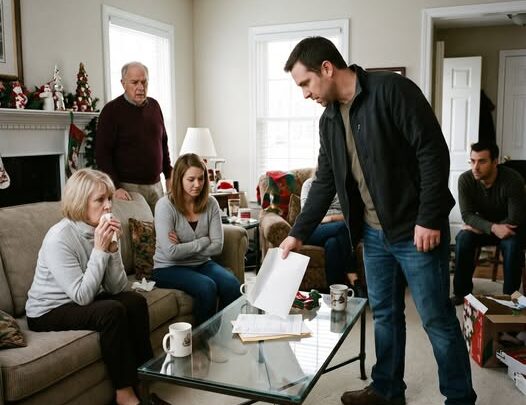
My mother was sitting on the couch, holding a tissue. Melissa had her arms crossed. My father stood beside the fireplace, looking like a judge preparing to deliver a sentence.
“Sit down,” Dad ordered.
I remained standing.
“This has gone far enough,” he said. “People from church are talking. The neighbors are whispering. Your mother can’t even go to the grocery store without someone mentioning that photograph.”
I looked at him.
“Maybe now she understands what humiliation feels like.”
Melissa shook her head.
“Don’t be cruel, Felix.”
I turned toward her.
“You sat there while my seven-year-old son tried to pretend his heart wasn’t broken. You watched him receive a cheap toy while your children opened expensive electronics. And you said nothing.”
“It wasn’t about the gifts,” she replied.
“Then what was it about?”
She didn’t answer.
My mother sighed dramatically.
“You’ve always been too sensitive, Felix.”
I looked at her.
“Is that what you call it when a child asks his father whether Grandma doesn’t like him anymore?”
She lowered her eyes.
Then Tyler, who had been silent in the corner, finally spoke.
“Then why did you tell me Melissa deserved more?”
The room froze.
My mother’s face turned pale.
My father’s jaw tightened.
Melissa turned toward Tyler.
“Why would you say that?”
Tyler didn’t look away.
“Because she did say it. She told me Felix doesn’t need handouts. She said giving him less builds his character and makes him stronger.”
I slowly turned toward my mother.
For once, she didn’t have an immediate explanation.
She looked at the floor.
“That’s not how I meant it,” she whispered.
But the damage had already been done.
I had spent years wondering why I was treated differently. I had convinced myself that perhaps I was being too sensitive or expecting too much.
Now I was hearing the truth from someone else.
And there was something else I had come to discuss.
Something far more serious than Christmas presents.
The Envelope on the Coffee Table
I slowly reached into my jacket pocket.
My mother’s eyes followed my hand.
I pulled out a thick, plain white envelope and placed it on the glass coffee table.
It landed with a heavy sound.
My father stared at it.
“What’s that?”
“The truth,” I replied.
I looked around the room.
“Since Melissa apparently needs handouts to keep her children happy, and since my presence supposedly builds character through poverty, I decided to find out exactly how we got here.”
I opened the envelope.
Inside were bank statements, business records, transaction summaries, and financial documents.
My father and I had been running a family business together for five years.
He managed much of the financial side of the operation, while I handled the day-to-day responsibilities.
I had trusted him.
For years, he told me the company was barely breaking even.
He said we needed to sacrifice, keep expenses low, and reinvest whatever money we could into the business.
Whenever I asked about increasing my salary, he explained that the company needed stability.
“We’re a family business, Felix,” he would say. “We have to grind now so everyone benefits later.”
I believed him.
I worked eighty-hour weeks.
I accepted a salary that barely covered rent, groceries, and the basic needs of my son.
I postponed plans for Lucas’s college savings because I believed the money needed to remain inside the company.
Meanwhile, my father managed the treasury.
But the financial records I had recently reviewed told a very different story.
I had gained access to additional account information after Tyler’s friend helped me identify discrepancies in the business records.
The transfers didn’t look like ordinary business expenses.
Some payments were described as reinvestments. Others were categorized under administrative or consulting costs.
But the money was moving into accounts connected to an offshore trust and Melissa’s personal finances.
The total identified in the records exceeded $90,000 for the year.
I slid the highlighted statements across the table.
“Except the company wasn’t simply breaking even, was it, Dad?”
He stared at the documents.
I continued.
“While you were telling me we couldn’t afford to increase my salary, money was moving out of the business. And while I was being told to delay Lucas’s college savings, Melissa’s household was receiving financial support.”
Melissa looked down.
My mother gripped her tissue.
I pointed toward the documents.
“These records show transfers that need to be explained. They show payments connected to accounts that were never properly discussed with me.”
My father took a half-step toward the table.
“Felix, we can talk about this.”
I placed my hand over the envelope.
“No. We’re going to talk about it properly, with the documents in front of us.”
The Money Behind the Expensive Christmas
I looked at Melissa.
“Now I understand how there was money for private school, a new SUV, and expensive electronics. I understand why there was money for designer shopping bags and generous gifts.”
She opened her mouth but said nothing.
I turned back toward my father.
“For five years, I believed that we were building something together. I thought every sacrifice was temporary. I thought I was helping secure a future for my son.”
My voice became quieter.
“But while I was working long hours and accepting less than I needed, money was being transferred elsewhere.”
My father shook his head.
“That’s not what happened. You don’t understand the capital distribution.”
“Then explain the transfers.”
“It’s complicated.”
“Then bring the accountant and explain it properly.”
He looked toward my mother.
She was crying now.
“Felix, please,” she whispered. “We are still family.”
I looked at her.
“Lucas is family too.”
Nobody answered.
I thought about Christmas morning again.
I remembered my son carefully opening that plastic bag. I remembered him examining the bent wheel and whispering that the toy was cool.
I remembered his question before bed.
Did Grandma not like my letter?
My voice dropped.
“You didn’t just treat the children differently. You made my son feel as though he was worth less than his cousins. And now I’m discovering that the financial situation I was told about may have been deliberately misrepresented.”
My father looked at the statements again.
For the first time, he seemed genuinely afraid.
“Felix, we can fix this,” he said.
I shook my head.
“You don’t get to decide that anymore.”
I Had Already Taken the First Legal Steps
I reached into my jacket and removed another document.
“As of eight o’clock this morning, I officially resigned as the primary operating officer.”
My father looked up sharply.
“What?”
“I have also instructed my attorney to begin a formal review of the company’s financial records.”
I explained that my legal representative had received the documentation and that an independent forensic accounting review was being prepared.
I had also asked my attorney to evaluate potential civil claims involving unpaid compensation, unauthorized transfers, and possible breaches of financial responsibilities.
The relevant tax and business records would be reviewed through the appropriate professional and legal channels.
I wasn’t going to make threats I couldn’t support.
I wasn’t going to argue about the records in a living room.
Everything would be handled through documented procedures.
My father sat down slowly.
“Felix, you can’t do this to your own family.”
I looked at him.
“You should have thought about that before treating our business like a private bank account.”
My mother began crying harder.
Melissa finally spoke.
“I didn’t know where all that money came from.”
I turned toward her.
“Then you should cooperate with the review and explain what you received. I am not asking anyone to guess. The records will show what happened.”
Tyler remained near the doorway, his expression serious.
He had been the first person in that room to challenge the family’s version of events.
I appreciated that he had spoken up, but I also knew that the next steps would need to be based on evidence rather than family arguments.
I picked up the casserole dish.
Then I looked at my parents one last time.
“I spent years trying to protect everyone’s feelings. I kept quiet because I thought family meant accepting things that hurt. But I will not let Lucas grow up believing he deserves less because his father refuses to stand up for him.”
I paused.
“You have forty-eight hours to have your attorney contact mine so the documents can be addressed through the proper process.”
Then I walked toward the door.
Behind me, nobody spoke.
The Beginning of a Different Future for Lucas
The drive home was quiet.
When I walked through our front door, Lucas was sitting on the living-room floor, playing with the little police car.
He had managed to straighten the bent wheel enough to make it roll across the carpet.
“Dad!” he said excitedly. “Look! I fixed it a little!”
I smiled and sat beside him.
“That’s pretty impressive, buddy.”
He pushed the car toward me.
“Can we make a police station for it?”
“Absolutely.”
We spent the next hour building a little station out of cardboard boxes. We used markers to draw windows and a garage door. Lucas decided that his police car needed a special parking space.
He was happy.
And that mattered more to me than anything that had happened inside my parents’ house.
I couldn’t change what had happened on Christmas morning. I couldn’t erase the moment my father humiliated him or the confusion in his eyes when he wondered whether Grandma disliked him.
But I could change what happened next.
I could teach him that love isn’t measured by expensive gifts, and that being treated unfairly doesn’t mean you deserve less.
I could show him that family relationships should be built on respect, honesty, and accountability.
And I could make sure that the financial future I worked so hard to build would no longer depend on promises that weren’t supported by the records.
The legal and financial review would take time. There would be difficult conversations, professional advice, and decisions that couldn’t be made overnight.
But I was no longer willing to ignore the warning signs.
What Christmas Taught Me About Family and Self-Respect
Some people might look at the photograph and think the story began with a cheap toy.
It didn’t.
The toy was simply the moment when years of unequal treatment became impossible to ignore.
It exposed the difference between what my parents said and what they did.
It forced me to ask questions about the family business that I should have asked much earlier.
Most importantly, it showed me that protecting a family image is not the same as protecting a family.
My son didn’t need an iPad to feel loved. He didn’t need designer sneakers or expensive clothes.
He needed adults who would treat him with kindness.
He needed his grandparents to make him feel welcome.
He needed his father to show him that his worth would never depend on how much money someone spent on him.
I couldn’t control the choices my parents made, but I could control the boundaries I established.
That Christmas, Lucas received a cheap plastic police car.
But he also learned something far more important: he was not responsible for the unfair decisions made by adults.
And I learned that sometimes the most important gift a parent can give a child is the courage to say, “This is not right, and I will not allow it to continue.”
The little police car still sits on Lucas’s shelf.
Its wheel isn’t perfect, and the plastic is scratched.
But whenever I see it, I remember the day I stopped accepting excuses and started asking questions.
Because my son was never the one who needed to become more grateful.
The adults were the ones who needed to learn what family really means.