Uncategorized
Meghan Markle’s New Glimpse of Lilibet Sparks Royal Buzz — But the Viral Claims Tell a Different Story

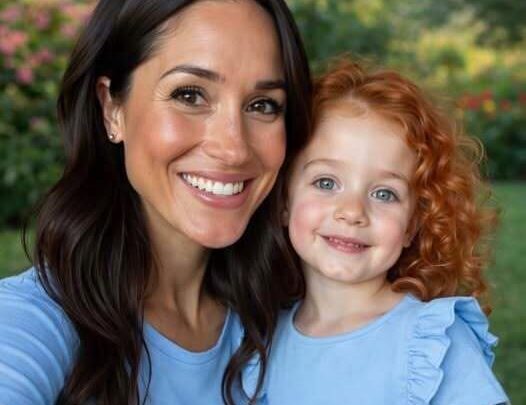
For years, Prince Harry and Meghan Markle have carefully managed how much of their children’s lives they share with the public.
Their decision to protect Prince Archie and Princess Lilibet from constant media attention has been one of the most discussed aspects of their life outside the working royal family. While millions of people around the world remain fascinated by the Sussex family, Harry and Meghan have repeatedly offered only selected glimpses of their children.
That is why even a simple photograph can quickly become a major talking point.
In 2026, Meghan shared several new glimpses of Lilibet, including photographs that gave the public a clearer look at her distinctive red hair. The images quickly attracted attention from royal watchers, entertainment publications and social-media users.
But alongside the genuine photographs came something else: a wave of sensational online claims suggesting that Meghan had somehow revealed a secret about Lilibet’s biological parentage.
That claim is not supported by credible evidence.
The real story is considerably more straightforward — and perhaps more interesting.
A Rare Glimpse of Lilibet
Meghan has gradually become more comfortable sharing carefully selected family moments online.
In May 2026, she posted a mirror selfie showing Lilibet helping her mother in her dressing room. Lilibet’s face was not shown directly, but her long red hair was clearly visible. Meghan captioned the image, “Mama’s little helper.”
The photograph was intimate without revealing too much.
That balance appears to be important to the Sussexes.
They can share a family moment with millions of followers while still protecting their daughter’s privacy.
Entertainment coverage immediately focused on Lilibet’s red hair, which closely resembles the coloring associated with her father, Prince Harry. E! News described the image as a glimpse of the young royal’s bright red hair, while other publications similarly highlighted the resemblance.
For royal followers, it was a familiar subject.
Harry’s red hair has been one of his most recognizable physical features throughout his life.
His children have also inherited noticeable aspects of his appearance.
The Red Hair That Started the Conversation
Lilibet’s hair became the central detail in many discussions surrounding the photographs.
There is nothing particularly mysterious about that.
Red hair is a genetic characteristic, and Harry has famously had red hair since childhood.
Over the years, photographs of Archie and Lilibet have repeatedly attracted attention because of their resemblance to their parents.
In 2026, Meghan’s social-media posts offered several more glimpses.
In March, photographs showed Lilibet helping her mother arrange flowers, again revealing her red hair while keeping her face out of view.
Then, for Lilibet’s fifth birthday in June, Meghan shared another family photograph. The image showed Harry holding his daughter while Meghan stood beside them. Lilibet’s long red hair was visible, although her face remained turned away from the camera. Meghan captioned the post, “Our dream girl. Happy 5th birthday, Lili.”
These were ordinary family milestones presented in a carefully controlled way.
Yet online speculation transformed the photographs into something much more dramatic.
How a Family Photograph Became a Royal Rumor
The internet has a remarkable ability to turn a small observation into a much larger story.
Someone sees a child’s hair.
Another person notices a resemblance.
A third person adds a question.
Soon, a social-media headline can imply that a photograph has revealed something that was never actually stated.
That appears to be what happened with claims about Lilibet’s supposed “true parentage.”
Some viral headlines suggested that Meghan had made a shocking revelation about the identity of Lilibet’s biological father.
There is no credible evidence supporting that claim.
Public reporting identifies Prince Harry and Meghan Markle as Lilibet’s parents, and reputable coverage of the family has not reported a verified revelation involving another biological father.
The photograph itself does not establish anything of the kind.
What Meghan Actually Shared
The documented photographs tell a much simpler story.
Meghan shared moments from family life.
She showed Lilibet helping her.
She celebrated her daughter’s birthday.
She posted photographs of Harry with their children.
She allowed followers to see glimpses of their home life while continuing to avoid showing Lilibet’s face clearly in many of the images.
ABC News also reported on family photographs Meghan shared in June 2026, including images of Harry, Archie and Lilibet. The post was captioned “Springing into summer.”
The photographs were not presented as evidence of a secret about Lilibet’s identity.
They were family photographs.
That distinction is important.
Why the Sussex Children Remain Such a Sensitive Subject
Harry and Meghan’s approach to their children’s privacy has been closely watched ever since the couple stepped back from their roles as senior working royals.
Their children were born into an extraordinary situation.
Before they were old enough to understand what a camera was, their names were already known around the world.
Millions of people knew when they were born.
Millions followed royal announcements about them.
Their family history was discussed by newspapers, television networks and social-media accounts.
For Harry and Meghan, controlling access to their children became part of their broader approach to family life.
That makes each photograph more significant than an ordinary celebrity family snapshot.
A single image can be copied thousands of times.
A hairstyle can become a headline.
A caption can be analyzed word by word.
And an innocent photograph can become the basis for speculation that has little connection to what was actually posted.
The Difference Between Resemblance and Evidence
One of the most important points to remember is that physical resemblance is not proof of biological parentage.
Children can inherit physical characteristics from their parents and extended family members.
Hair color, eye color, facial features and complexion can vary significantly even among close relatives.
A photograph can show resemblance.
It cannot establish a person’s biological parentage.
That requires entirely different evidence.
This is particularly important when discussing children of famous people.
A celebrity’s family may be constantly photographed, but photographs do not give the public access to every private fact about that family.
They show only what the image captures.
Why Lilibet’s Hair Attracted So Much Attention
There is also a cultural reason that Lilibet’s red hair became such a popular subject.
Prince Harry has been strongly associated with his red hair throughout his public life.
As a result, seeing a young daughter with similar coloring naturally invites comparisons.
Media outlets have repeatedly described the resemblance.
E! News referred to Lilibet’s red hair as a feature associated with her father, while Vanity Fair and other publications similarly highlighted the distinctive color in photographs shared by Meghan.
That is a perfectly ordinary observation.
The problem begins when resemblance is turned into evidence for an unsupported theory.
The Power of a Royal Photograph
Royal photographs have always carried unusual significance.
For generations, official portraits have helped shape the public’s understanding of the British royal family.
A photograph can become a historical image.
A child’s first public appearance can become an international event.
Even an informal family photograph can generate enormous interest.
The Sussex family has changed the way it participates in that tradition.
Instead of relying exclusively on palace photographers and traditional royal announcements, Harry and Meghan have often used their own platforms to share selected moments.
This gives them more control over the timing, context and presentation.
It also means that their followers receive images directly from the family rather than always seeing them through traditional media organizations.
Meghan’s Approach to Motherhood
The recent photographs also reveal something less sensational but more meaningful about Meghan’s approach to sharing her children.
She appears to favor ordinary moments.
Lilibet helping in the dressing room.
Lilibet participating in flower arranging.
Family celebrations.
Harry spending time with his children.
These are small scenes rather than formal royal portraits.
They show a family trying to preserve ordinary experiences despite extraordinary public attention.
The contrast is striking.
The world may see Lilibet as a princess and member of the royal family.
Her parents’ photographs often present her simply as their daughter.
That difference appears to be intentional.
Lilibet’s Fifth Birthday
The birthday photograph shared in June 2026 provided another example.
Meghan posted an image showing Harry holding Lilibet, with the child’s long red hair visible from behind.
Meghan stood beside them.
The family appeared relaxed and affectionate.
The caption was simple:
“Our dream girl.”
The photograph was widely reported by British and American media outlets. ITV and The Independent both reported the birthday post and described the image of Harry, Meghan and Lilibet.
There was no documented announcement about a different biological father.
There was no verified revelation about Lilibet’s parentage.
There was simply a birthday tribute from a mother to her daughter.
Why Sensational Headlines Spread So Quickly
The phrase “shocking revelation” is powerful.
So is “royal secret.”
Combine those phrases with a photograph of a young royal child, and the story can become extremely clickable.
But a headline can create an expectation that the underlying material does not support.
This is particularly common with celebrity and royal stories.
A real photograph becomes the foundation.
A real detail is added.
Then speculation is introduced.
Finally, the headline presents the speculation as though it were a confirmed revelation.
Readers may not notice the difference until they reach the end of the article — if they reach it at all.
That is why separating confirmed information from speculation is essential.
What We Actually Know About Lilibet
The publicly documented facts are straightforward.
Lilibet Diana Mountbatten-Windsor was born in 2021.
She is the daughter of Prince Harry and Meghan Markle.
She is the younger sibling of Prince Archie.
She has distinctive red hair that has been visible in several photographs shared by her mother.
Meghan has increasingly shared selected glimpses of her daughter while continuing to limit how much of Lilibet’s private life is made public.
And in 2026, those photographs have once again generated significant public interest.
Those facts are enough to make the story interesting without adding an unsupported mystery.
The Bigger Conversation About Privacy
Perhaps the most important part of the story isn’t the rumor at all.
It is the question of where the boundary between public interest and private family life should be drawn.
Harry and Meghan are public figures.
Their decisions, careers and public statements naturally attract attention.
Their children, however, are individuals who did not choose to become famous.
That distinction is especially important when discussing claims about a child’s identity or parentage.
A photograph can be analyzed endlessly, but that does not mean the public is entitled to invent private details that have never been established.
The fascination surrounding Lilibet demonstrates how difficult that boundary can be.
A Family Living Under Extraordinary Attention
Harry and Meghan have spent years navigating an unusual position.
They remain connected to one of the world’s most famous royal families while living outside the traditional structure of royal working life.
Their children carry royal titles and have family ties stretching across generations.
At the same time, their parents have repeatedly emphasized their desire to create a more private childhood for them.
That tension explains why every new family photograph attracts so much attention.
A single image can simultaneously be a personal memory and a global news story.
The Image Behind the Headlines
When the sensational language is removed, the image is remarkably simple.
A mother shares a moment involving her daughter.
A little girl with red hair appears in the frame.
A family celebrates a birthday.
A father holds his child.
There is no verified secret about biological parentage hidden in the photographs.
There is no credible evidence that Meghan used Lilibet’s hair to reveal another biological father.
The dramatic interpretation came from online speculation rather than a documented announcement.
And that distinction matters.
The Real Story Is About Recognition
There is something fitting about how much attention has been paid to Lilibet’s appearance.
Royal families have always been studied through photographs.
People look for similarities between generations.
They compare children with parents and grandparents.
They notice hair color, facial features and expressions.
But families are about more than appearances.
Lilibet’s relationship with Harry and Meghan cannot be understood through a photograph alone.
Neither can the private experiences of any family.
A picture can capture a moment.
It cannot tell an entire story.
Final Thoughts
Meghan Markle’s photographs of Princess Lilibet have certainly attracted attention, particularly because they offer rare glimpses of a young member of the Sussex family.
Lilibet’s red hair has become one of the most recognizable physical features visible in the family’s carefully selected photographs, and the resemblance to her father has naturally become a popular topic among royal watchers.
But the viral claim that Meghan revealed a shocking secret about Lilibet’s biological father is not supported by credible evidence.
The documented story is much simpler.
A mother shared photographs of her daughter.
A family celebrated important moments.
The public noticed a child’s distinctive red hair.
And the internet did what it often does: it turned a small detail into a much bigger mystery.
For readers, the most responsible approach is to enjoy the genuine family moments while separating verified information from speculation.
Because when it comes to children — even children born into one of the world’s most famous families — a photograph should remain a photograph until there is credible evidence that it means something more.