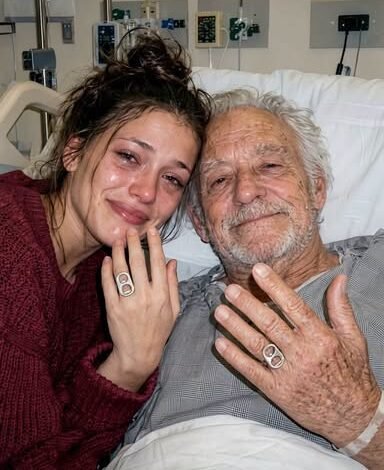
I Married a Stranger in a Hospital—Then His Backpack Revealed a Secret Legacy
At twenty-nine, I never imagined that one of the most important relationships of my life would begin in a hospital waiting room.
I had gone there because I was grieving my mother and searching for a way to make that grief useful.
For almost a year, I had volunteered at the hospital, spending time with patients who had little or no family beside them during difficult final days. I had learned that sometimes a person does not need a solution. Sometimes they simply need another human being willing to sit beside them.
That was how I met Julian.
He was seventy-two, frail, and suffering from advanced heart failure.
He knew his time was limited.
I knew almost nothing about him.
Yet somehow, within a few days, our conversations became important to both of us.
Then one afternoon, Julian reached for my hand.
“Marry me, Nora,” he whispered.
I thought he was joking.
He wasn’t.
His explanation was simple but heartbreaking. He did not want his final moments to be handled as though he were simply an anonymous patient. He wanted to leave the world as someone’s husband.
I knew how unusual the request was.
Still, two days later, a hospital chaplain married us.
There was no elaborate ceremony.
I wore a yellow sweater.
We didn’t even have wedding rings.
Instead, Julian slipped a soda-can pull tab onto my finger.
We laughed about it.
For the next seven days, I stayed close to him.
I held his hand through difficult moments and listened whenever he wanted to talk.
Then his heart stopped.
I was suddenly a widow after a marriage that had lasted only one week.
I thought that was where our strange little story ended.
I was wrong.
The Attorney With the Green Backpack
After Julian died, I sat alone in his hospital room.
The silence was overwhelming.
Although I had known him for only a short time, his absence felt enormous.
Then an elderly man entered carrying a green backpack.
“Nora?” he asked.
I nodded.
“My name is Arthur Pendelton. I’m your husband’s attorney.”
He placed the backpack in my hands.
It was surprisingly heavy.
I looked at him.
“What is this?”
“Julian left it for you.”
Then Arthur lowered his voice.
“Julian wasn’t who you thought he was.”
My hands tightened around the backpack.
“He wanted you to know the truth.”
I didn’t understand.
I had known Julian as a dying man who seemed lonely.
Now his attorney was telling me that there was an entire part of his life I had never seen.
I opened the zipper.
Inside were three objects.
A worn leather notebook.
A legal deed wrapped carefully in oilskin.
And a folded piece of red silk.
The silk was the first thing I pulled out.
When I unfolded it, I realized it was a small handmade dress.
It looked old.
Very old.
And somehow, it seemed to carry a story of its own.
The Red Dress Belonged to Lily
Arthur sat down across from me.
“Forty-five years ago,” he began, “Julian was a master tailor in Chicago.”
I looked at the dress again.
“He had a wife and two children.”
I had never heard Julian mention either.
“A son named Caleb and a daughter named Lily. They were twins.”
My attention immediately returned to the red dress.
“Lily’s favorite thing was that dress,” Arthur said.
Julian had made it for her fifth birthday.
It was carefully sewn by hand, reflecting the skills he had developed as a tailor.
But shortly after Lily’s birthday, tragedy struck the family.
A house fire caused by a faulty heating unit swept through their home.
Julian managed to rescue his wife and his son, Caleb.
But when he returned for Lily, it was too late.
The only thing he was able to save from his daughter’s room was the red dress.
I touched the fabric.
Suddenly, the grief I had been carrying over my own mother seemed to connect with Julian’s decades-old grief.
Two strangers.
Two different losses.
And somehow, we had found each other in the same hospital.
A Family Broken by Grief
After Lily’s death, Julian’s marriage eventually collapsed.
His wife could no longer remain in the same life after such a devastating loss.
She moved away with Caleb.
Contact between Julian and his son eventually disappeared.
Julian became increasingly isolated.
According to Arthur, he poured himself into tailoring and investments.
Over the following decades, he quietly built wealth.
But money was not his primary motivation.
He established a private trust.
He saved.
He invested.
And he continued to carry Lily’s memory.
The red dress remained one of the few physical reminders of the daughter he had lost.
I looked at Arthur.
“Why didn’t he tell me any of this?”
Arthur didn’t answer immediately.
Instead, he reached into his coat and removed a sealed envelope.
“Because there was another reason he married you.”
Why Julian Chose Me
I opened the envelope.
Arthur explained that Julian had become aware that his estranged son, Caleb, had been searching for him.
But Caleb wasn’t simply looking for reconciliation.
He had discovered that Julian owned a valuable piece of downtown Chicago real estate.
It was the location where Julian’s old tailor shop had once stood.
The property had become extremely valuable over the years.
Caleb, now a corporate developer, had plans for the area.
He wanted to redevelop the block.
Julian knew what might happen to the property if he died without an estate plan.
But Arthur told me something else.
Julian had watched me for almost a year before asking me to marry him.
He had seen me volunteering with patients.
He had watched me sit with people who were alone.
He had seen how I treated strangers when I had nothing to gain from them.
He wanted to know whether my kindness was genuine.
And eventually, he believed it was.
Arthur explained that Julian did not marry me simply to avoid dying alone.
He believed I was someone who could protect what mattered to him.
The shop.
Lily’s memory.
And the legacy he had spent decades building.
Julian’s Final Letter
Arthur pointed toward the leather notebook.
“Open it.”
I did.
A marked page contained Julian’s final message.
It was written in his neat handwriting.
He apologized for keeping so much from me.
He explained that he needed to know my kindness was genuine and not influenced by the possibility of wealth.
Then he mentioned the pull tab.
The strange little substitute for a wedding ring suddenly became more meaningful.
To Julian, it represented the promise we had made during the final week of his life.
He also asked me to protect Lily’s memory and the old tailor shop.
But there was one final warning.
Caleb knew Julian was gone.
And Caleb would come for the property.
I barely had time to process the letter.
The hospital room door suddenly slammed open.
Caleb Arrives
A tall man wearing an expensive charcoal suit entered the room.
A younger corporate associate followed behind him.
The resemblance was unmistakable.
I knew immediately who he was.
Caleb.
Julian’s son.
He barely looked at me.
Instead, he addressed Arthur.
“I received the notification from the nurse’s station. Where are the estate authorization documents?”
Arthur remained calm.
“You’re too late.”
Caleb frowned.
“What does that mean?”
“Your father was married.”
Arthur gestured toward me.
“This is Nora Vance. Julian’s lawful wife.”
Caleb finally looked at me.
Then he noticed the green backpack.
Then the red dress.
His expression changed for a moment.
The sight of his sister’s dress appeared to affect him.
But the emotion quickly disappeared.
He accused me of taking advantage of his father’s condition.
He called the marriage a scam.
He said he would challenge it.
I told him that Julian had been lucid when we married.
The hospital chaplain had performed the ceremony.
Julian knew exactly what he was doing.
Caleb refused to accept it.
The Property Became the Center of the Fight
Caleb’s company had plans for the downtown property.
He had spent years preparing a major development project.
The building stood on land that had become extremely valuable.
To Caleb, it was a business asset.
To Julian, it represented decades of memories.
To me, it had suddenly become a responsibility I never expected.
Caleb threatened legal action.
He warned that his company could afford years of litigation.
Arthur, however, had prepared for exactly this possibility.
He produced legal documentation showing that Julian had already transferred the property through an irrevocable deed.
There was also a video deposition documenting Julian’s wishes and evidence relating to his mental competency.
Caleb was furious.
But the documents changed the situation.
Julian had not left his affairs to chance.
He had prepared carefully.
The Fight Did Not End at the Hospital
Over the following weeks, Caleb’s legal team challenged the marriage and attempted to interfere with the estate.
They filed motions.
They questioned the circumstances surrounding the marriage.
They even made large settlement offers.
But Julian’s estate planning had been prepared before his death.
The legal documents were strong.
The property remained under my control.
Yet I knew that owning it wasn’t the same as understanding it.
I had never been a business owner.
I had never managed historic property.
And I certainly had never imagined inheriting a building worth millions.
Then I remembered Julian’s final instruction.
Protect the shop.
Returning to the Oak Tailor
Three weeks after Julian’s death, I stood outside the old building in downtown Chicago.
Two modern skyscrapers rose nearby.
Between them stood a two-story brick structure.
Its windows were dusty.
Its paint had faded.
But above the entrance was an old sign:
The Oak Tailor — J. Vance, Est. 1974.
Arthur stood beside me.
So did a small group of historic preservation architects.
I unlocked the front door.
When I stepped inside, I immediately understood why Julian had fought so hard to preserve the building.
The air smelled of cedar, brass, and old textiles.
Industrial sewing machines remained in place.
Shelves held bolts of wool, silk, and linen.
It felt frozen in time.
This wasn’t simply a building.
It was a record of Julian’s life.
Every machine, table, and piece of fabric seemed to carry a memory.
Caleb Returned With One Final Offer
Later that day, Caleb arrived.
He walked through the building with a mixture of frustration and disbelief.
“You turned down the twenty-million-dollar offer,” he said.
I nodded.
He couldn’t understand why.
From his perspective, selling the property would have been the obvious decision.
I looked toward the glass case where Lily’s red dress had been carefully displayed.
“I didn’t keep the building to hurt you,” I told him.
“I kept it because your father wanted it protected.”
I explained that Julian had spent decades working there.
He had lost his daughter.
He had lost his marriage.
He had lost contact with his son.
But he had never completely abandoned the memories connected to that place.
Caleb Finally Looked at His Sister’s Dress
Caleb walked toward the display case.
For a long time, he said nothing.
He stared at the red dress.
Then he spoke quietly.
“He abandoned us.”
His voice was different now.
It no longer sounded like the voice of a powerful developer.
It sounded like the voice of a son who had spent decades carrying unanswered questions.
I told him that Julian’s actions after the tragedy did not necessarily mean he had stopped loving his children.
Julian had been grieving too.
Then I showed Caleb another photograph.
I had found it inside Julian’s journal.
It showed Julian as a younger man standing outside the shop with Caleb sitting on his shoulders.
They were both smiling.
On the back, Julian had written a simple message identifying Caleb as his son and expressing hope for his future.
Caleb’s hand began to tremble.
The Building Meant Something Different to Him
Caleb stared at the photograph.
For the first time, he saw evidence that his father had remembered him.
The anger did not disappear completely.
But something changed.
The building was no longer just an asset that had been taken away from him.
It was part of his childhood.
Part of his father’s life.
Part of the family history he had lost.
Caleb eventually made an unexpected decision.
He told me that his developers would adjust the planned tower’s foundation so the historic property would remain untouched.
Then he looked at me.
“Keep the shop, Nora.”
He left.
A New Purpose for Julian’s Legacy
I could have sold the building.
The money would have changed my life.
But I kept thinking about Julian’s final request.
Protect the shop.
Protect Lily’s memory.
And do something meaningful with what he had built.
So I used part of the investment trust to restore the property.
The old building was repaired rather than demolished.
The sewing machines were preserved.
The historic materials were catalogued.
And the building was transformed into a community space.
Six months later, it reopened under a new name:
The Lily Vance Memorial Textile Center and Community Workshop.
It was no longer simply a tailor shop.
It became a place where people could learn.
A Legacy Built Around Helping Others
The center offered free clothing-design and sewing classes.
It also provided tailoring assistance for people who could not easily afford formal clothing.
Low-income students could learn practical skills.
Young people preparing for job interviews could receive help with professional clothing.
Foster youth could participate in workshops.
The building became busy again.
But this time, the sound inside the shop was not simply the sound of commercial production.
It was the sound of people learning.
Creating.
Helping one another.
And building confidence.
That was the kind of legacy Julian had hoped for.
The Red Dress Became a Memorial
Lily’s red dress was placed inside a museum-quality glass case.
It became the heart of the center.
Visitors could see the handmade stitching and understand that the building’s story was about more than business.
It was about memory.
Loss.
Family.
Craftsmanship.
And the ways people can choose to honor someone they have lost.
The dress had once belonged to a five-year-old girl.
Decades later, it became a symbol of why the building had survived.
The Soda-Can Pull Tab Stayed With Me
I never replaced the pull tab with a traditional wedding ring.
Instead, I had it turned into a small pendant.
I wore it on a thin gold chain.
It wasn’t valuable in a financial sense.
But its meaning was impossible to measure.
Julian had slipped it onto my finger during a marriage ceremony that lasted only seven days.
At the time, I thought it was simply a funny substitute for a ring.
Later, I realized it represented the unusual promise we had made to one another.
He had asked me to make sure he didn’t leave the world feeling completely alone.
And I had stayed.
In return, he trusted me with the story of his life.
I Had Married a Stranger
When I first met Julian, I knew almost nothing about him.
I didn’t know about Lily.
I didn’t know about Caleb.
I didn’t know about the tailor shop.
I didn’t know about the trust.
I didn’t know that the building was worth millions.
And I certainly didn’t know that one day his final gift to me would become the beginning of something much larger.
I married him because he was afraid of dying alone.
I stayed because I cared about him.
And after his death, I discovered that he had spent his life caring about people and places that had been forgotten.
The Truth Was Larger Than the Money
At first, the estate made everything seem like a financial story.
Fourteen million dollars.
A valuable downtown property.
A developer who wanted the land.
An inheritance.
But the more I learned, the less the money seemed important.
The true story was about what Julian had lost and what he wanted preserved.
The property was valuable because of its location.
But to Julian, it was valuable because it contained memories.
The red dress was only fabric.
But to him, it represented Lily.
The soda-can pull tab was nearly worthless.
But to me, it represented the final week we shared.
And the community center was worth more than any sale because it gave Julian’s legacy a purpose.
Caleb and I Eventually Reached an Understanding
Caleb never became my closest friend.
We were two people connected by an unusual family story.
But over time, our conversations became less hostile.
He eventually visited the center without his attorneys.
He stood in front of Lily’s dress.
He looked at old photographs.
He asked questions about his father.
I answered what I could.
Some questions had no answers.
Julian was gone.
We could not ask him why he made certain choices.
But we could finally talk about him without fighting over property.
That was progress.
The Masterpiece Julian Left Behind
On the center’s opening day, the building was filled with people.
A high school student stood near one of the worktables while an older volunteer adjusted the hem of a donated formal dress.
Sewing machines hummed.
People laughed.
Others learned techniques that might help them find work or express their creativity.
I stood near the front window.
My fingers touched the small pendant around my neck.
The soda-can pull tab caught the light.
I looked across the room at the red dress inside its glass case.
For a moment, I thought about the man I had met in a hospital.
A stranger.
A dying man.
A person who had asked me to marry him because he didn’t want his final hours to feel anonymous.
I had thought I was giving him something.
Company.
Comfort.
A hand to hold.
But Julian had given me something too.
He gave me a story.
He trusted me with his daughter’s memory.
He gave me a chance to turn a painful inheritance into something useful.
A Marriage That Lasted Seven Days Left a Lifetime of Meaning
My marriage to Julian lasted only one week.
But its impact lasted far longer.
It changed how I understood grief.
It changed how I understood family.
It changed how I understood inheritance.
And it taught me that a legacy isn’t necessarily the amount of money someone leaves behind.
Sometimes a legacy is a place.
Sometimes it is a skill.
Sometimes it is a memory.
Sometimes it is a promise made between two people who barely had time to know each other.
And sometimes it is a building filled with people who were once overlooked.
The Shop Still Stands
The Oak Tailor building remains standing among the modern structures surrounding it.
The old sign was restored.
The sewing machines remain.
The historic fabrics are carefully preserved.
And Lily’s red dress remains behind glass.
Every time I walk through the doors, I think about Julian.
I think about the daughter he lost.
I think about the son he never stopped loving, even after decades apart.
And I think about the strange circumstances that brought me into their story.
I entered Julian’s life because I didn’t want a dying stranger to feel alone.
I left the hospital carrying a backpack filled with secrets.
But the greatest thing inside that backpack wasn’t the deed.
It wasn’t the financial records.
It wasn’t even the red dress.
It was the truth.
Julian had spent decades trying to protect something meaningful.
In the end, he trusted a woman he had known for only seven days to help carry that responsibility forward.
And now, whenever the sewing machines begin humming inside the old shop, I think about his final words.
We didn’t simply save a building.
We saved a memory.
And we gave that memory somewhere to live.