A Father’s Cruel Decision at His Wife’s Funeral
Lucy waited until the white van disappeared beyond the cemetery gates before turning her mother’s framed photograph over. With trembling fingers, she pressed her thumbnail beneath one corner of the cardboard backing.
A tiny brass key had been taped inside.
“Mom told me not to touch this unless Dad tried to get rid of us,” she whispered.
Her words struck me harder than anything Arthur had said beside Rose’s grave.
Rachel moved closer to her sister, shielding the key from the relatives still walking toward their cars. Six-year-old April held tightly to my hand, her small fingers wrapped around mine as if she feared that I, too, might disappear.
I stared at the key.
“What does it open, sweetheart?”
“A box at your house,” Lucy answered. “Mom put it there the last time we visited.”
For a moment, I could not speak. My daughter had been dying, yet somehow she had found the strength to prepare for a future in which she would no longer be there to protect her children.
And she had known something about her husband that I was only beginning to understand.
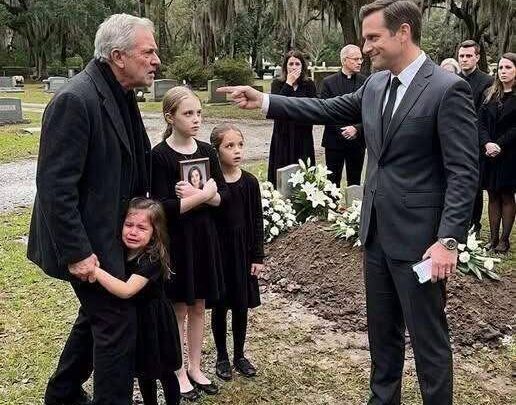
Less than an hour after Rose was buried, Arthur had announced in front of more than two hundred mourners that he would not raise his three daughters. He had pointed toward me, declared that the girls were now my responsibility, and climbed into a white van with Vanessa, the woman he intended to marry.
He had not asked whether I could manage three grieving children. He had not discussed school, medical care, clothing, or the emotional needs of girls who had just lost their mother.
He had simply walked away.
At the cemetery, I had wanted to strike him.
Now I wanted to know what Rose had feared enough to hide a key inside her own photograph.
I slipped it into my coat pocket and guided the girls toward my car.
Whatever waited inside that box, I would discover it privately. Rose had trusted me with something important, and I would not turn her final act into another public spectacle.
The Drive Home and the Questions No Child Should Have to Ask
The girls sat together in the back seat during the drive across Savannah.
Lucy held the photograph upright between her sisters. Rachel kept one arm around April, who eventually fell asleep against her shoulder.
Lucy, however, watched every vehicle behind us.
“Are you afraid your father will come back?” I asked gently.
She hesitated before nodding.
“He checks our backpacks sometimes. He used to look through Mom’s phone, too.”
“Did he ever hurt any of you?”
Lucy looked at Rachel before answering.
“He yelled. Sometimes he broke things. Mostly, he acted like we weren’t there.”
Rachel rubbed April’s shoulder.
“Mom said being ignored can still be a warning.”
That sounded exactly like Rose. Even as a child, she had noticed the quiet damage other people dismissed because it left no obvious mark.
I wanted to ask a hundred more questions, but I stopped myself. They had spent the morning at their mother’s funeral, listened to their father reject them, and watched the adults around them struggle to understand what had happened.
They needed somewhere safe more than they needed an interrogation.
When we arrived home, I made grilled cheese sandwiches because it was the only meal I trusted myself not to ruin.
April ate half of hers at the kitchen table, still wearing the black dress she had worn to bury her mother. Rachel carried their overnight bags upstairs, while Lucy remained beside the garage door with the brass key in her palm.
“Mom said the box was behind the winter blankets,” she told me.
I had kept old storage bins along the garage’s back wall for years. Rose had helped me reorganize them several weeks before she died. At the time, she had laughed about my habit of saving everything, from worn extension cords to coffee cans full of screws.
Now I remembered how carefully she had moved one particular plastic bin herself.
Behind the folded blankets sat a small metal lockbox I had never seen before.
The brass key fit perfectly.
Inside were a black notebook, a compact digital recorder, and a thick cream-colored envelope. Rose had written three words across its front in her familiar handwriting:
FOR VANESSA ONLY.
Vanessa was the woman in the passenger seat of Arthur’s van.
I had never spoken to her, but Lucy recognized the name immediately.
“That’s Dad’s girlfriend,” she said. “Mom knew about her.”
Beneath the envelope lay a single sheet addressed to me.
Dad,
If you are reading this, Arthur has done what he promised he would do.
Please keep the girls together.
Do not release everything publicly, no matter how angry you are. Let the truth protect them before it punishes anyone.
My hands began shaking before I reached the final line.
The notebook will explain the recordings.
The envelope belongs to Vanessa only after Arthur abandons the girls or tries to place them with the state.
I lowered myself onto an overturned bucket.
Rose had not written that Arthur might abandon his daughters.
She had written as though she already knew he would.
The Notebook That Recorded a Family’s Collapse
Lucy knelt beside the open box.
“Mom started the notebook last winter,” she explained. “Dad thought she was writing down her medicine.”
I opened the first page.
At the beginning, the entries were ordinary enough to break my heart.
Rose had written down school pickup times, April’s dentist appointment, Rachel’s reading assignment, Lucy’s science project, and the foods the girls preferred when they were frightened or sick.
There were notes about birthdays, favorite bedtime stories, and the stuffed rabbit April needed whenever she slept somewhere unfamiliar.
These were the details of a mother preparing for the possibility that she might not be present to handle the little things.
Then the entries changed.
Arthur came home after midnight again.
Arthur told the girls he would not be responsible for their lives once I was gone.
Arthur said Vanessa wanted a marriage without baggage.
Arthur asked whether Dad would take all three girls permanently.
Arthur said Monday would be soon enough to call Child Protective Services.
Each entry included a date, an approximate time, and the names of anyone who might have overheard the conversation.
Rose had not written like someone trying to win an argument with an unfaithful husband. She had written like a mother building a bridge her daughters could cross after she was no longer there to carry them.
The final pages explained the digital recorder.
Rose had saved recordings of certain conversations Arthur initiated in their kitchen and bedroom, usually when he believed the girls were asleep. Beside each file number, she had written a short explanation of what it contained.
I did not play the recordings in front of April.
Instead, I took the device into the laundry room, closed the door, and selected the first file Rose had marked as important.
Arthur’s voice filled the small room.
“You keep acting like I’m supposed to become some grieving single father,” he said. “That isn’t the life I agreed to.”
Rose’s reply was weak but clear.
“They are your daughters.”
“They can be Charles’s problem.”
“What if my father cannot take them?”
“Then the state can. I’m not losing the rest of my life because you got sick.”
I gripped the edge of the counter.
The washer beside me was silent, yet the sound of my own heartbeat seemed deafening.
Rose asked whether Vanessa knew he intended to surrender the girls.
Arthur laughed.
“Vanessa thinks you already arranged for your father to raise them. She thinks this was your decision.”
I stopped the recording.
Until that moment, I had assumed Vanessa had willingly accepted Arthur’s plan. I had imagined her sitting beside him in the van, content to begin a new life without the inconvenience of three children.
But the recording revealed something worse.
Arthur had told each woman a different story.
He had told Rose that Vanessa refused to raise the girls. He had told Vanessa that Rose had chosen to give them away. And at the cemetery, he had presented himself as a man with no other option.
Every version left Arthur blameless while someone else carried the consequences.
I returned to the second recording.
This time, Arthur complained about the girls’ clothing, school schedules, medical appointments, and the space their belongings occupied in the house.
He wanted their rooms cleared before the wedding.
When Rose asked when he planned to marry Vanessa, he answered without hesitation.
“Soon. I’ve already waited long enough.”
The date written in Rose’s notebook was six weeks before she died.
I turned off the recorder and pressed both hands against the counter.
For a moment, grief and anger became indistinguishable.
Then Lucy knocked softly.
“Grandpa?”
I opened the door.
She searched my face, and I suddenly understood that she was not asking what I had heard.
She was asking whether the truth had made me want them less.
I pulled her into my arms.
“You three are staying together,” I promised. “Nothing in that box changes that.”
For the first time since the cemetery, her shoulders relaxed.
Protecting the Girls Before Exposing Their Father
That night, the girls slept in Rose’s old bedroom and the guest room, with every hallway light turned on.
April woke twice, calling for her mother. Rachel refused to remove the black shoes Rose had buckled for her before her final hospital stay. Lucy placed the framed photograph on the nightstand but kept the brass key beneath her pillow.
I barely slept.
By morning, I understood that anger alone would not protect the girls. I needed to be careful, organized, and prepared to let the proper authorities determine what happened next.
I contacted a family attorney and explained the immediate facts. Arthur had publicly refused responsibility for his daughters, threatened to involve child welfare authorities, and left them with me without a plan for their care.
The attorney did not promise an easy victory.
She advised me to preserve the notebook and recordings, document what I had personally witnessed, and identify the people who had heard Arthur’s statement at the cemetery.
She also warned me not to post the recordings online or distribute private conversations indiscriminately. Their legal significance would depend on the circumstances in which they had been made, the applicable law, and how they were handled.
Rose had already given me the most important instruction: protect the children first.
By noon, relatives were calling.
Some wanted to know whether Arthur had truly meant what he said. Others urged me to avoid a family scandal so soon after the funeral.
One cousin suggested that grief might have caused Arthur to speak carelessly.
I asked whether grief had also made him arrange for his fiancée to wait in a van outside his wife’s burial.
The cousin had no answer.
That afternoon, a child welfare worker met with us after Arthur followed through on his threat and reported that the children had been taken by an interfering relative.
His version of events began to unravel under simple questions.
He had no message asking me to care for the girls temporarily. He had packed none of their belongings. He had not called to ask whether April had her inhaler, whether Rachel had eaten, or whether Lucy understood where she would attend school.
The worker spoke with each girl separately.
I did not hear their conversations, and I did not ask them to repeat anything afterward. Whatever they needed to say, they deserved to say without worrying about protecting my feelings.
When Lucy emerged, she held Rose’s photograph against her chest.
I took her hand.
“You did nothing wrong,” I told her.
She nodded, but her eyes remained fixed on the front door.
Arthur arrived before sunset.
He was no longer wearing the tailored gray suit he had worn at the cemetery, but his expression was just as impatient.
He stepped onto my porch and demanded to speak to the girls.
“You created a scene at the funeral,” he accused. “I was upset, and you took advantage of it.”
“You told hundreds of people you were handing your daughters to the state.”
“I said it because you were standing there judging me.”
“You had already told Rose the same thing.”
That stopped him.
His eyes shifted toward the front window, where the edge of Rose’s photograph was visible through the curtain.
“What did she leave?” he asked.
He did not ask whether the girls were sleeping. He did not ask whether they had cried or whether April had been frightened.
He wanted to know what Rose had left behind.
I stepped between him and the door.
“Go home, Arthur.”
His expression hardened.
“Those recordings are private marital conversations.”
I had never mentioned the recordings.
By trying to frighten me, he had revealed that he knew they existed.
Lucy stood in the hallway behind me, close enough to hear.
Arthur noticed her and immediately softened his voice.
“Lucy, sweetheart, tell Grandpa this has been a misunderstanding.”
She did not move toward him.
“You said we were ruining your life,” she replied.
“I never said that.”
“Mom recorded it.”
Arthur looked past her toward the staircase, as if he might force his way inside and search every room.
I closed the door.
For several seconds, neither of us moved.
Then Lucy whispered, “He’s going to be angry.”
I knelt beside her.
“He is responsible for his own choices,” I said. “You are not responsible for making him happy.”
It was a lesson Rose had tried to teach them, and one I intended to keep teaching for as long as they needed it.
The Woman in the Van Finally Learns the Truth
The next morning, Vanessa called.
Her voice was controlled, but she sounded as though she had not slept.
“Arthur says Rose left something with my name on it,” she said. “Is that true?”
I looked at the cream-colored envelope on the kitchen counter.
“How did he know?”
“He said Rose was vindictive and might try to interfere with our wedding.”
“Did he tell you he planned to send his daughters into foster care?”
A long silence followed.
“He told me Rose wanted the girls to live with you,” Vanessa finally answered. “He said they had already agreed.”
I asked whether she had heard what Arthur announced at the cemetery.
She had not.
Arthur had instructed her to remain in the van because Rose’s family might blame her for the affair. Afterward, he climbed into the driver’s seat and told Vanessa that everything had gone exactly as expected.
I explained that Rose had left an envelope for her, but I would not send photographs of its contents or leave it somewhere Arthur could intercept it.
Vanessa arrived at my house that evening.
Without her oversized sunglasses, she looked younger and far less certain than she had from across the cemetery.
Lucy watched her from the dining room doorway.
Vanessa noticed the child and whispered, “I was told you wanted to live here.”
Lucy answered without anger.
“Dad never asked us.”
I placed Rose’s envelope on the table.
Vanessa recognized the handwriting. Arthur had once shown her a birthday card from Rose while insisting that his wife knew about the relationship and had accepted it.
The envelope contained a letter and instructions to play two numbered recordings.
Rose had not insulted Vanessa. She had not blamed her for the affair or demanded revenge.
Instead, she had written that Arthur was telling them opposite stories because he needed both women to make decisions without knowing the truth.
He told me you would never accept my daughters.
He told you I chose to give them away.
Neither statement is true.
Before you marry him, listen to what he says when he believes you cannot hear him.
Vanessa read the letter twice.
Then she asked me to play the first numbered file.
Arthur’s voice filled the room.
He described the girls as obligations that would disappear once Rose died. He said Vanessa wanted a clean start, although Vanessa shook her head before he had finished the sentence.
Then came the second recording.
Rose asked what Arthur had promised Vanessa about their future.
Arthur replied, “I told her your father was taking the girls and that I’d be free before the wedding. That’s all she needs to know.”
Vanessa pressed both hands against the table.
Their wedding was scheduled for the following Saturday. The dress was ready, the venue had been paid for, and relatives were already making travel arrangements.
For several minutes, she said nothing.
Then she asked whether she could call Arthur from my kitchen.
I agreed, but I did not tell her what to say.
She placed the phone on speaker.
Arthur answered warmly until Vanessa told him where she was.
His voice changed immediately.
“You had no right to go there.”
“You told me Rose arranged for Charles to raise the girls,” Vanessa said.
“She did.”
“I just heard you admit that she didn’t.”
Arthur blamed grief, exhaustion, Rose’s medication, and the poor quality of the recorder.
When none of those explanations worked, he blamed the children.
“You don’t know what those girls are like,” he said. “You don’t know what I’ve had to put up with.”
Vanessa’s eyes lifted toward Lucy.
Lucy remained in the doorway, one hand resting on the frame that had carried the key.
“They just buried their mother,” Vanessa replied. “And you’re talking about them like they damaged your furniture.”
“I was supposed to be finished with all of this by Monday,” Arthur snapped.
The sentence hung in the kitchen.
He had said too much because he still believed the problem was timing rather than cruelty.
Vanessa removed her engagement ring.
“You are finished with the wedding,” she said.
Arthur shouted her name, but she ended the call.
There was no triumphant speech afterward.
Vanessa placed the ring beside Rose’s envelope and covered her face with both hands.
Lucy crossed the room and quietly moved the tissue box within her reach.
That small act affected Vanessa more than the recordings had.
The child Arthur described as a burden was comforting the woman he had used as an excuse to abandon her.
The Wedding That Never Happened
Vanessa left the ring on the table and asked me to keep Rose’s letter until the legal questions were settled.
She also agreed to describe what Arthur had told her before the funeral and what he had admitted during their call.
She did not ask to become part of the girls’ lives. She simply refused to continue supporting a lie.
Arthur’s wedding ended six days before he was supposed to reach the altar.
But the cancellation did not make him suddenly remorseful.
His next move was to file a statement claiming that he had always intended to care for his daughters and that I had manipulated his words during a moment of grief.
The more he tried to rewrite the funeral, the more witnesses came forward.
The priest remembered Arthur saying the girls were my responsibility. My godmother remembered him threatening to contact Child Protective Services on Monday. Several mourners recalled the careless wave of his hand when he looked toward his daughters.
One relative had even written down his words immediately because she could not believe what she had heard.
The notebook and recordings did not produce an instant final judgment. Nobody promised that the process would be simple, and I refused to tell the girls that everything would be solved in a few days.
But the evidence did something important.
It prevented Arthur from pretending the cemetery confrontation had never happened.
A temporary arrangement kept all three girls in my home while their circumstances were reviewed. Contact with Arthur was handled through an agreed process intended to prevent unexpected visits and pressure on the children.
He complained that everyone had turned against him.
The truth was less dramatic.
People had stopped carrying his version of events for him.
During one meeting, Arthur insisted that he wanted his daughters back.
Lucy asked him to name April’s teacher.
He could not.
Rachel asked him what food she refused to eat when she felt sick.
He guessed incorrectly.
April did not ask a question.
She climbed into my lap and held Rose’s photograph against both of us.
Arthur stared at the frame as though it had betrayed him.
He never understood that the photograph had not defeated him.
His own choices had.
The notebook gave those choices dates. The recorder preserved his words. The envelope placed the truth in front of the woman he had planned to marry.
Learning to Live After the Truth Came Out
Months passed before the girls stopped keeping packed bags near their bedroom doors.
Rachel began leaving her black funeral shoes in the closet instead of beside her bed. April slept through the night as long as the hallway light remained on. Lucy returned to school and joined the science club, although she still checked the driveway whenever an unfamiliar vehicle slowed near the mailbox.
I learned how to braid hair badly, sign three sets of school forms, and keep enough sandwich bread in the kitchen for emergencies.
Some mornings were loud and ordinary.
Others began with one of the girls crying before breakfast because grief had found a new way into the room.
I never told them that Rose had planned everything perfectly.
She had not.
She could not have known exactly what Arthur would say at the cemetery, how quickly he would contact the authorities, or whether Vanessa would believe her.
What Rose had done was leave enough truth for her daughters to be heard when they were too frightened to explain everything themselves.
The temporary arrangement eventually became a longer-term plan that kept the sisters together in my home while the adults handled the remaining decisions through the proper process.
Arthur did not disappear, and the story did not end with one dramatic punishment.
He was still their father, but he no longer controlled the truth simply because he was the loudest person in the room.
The girls were allowed to express what contact they could manage, with support and clear boundaries around them.
Vanessa moved forward with her own life and never asked me to return the engagement ring.
Eventually, I mailed it to her with Rose’s letter after she requested both.
She sent back a short note.
Your daughter saved four people from the same lie.
I placed that note inside the black notebook, not as evidence, but as a reminder that Rose’s final act had reached the person she intended.
The Brass Key on the Anniversary of Rose’s Death
On the first anniversary of Rose’s death, the girls and I visited the cemetery with white lilies.
April stood between her sisters and told her mother about kindergarten. Rachel described the book she was reading. Lucy said very little, but before we left, she removed the brass key from her pocket and placed it in my hand.
“I don’t need to keep it under my pillow anymore,” she said.
I held it for a moment, remembering the day she had discovered it beneath the photograph’s backing.
Then I returned the key to its hiding place inside the frame, even though there was nothing left for it to unlock.
At home, I set Rose’s photograph on the kitchen shelf above the place where the girls dropped their backpacks each afternoon.
It was no longer an object Lucy needed to grip while her world fell apart.
It had become part of the ordinary rhythm Rose had fought to preserve.
Three backpacks by the door.
Four plates at the table.
Three daughters coming home together.
And a mother whose love had continued to protect them long after her voice had fallen silent.
Arthur had believed he could abandon his daughters and walk away from the consequences. He thought he could tell one woman that his wife had agreed to surrender the children, tell his wife that another woman wanted them gone, and tell a cemetery full of mourners that nobody else had a choice.
He had underestimated Rose.
She had not left behind a public accusation or a demand for revenge. She had left a notebook, recordings, a letter, and a key.
Those things could not erase the girls’ grief. They could not give them back their mother or make the past harmless.
But they helped protect the truth when it mattered most.
And in the end, that truth did not need to shout.
It only needed to be heard.