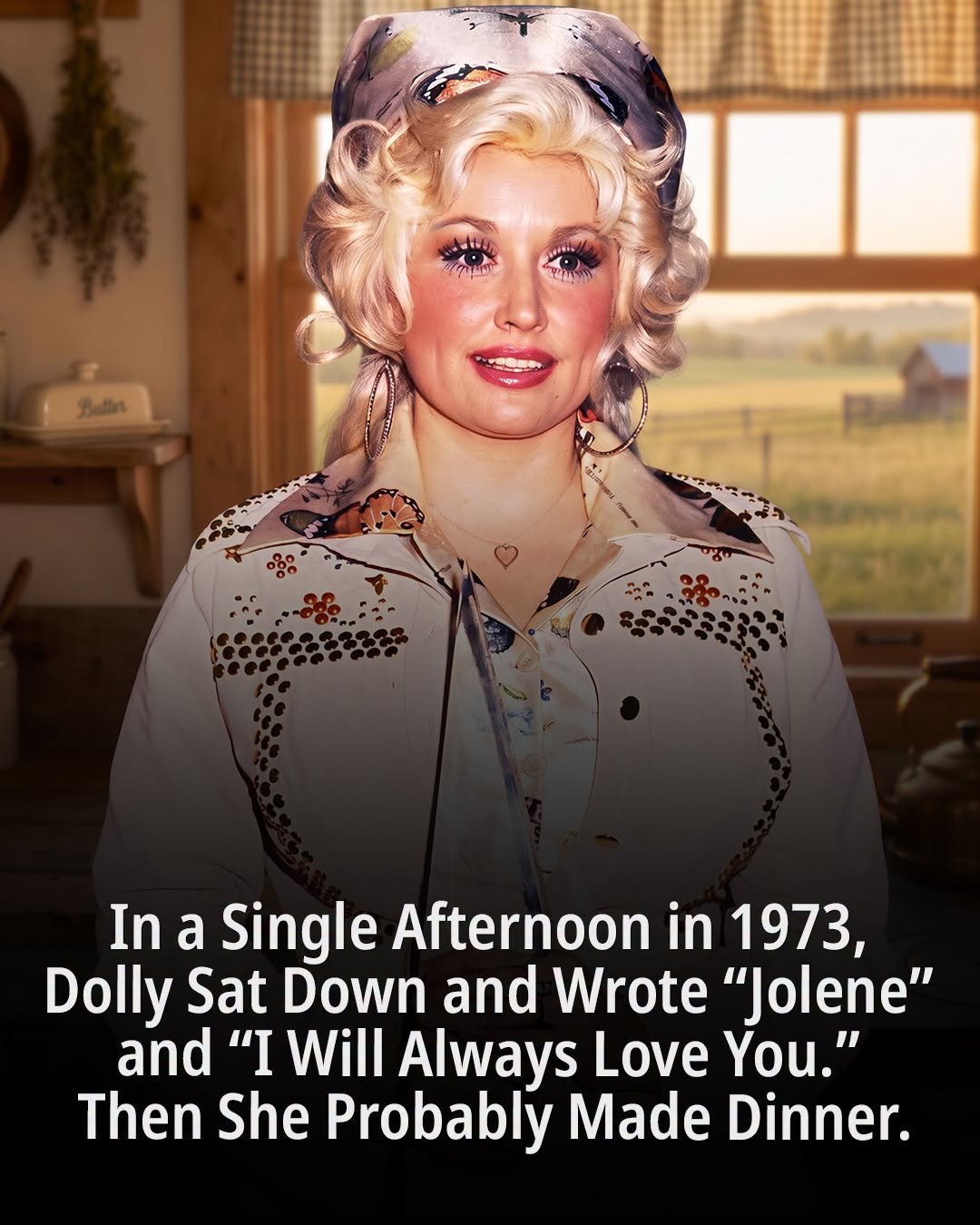
Dolly Parton Wrote “Jolene” and “I Will Always Love You” in the Same Creative Burst
Few songwriters have ever produced two compositions as enduring as “Jolene” and “I Will Always Love You.” Even more remarkable is Dolly Parton’s long-standing account that the two songs were written during the same creative period in 1973, possibly on the very same day.
The songs could hardly seem more different.
“Jolene” is an urgent plea from a woman worried that another woman could take the man she loves. “I Will Always Love You,” meanwhile, is a tender farewell written as Parton prepared to leave her professional partnership with Porter Wagoner and establish herself as a solo artist.
Parton has described finding the two songs together on an old cassette tape when her recordings were being transferred to digital storage. Because they appeared back-to-back, she said they could very well have been written on the same day.
That possibility has become one of the most fascinating stories in country music history.
Two Songs With Completely Different Stories
At first glance, “Jolene” and “I Will Always Love You” appear to tell completely different stories.
One is about protecting a relationship.
The other is about accepting that a relationship—in this case, a professional one—has reached its natural ending.
Yet both songs came from deeply personal circumstances in Parton’s life.
“Jolene” drew on an incident involving her husband, Carl Dean, and a red-haired bank employee whom Parton said had been flirting with him. The song transformed that real-life situation into a dramatic story about insecurity, admiration, and the fear of losing someone.
“I Will Always Love You” came from an entirely different kind of emotional conflict. Parton was trying to separate herself professionally from Wagoner after years of working together on The Porter Wagoner Show. She turned her feelings about that difficult decision into a song.
The fact that both songs emerged during the same period makes the story even more extraordinary.
The Story Behind “Jolene”
The inspiration for “Jolene” is one of the most frequently discussed stories in Parton’s songwriting history.
Parton has explained that the song’s origins involved two separate real-life moments that eventually came together.
One supplied the name.
The other supplied much of the story.
While Parton was performing with Wagoner, a young red-haired girl approached her and asked for an autograph. The girl gave her name as Jolene.
Parton immediately liked the name.
She later explained that she thought it was beautiful and told the girl that if she ever heard a song called “Jolene,” she would know it was about her.
That simple encounter provided the title for what would become one of the most recognizable songs in country music.
A Name Dolly Didn’t Want to Forget
The name stayed with Parton.
According to accounts of the story, she repeated “Jolene” to herself as she made her way back to the bus so she would remember it.
The repetition eventually became part of the song itself.
That is one of the clever details behind the composition: the name is not merely the title. It becomes part of the rhythm and identity of the entire song.
The repeated name immediately establishes the emotional urgency of the narrator.
It sounds almost like a plea before the listener even knows the full story.
And the story Parton eventually created around the name came from something much closer to home.
The Red-Haired Bank Teller
Parton has said that “Jolene” was loosely based on an incident involving Carl Dean and a bank employee.
According to her recollection, the woman was attractive, red-haired, and flirtatious toward Dean.
Parton has described the situation with humor over the years, explaining that Dean enjoyed the attention he received at the bank.
Rather than turning the experience into a private argument, Parton transformed it into songwriting material.
She created the character of Jolene: a beautiful woman whom the narrator fears could take away the man she loves.
The song therefore takes a small piece of real life and turns it into a much larger emotional story.
“Jolene” Was More Than a Jealousy Song
It would be easy to describe “Jolene” simply as a song about jealousy.
But Parton’s writing makes it more complicated.
The narrator is afraid.
She feels vulnerable.
Yet she also openly admires the woman she sees as a potential rival.
That combination gives the song its emotional complexity.
The narrator isn’t simply insulting Jolene. Instead, she acknowledges Jolene’s beauty and appeal while admitting that she feels unable to compete.
That vulnerability is part of what has allowed the song to remain relatable for generations.
The situation is specific, but the emotion is universal: the fear that someone else might be able to take away the person you love.
“I Will Always Love You” Had a Different Meaning
While “Jolene” was inspired by concerns within Parton’s marriage, “I Will Always Love You” was not originally a romantic breakup song.
Its original purpose was professional.
Parton had spent years working alongside Porter Wagoner, who had played an important role in launching her career.
But she eventually decided that she needed to leave the partnership and pursue her own path.
The decision was emotionally difficult because their professional relationship had also developed into a close personal bond.
Rather than simply telling Wagoner she was leaving, Parton wrote a song to express what she felt.
The result became “I Will Always Love You.”
Dolly’s Emotional Goodbye to Porter Wagoner
Parton’s relationship with Wagoner was complicated.
He had helped introduce her to a national audience and had given her a major professional opportunity.
But Parton increasingly wanted to establish herself independently.
According to her later recollections, Wagoner was not initially receptive to what she was trying to tell him.
Parton decided that writing would allow her to communicate what she was feeling more effectively.
She wrote the song as a farewell—not because she had stopped caring about Wagoner, but because she needed to move forward.
That distinction became central to the song’s emotional power.
The Song Made Porter Cry
After writing “I Will Always Love You,” Parton sang it to Wagoner in his office.
His reaction was deeply emotional.
Parton has recalled that Wagoner cried while she sang the song, recognizing how much feeling had gone into it.
He eventually agreed to let her pursue her solo career and asked to be involved with the recording.
Parton’s farewell had therefore accomplished something that a conventional conversation might not have been able to do.
The song communicated both gratitude and independence.
She was leaving, but she wasn’t erasing everything they had accomplished together.
A Song About Leaving Without Anger
That is one reason “I Will Always Love You” has endured.
It is not fundamentally an angry goodbye.
Instead, it expresses affection while accepting separation.
Parton was able to say, in effect, that a relationship could end without the love or respect disappearing.
That idea eventually made the song much bigger than its original circumstances.
Although it was written for Wagoner, listeners could later interpret it through their own experiences with relationships, family, friendship, career changes, and other forms of separation.
The Same Day? Dolly Has Said It Was Possible
The fascinating connection between the two songs comes from Parton’s own recollection.
She has said that when old recordings were being transferred to hard drives, she discovered that “I Will Always Love You” and “Jolene” were on the same cassette tape, one after the other.
Because of that, she believed it was possible that she had written both during the same songwriting session.
In an interview, Parton described it as a particularly productive writing day.
There is an important distinction here: the exact timing should be described as Parton’s recollection that they may have been written on the same day, rather than as an independently documented fact.
That makes the story no less remarkable.
One Creative Session, Two Music Classics
Imagine the contrast.
Parton was working on a song about a woman she feared might take her husband.
Then she was writing another song about leaving a major professional partnership.
The emotional directions could not have been more different.
One song asks someone not to take a loved one.
The other accepts the need to walk away.
Yet both came from the same songwriter, during the same extraordinary period of creativity.
That is perhaps the clearest demonstration of Parton’s versatility as a songwriter.
She could take very different emotions and turn both into songs that felt completely authentic.
“Jolene” Became a Country Classic
“Jolene” was released as a single in 1973 and became one of Parton’s signature recordings.
It reached No. 1 on the U.S. country chart and eventually became one of the most frequently covered songs in her catalog.
Over the decades, musicians from very different backgrounds have recorded their own versions.
The song’s basic story is simple enough to understand immediately, but its emotional tension gives performers plenty of room to interpret it.
That flexibility helped “Jolene” move beyond its original country audience.
It became part of the broader American songwriting tradition.
“I Will Always Love You” Took an Unexpected Journey
The story of “I Will Always Love You” became even larger.
Parton’s original recording was a successful country song, and she later recorded the song again.
But the composition reached an entirely different level of international recognition when Whitney Houston recorded her version for the 1992 film The Bodyguard.
Houston’s recording became a global phenomenon and introduced Parton’s songwriting to millions of listeners who may never have heard the original country recording.
The success also demonstrated the extraordinary strength of Parton’s underlying composition.
The song could be transformed from a restrained country farewell into a huge pop and soul performance without losing its emotional core.
Dolly’s Songwriting Was Always Personal
Parton’s greatest songs frequently began with something personal.
She wrote about family, poverty, relationships, ambition, faith, loneliness, work, and independence.
But she had a remarkable ability to take a specific experience and make it universal.
“Jolene” began with a particular woman at a bank and a memorable name from a young fan.
“I Will Always Love You” began with the difficult decision to leave a professional partnership.
Neither story would seem destined to become an international standard.
Parton’s songwriting transformed them.
The Emotional Connection Between the Two Songs
Although the stories differ, there is an interesting emotional connection between them.
Both songs are about love and uncertainty.
“Jolene” asks: What happens if the person I love chooses someone else?
“I Will Always Love You” asks: What happens when I have to leave someone I still care about?
One is about holding on.
The other is about letting go.
And both are emotionally honest.
Parton does not try to make either situation more complicated than necessary. She takes a powerful feeling and gives it a melody that listeners can remember immediately.
Dolly Parton’s Ability to Turn Life Into Music
Parton’s greatest strength as a songwriter may have been her ability to notice small moments.
A name from a little girl became “Jolene.”
A flirtatious interaction at a bank became the basis for a story about romantic insecurity.
A painful professional decision became “I Will Always Love You.”
These were not necessarily enormous events when they happened.
But Parton understood that everyday experiences can contain powerful emotions.
Her songwriting turned those emotions into stories that could survive for decades.
Why the “Same Day” Story Matters
The idea that “Jolene” and “I Will Always Love You” might have been written on the same day has become part of Parton’s songwriting mythology for a good reason.
Both songs are now regarded as defining pieces of her catalog.
“Jolene” became one of country music’s most recognizable songs.
“I Will Always Love You” became one of the most successful compositions of the modern era, especially after Houston’s version.
Yet Parton apparently did not need weeks of separate inspiration to create them.
She may have produced both during one concentrated burst of creativity.
As Parton herself has suggested, it was simply a very good writing day.
Two Songs That Defined Different Sides of Dolly
“Jolene” showed Parton’s ability to create a dramatic character and tell a story from the perspective of someone emotionally exposed.
“I Will Always Love You” showed her ability to express restraint, tenderness, gratitude, and independence.
Together, they represent two different sides of the same songwriter.
One is conversational and urgent.
The other is gentle and reflective.
One asks for mercy.
The other offers a blessing as someone walks away.
Both are unmistakably Dolly Parton.
A Legacy That Continues Beyond Country Music
Parton’s influence has never been confined to country music.
Her songs have been interpreted by performers working in pop, rock, bluegrass, gospel, R&B, and other genres.
That broad appeal is one of the reasons her songwriting legacy remains so significant.
The songs do not depend entirely on the original recordings.
Their stories and melodies are strong enough to be reinterpreted.
That is particularly true of “Jolene” and “I Will Always Love You.”
Both compositions have outgrown the circumstances that inspired them.
Final Thoughts
The story of “Jolene” and “I Will Always Love You” offers an extraordinary glimpse into Dolly Parton’s creative process.
According to Parton’s own recollection, the two songs may have been written on the same day in 1973, after she later found the recordings together on an old cassette.
The songs themselves came from very different emotional places.
“Jolene” was inspired in part by a real-life situation involving Carl Dean and a red-haired bank teller, while the name came from a young girl who asked Parton for an autograph.
“I Will Always Love You,” meanwhile, was written as Parton’s emotional farewell to Porter Wagoner as she prepared to pursue her own career. She sang it to him personally, and his emotional response helped confirm just how powerful the song was.
One song was about the fear of losing someone.
The other was about finding the courage to leave.
And yet both emerged from the pen of the same songwriter during one remarkable period of creativity.
That is what makes the story so enduring. Dolly Parton didn’t simply write two famous songs. She demonstrated how two completely different human experiences—holding on and letting go—could become timeless music.