News
Guess Who This Boy Became: The Circulated Photos Point to Jean-Claude Van Damme
Guess Who This Boy Became: The Circulated Photos Point to Jean-Claude Van Damme

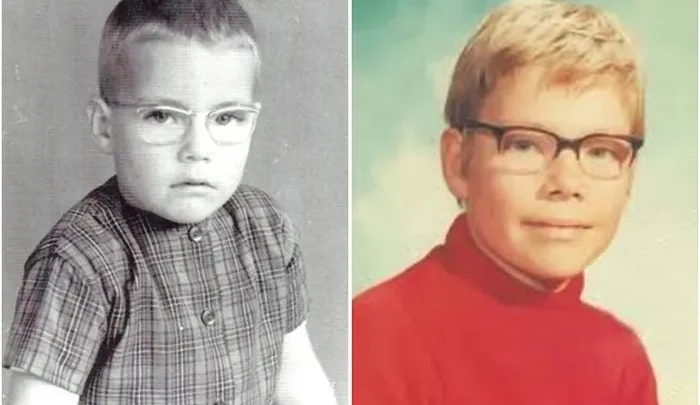
This Shy Boy in Glasses Grew Up to Become a Hollywood Action Legend — Can You Recognize Him?
Imagine looking through an old family photo album and finding a picture of a young boy wearing oversized glasses, a neatly buttoned shirt, and an expression that suggests he would rather be somewhere else than posing for a camera.
Nothing about the picture immediately suggests a future Hollywood superstar.
There are no bulging muscles, no dramatic fighting poses, and certainly no indication that this seemingly ordinary child would one day become famous for some of the most spectacular martial arts moves ever captured on film.
Yet that is exactly the transformation behind a fascinating celebrity story that has attracted attention online.
Two childhood portraits have circulated alongside a familiar question: Can you recognize this little boy before he became famous?
One image shows a child in a plaid shirt and glasses. Another shows a slightly older boy wearing a red turtleneck.
The photographs are presented online as childhood images of the same future celebrity, although their original archival provenance has not been independently established.
According to the circulated story, the mysterious boy grew up to become Jean-Claude Van Damme, the Belgian martial artist and actor whose impressive kicks, remarkable flexibility, and unforgettable action movies made him an international star.
But the most interesting part of his journey is not simply the difference between his childhood appearance and his adult image.
It is the extraordinary combination of discipline, determination, physical training, setbacks, and ambition that helped transform a shy young boy into one of Hollywood’s most recognizable action performers.
And one unexpected ingredient in that transformation was ballet.
The Surprising Identity Behind the Childhood Photos
The name Jean-Claude Van Damme immediately brings to mind intense action sequences, athletic movements, and some of the most memorable martial arts films of the late 1980s and 1990s.
For millions of movie fans, he represents a particular era of Hollywood entertainment, when action stars often performed elaborate physical sequences that became central to their screen identities.
But before the fame, Van Damme was Jean-Claude Camille François Van Varenberg, a boy growing up in the Brussels area of Belgium.
He was born on October 18, 1960, in Berchem-Sainte-Agathe, a municipality within the Brussels-Capital Region.
His parents were Eliana and Eugène Van Varenberg.
His father worked as an accountant and florist, and his family lived a life far removed from the glamorous world of international movie premieres.
Published accounts of his childhood describe a slender, shy, and relatively quiet boy.
That description creates a striking contrast with the confident action hero audiences would later see on movie screens.
The childhood photographs circulating online appear consistent with the general descriptions of his early appearance, particularly the glasses.
However, because the original source and dating of the specific images are not firmly documented here, they should be treated as photographs attributed to Van Damme rather than independently authenticated childhood records.
The broader story of his transformation, fortunately, is supported by a substantial public biographical record.
Growing Up in Belgium Before the Hollywood Dream
Jean-Claude Van Damme’s early life unfolded in Brussels, a city known for its historic architecture, multilingual culture, and rich artistic traditions.
Long before he became associated with American action cinema, his daily surroundings were European neighborhoods, schools, local businesses, and sports facilities.
There was no guarantee that he would become an actor.
In fact, as a child, his future appeared far more ordinary.
Accounts of his upbringing frequently emphasize that he was physically slight and lacked the powerful appearance he would later develop.
He was also interested in artistic activities, including drawing.
These details are important because they challenge the idea that famous athletes and action stars always display extraordinary physical dominance from an early age.
Some develop their abilities gradually through years of training.
Others discover a sport or discipline that fundamentally changes their confidence.
For Van Damme, martial arts would become that defining influence.
His father’s decision to introduce him to karate was a crucial moment in his childhood.
What initially began as a way to encourage physical development and discipline gradually became the foundation of an entirely different future.
The young boy who entered a karate school could not have known that the skills he was about to learn would eventually take him across the Atlantic Ocean and onto movie screens around the world.
Why His Father Introduced Him to Karate
The most important early training in Van Damme’s life was karate, not ballet.
Biographical sources differ slightly about his exact age when he began.
Some place his introduction to martial arts at ten, while others say eleven. Accounts involving his instructor Claude Goetz also refer to the period around his early adolescence.
Despite these minor differences, the central story remains consistent.
His father wanted him to become stronger and more physically confident.
He introduced the boy to formal martial arts instruction, where Van Damme began learning karate.
The discipline required far more than simply memorizing punches and kicks.
Students were expected to develop coordination, balance, concentration, patience, and respect for the training process.
Progress depended on repetition and effort.
For a naturally slender child, those challenges could be demanding.
Yet Van Damme gradually embraced the discipline.
He became deeply interested in improving his abilities and developing greater physical control.
The experience also introduced him to a structured environment in which progress could be measured through practice.
His early karate training would eventually influence almost every stage of his professional life.
It helped shape not only his athletic abilities but also his approach to performing physical action on screen.
Meeting Claude Goetz: The Teacher Who Helped Shape His Future
One of the most important figures in Van Damme’s early development was Belgian martial arts instructor Claude Goetz.
Goetz trained the young Van Damme during the period when karate became central to his life.
His guidance contributed to the development of the techniques, physical discipline, and athletic confidence that Van Damme would later demonstrate in competition and film.
A retrospective profile published by The Bulletin discussed Van Damme’s early years and included recollections from people who knew him during his youth.
Those accounts describe a boy whose physical appearance was very different from the muscular athlete he later became.
That contrast is precisely what makes the childhood story so compelling.
Goetz did not simply encounter a fully formed champion.
He worked with a developing student whose eventual success required considerable effort.
Training involved learning techniques, building strength, improving speed, and developing control.
As Van Damme grew older, those abilities became increasingly important.
He was not simply becoming stronger.
He was learning how to use his body with precision, an ability that would later distinguish his film performances.
From a Skinny Child to a Dedicated Martial Artist
Van Damme’s progress was the result of sustained commitment rather than an overnight transformation.
As he continued training, he became increasingly interested in the technical and competitive aspects of martial arts.
His practice expanded into more demanding physical exercises.
He developed greater flexibility, improved his kicking techniques, and pursued strength training to complement his karate skills.
This combination of abilities became central to his athletic identity.
A powerful kick requires more than muscular strength.
It also depends on stability, timing, coordination, and control.
Likewise, executing complicated movements repeatedly demands both physical conditioning and mental concentration.
Van Damme’s training encouraged him to develop these qualities together.
Over time, his appearance changed as well.
The thin boy described in early accounts gradually developed a stronger, more athletic physique.
Yet the transformation was not simply cosmetic.
His growing confidence came from learning difficult skills and repeatedly testing his abilities.
This period established the physical foundation that audiences would later associate with his action movies.
The famous screen performer was still years away, but the essential preparation had already begun.
The Unexpected Role Ballet Played in His Transformation
Perhaps the most surprising element of Jean-Claude Van Damme’s early training was his interest in classical ballet.
Many people associate ballet primarily with theater, music, and artistic performance.
They do not immediately connect it with high-impact action films or martial arts competition.
However, ballet requires exceptional physical discipline.
Dancers develop balance, coordination, flexibility, spatial awareness, and precise control over their movements.
Those qualities can also be valuable in athletic activities that involve complex movement.
Van Damme began studying ballet when he was approximately sixteen years old.
He continued for about five years, according to widely cited biographies.
That means ballet came after his introduction to karate, rather than serving as his first major childhood training discipline.
This distinction matters because viral celebrity stories sometimes rearrange events to make a transformation appear simpler or more dramatic.
The documented timeline presents a more interesting reality.
Van Damme was already seriously involved in martial arts when he expanded his training through dance.
Instead of replacing karate, ballet became another discipline that contributed to his broader physical development.
Why Ballet and Martial Arts Worked Together
At first glance, karate and ballet may seem like unrelated activities.
One is often associated with self-defense and competition.
The other is commonly associated with choreography and theatrical performance.
Yet the two disciplines share important physical demands.
Both require practitioners to understand body alignment, controlled movement, balance, and the relationship between strength and flexibility.
Both also demand long periods of technical practice.
Van Damme’s later screen performances frequently demonstrated impressive leg extensions, controlled kicks, and unusual flexibility.
His ballet background is often discussed as one influence on those abilities.
It is important not to claim that ballet alone created his famous fighting style.
Years of martial arts practice, stretching, conditioning, and performance experience also contributed to his physical abilities.
The more accurate explanation is that Van Damme developed a combination of skills drawn from several demanding disciplines.
That combination helped give his action sequences a distinctive appearance.
His kicks often looked carefully controlled rather than merely forceful.
His movements emphasized extension and athletic presentation, qualities that became recognizable parts of his screen persona.
The Ballet Teacher Who Remembered His Talent
The story of Van Damme’s ballet training includes another interesting figure: dance teacher Monette Loza.
In The Bulletin’s retrospective account of Van Damme’s early life, Loza recalled his time studying ballet.
According to the profile, he became interested in her classes during his teenage years.
The account describes a connection through the family flower business, where Loza was a customer.
Van Damme subsequently studied at her school.
She remembered his unusual flexibility and dedication.
The training continued for approximately five years, an impressive commitment for someone already deeply involved in martial arts.
Her recollections help explain why ballet should be considered a serious part of his development rather than a brief curiosity.
Although Van Damme ultimately pursued martial arts and acting, the years spent studying classical dance added another dimension to his athletic education.
The story also challenges stereotypes about what an aspiring action star should study.
Training that appears unrelated to a future profession can sometimes contribute valuable skills.
For Van Damme, ballet became part of the preparation behind a distinctive Hollywood career.
Building the Muscular Physique That Became His Trademark
Martial arts and ballet were not Van Damme’s only physical interests.
He also pursued weight training and bodybuilding.
As a teenager, he recognized the importance of developing greater physical strength.
His naturally slender build made that goal particularly meaningful.
Strength training allowed him to develop muscle while continuing to work on his athletic movement.
Published biographies describe his participation in bodybuilding and refer to a Mr. Belgium title in 1978.
Accounts of his competitive record vary in detail, so individual achievements should be checked carefully rather than treated as interchangeable.
What is clear is that physical conditioning became an important part of his teenage development.
By combining strength training with martial arts and ballet, he developed an unusually broad athletic background.
The results eventually became one of his most recognizable professional characteristics.
His muscular appearance helped distinguish him visually in action films.
But the ability to combine that appearance with speed, flexibility, and precise movements made his performances especially memorable.
His later nickname, “The Muscles from Brussels,” captured both his physical image and his Belgian origins.
Competing in Martial Arts Before Becoming an Actor
Before achieving Hollywood fame, Van Damme participated in martial arts competitions.
His competitive experience became another significant chapter in his development.
Facing opponents requires a different kind of preparation from practicing techniques in a training environment.
A competitor must react to movement, manage pressure, maintain concentration, and make decisions quickly.
Van Damme’s karate background gave him experience with these demands.
His biographies describe competition during his teenage years and participation in Belgian martial arts circles.
There are disagreements among published accounts about some of his exact titles and competitive results, making it important to avoid exaggerated claims.
Nevertheless, his sustained involvement in martial arts is well established.
That experience later contributed to the credibility of his screen performances.
Audiences watching a Van Damme film were seeing an actor with substantial physical training, rather than someone whose martial arts experience existed only within movie choreography.
Of course, film fighting and real competition are different activities.
Movie action is designed for visual storytelling and requires careful coordination with performers and production teams.
Van Damme’s competitive background provided useful foundations, while his later work developed those foundations into a recognizable cinematic style.
The Young Belgian Athlete Who Dreamed of Hollywood
By his late teenage years, Van Damme had developed ambitions beyond local sporting success.
He wanted to become an international movie star.
That dream was enormous for a young man growing up in Belgium.
Hollywood was thousands of miles away, and entering the American film industry presented considerable challenges.
He would have to navigate a new professional environment, communicate across cultural differences, and compete for opportunities in an industry filled with ambitious performers.
There was no guarantee that martial arts talent alone would lead to film roles.
In fact, many physically gifted athletes never become successful actors.
Van Damme needed to find a way to transform his skills into an appealing screen presence.
He was inspired by the possibilities of action cinema and the success of performers who combined physical abilities with entertainment.
The dream gradually became more than a passing fantasy.
It shaped his decisions and encouraged him to pursue opportunities outside Belgium.
Leaving behind familiar surroundings would require significant determination.
Yet he believed his unusual combination of martial arts abilities, physical conditioning, and performance style could find a place in American movies.
The Difficult Journey From Brussels to America
Van Damme’s transition to the United States was far from effortless.
Accounts of his early Hollywood years describe limited financial resources, uncertain employment, and the challenge of finding meaningful opportunities.
He was entering an industry where connections, auditions, timing, and persistence could matter as much as talent.
Early biographical profiles describe a period of work in ordinary jobs while he pursued his acting ambitions.
The details of the exact sequence vary among accounts.
What remains consistent is that he did not immediately arrive in Hollywood as a successful leading man.
His athletic background could attract attention, but he still needed a major role that would introduce him to a wider audience.
This part of his story is important because celebrity biographies often skip over the uncertain years between preparation and recognition.
Looking backward, his eventual success can appear inevitable.
At the time, however, his future was far from certain.
The young Belgian martial artist had spent years developing his abilities, but he still needed a breakthrough.
His determination would soon bring him closer to the role that changed his career.
Bloodsport: The Movie That Changed Everything
In 1988, Jean-Claude Van Damme achieved a major breakthrough with the martial arts film Bloodsport.
The movie introduced him to a much larger international audience.
His performance showcased the physical abilities he had spent years developing.
Viewers saw powerful kicks, impressive flexibility, athletic movement, and a distinctive screen presence.
The film provided an effective platform for demonstrating his strengths as an action performer.
For audiences interested in martial arts cinema, Van Damme offered something visually memorable.
His combination of strength and flexibility made his fighting sequences stand out.
The success of Bloodsport helped establish him as a recognizable leading actor in the action genre.
It also created opportunities for additional film projects.
This was a defining moment in the story of the once-shy boy from Brussels.
Years of karate, conditioning, ballet, and competitive training had helped prepare him for the physical demands of action cinema.
But it took a successful film to transform that preparation into international recognition.
Bloodsport became the breakthrough that brought his name to movie audiences around the world.
The Action Movies That Made Jean-Claude Van Damme Famous
Following Bloodsport, Van Damme appeared in a series of films that strengthened his reputation as an action star.
Among his best-known movies are Kickboxer (1989), Lionheart (1990), Double Impact (1991), Universal Soldier (1992), Hard Target (1993), and Timecop (1994).
These films contributed to his position among the recognizable action performers of the era.
Each offered opportunities to showcase different aspects of his physical style and screen personality.
Kickboxer reinforced his association with martial arts-centered storytelling.
Double Impact gave him an opportunity to portray twin characters, demonstrating a different dimension of his acting persona.
Universal Soldier brought his physical presence into a science-fiction action setting.
Timecop became another notable entry in his film career.
Together, these projects created a recognizable body of work.
For many fans, Van Damme’s movies are closely associated with the entertainment style of the late 1980s and 1990s.
His physical performance was a central part of their appeal.
Yet behind those dramatic screen moments stood years of training that had begun in a Belgian karate school.
The Famous Kicks and Splits That Defined His Screen Image
Few action stars are associated with flexibility as strongly as Jean-Claude Van Damme.
His high kicks, extended leg movements, and dramatic splits became signature features of his performances.
These movements were visually impressive because they combined athletic strength with an unusual range of motion.
They also made his fighting style instantly recognizable.
His flexibility was not simply a natural gift displayed without effort.
It was supported by years of physical training.
Karate encouraged controlled kicking techniques.
Ballet introduced another demanding form of movement education.
Conditioning helped him develop the strength required to perform athletic movements repeatedly.
Together, these disciplines contributed to the screen style that audiences came to expect.
For a young viewer discovering Van Damme’s movies for the first time, the movements might look almost impossible.
But the long training history behind them demonstrates the difference between a spectacular result and the preparation required to achieve it.
The finished film shows only the performance.
It rarely reveals the countless hours spent practicing techniques, improving balance, and developing physical control.
Why His Childhood Transformation Still Fascinates Fans
Celebrity childhood photographs attract attention because they reveal a version of a famous person that audiences rarely see.
People become familiar with actors after they have developed recognizable professional identities.
Those identities often involve carefully selected appearances, hairstyles, costumes, and public images.
A childhood photograph interrupts that familiarity.
It reminds viewers that even internationally recognized celebrities were once ordinary children.
In Van Damme’s case, the contrast is particularly striking.
The boy described in biographical accounts was shy, slender, and associated with glasses.
The adult performer became famous for muscular strength, confidence, and spectacular athletic movements.
That dramatic difference makes the story immediately interesting.
But the transformation becomes more meaningful when readers understand the work that occurred between those two stages.
It was not simply a matter of growing older.
Van Damme pursued multiple demanding forms of training, developed ambitions beyond his home country, and worked toward a career in an exceptionally competitive industry.
The childhood comparison attracts attention.
The years of preparation explain why the story is worth remembering.
What Viral Celebrity Posts Sometimes Get Wrong
Online celebrity stories often simplify complicated biographies.
A short social media post may describe an unusual childhood detail, add a dramatic transformation, and end with a famous name.
This format can be entertaining, but it sometimes creates misleading impressions.
The story about Van Damme’s ballet training is a useful example.
Ballet was genuinely part of his development.
However, some circulated versions suggest that it was the original foundation of his childhood training.
The better-supported chronology places karate first.
Van Damme began martial arts around the age of ten or eleven and took up ballet later, at approximately sixteen.
That correction does not make his story less impressive.
In fact, it makes his development more interesting by showing how several disciplines contributed at different stages.
The authenticity of the specific circulated childhood photographs is another separate question.
A photograph appearing alongside a biographical article does not automatically establish its original source.
Readers should distinguish between a documented biography and images whose provenance has not been independently confirmed.
Accuracy matters even in entertaining celebrity stories.
What His Story Teaches About Confidence and Personal Growth
Van Damme’s early life offers a broader illustration of how people can change through sustained effort.
The difference between his childhood appearance and adult image may be visually dramatic, but the more important change involved skill development.
He learned techniques that initially challenged him.
He built greater physical strength.
He explored disciplines that required different forms of coordination.
He developed competitive experience and eventually pursued an ambitious professional goal.
These developments happened over years rather than weeks.
That timeline is worth remembering because dramatic transformations are often presented as sudden events.
In reality, meaningful improvement frequently comes from repeated effort, changing interests, access to teachers, and opportunities that arise over time.
Of course, one celebrity’s experience should not be treated as a universal formula for success.
Not everyone who studies martial arts will become an actor, and not every ambitious young person will achieve international fame.
Still, Van Damme’s story demonstrates the possibilities that can emerge when someone develops several complementary abilities.
The result was a career that few could have predicted from his childhood appearance alone.
The Enduring Appeal of the Muscles From Brussels
Jean-Claude Van Damme’s reputation has remained closely tied to the distinctive physical style that brought him international recognition.
His films belong to an era of action entertainment that many viewers continue to revisit.
For longtime fans, his performances evoke memories of classic martial arts movies and the stars who helped define the genre.
For younger audiences, his career provides an introduction to a different generation of action cinema.
His nickname, “The Muscles from Brussels,” remains a memorable reference to his origins and public image.
Yet the childhood story reminds us that the nickname describes only the outcome of a much longer journey.
Before Hollywood, there was Brussels.
Before the famous muscles, there was a slender young boy.
Before the spectacular film kicks, there were years of karate practice, conditioning, and ballet training.
And before international recognition, there was an ambitious athlete trying to build a future beyond his home country.
Those earlier chapters make his professional achievements more meaningful.
They reveal the preparation behind an image that audiences might otherwise take for granted.
Frequently Asked Questions About Jean-Claude Van Damme
Who is the boy in glasses in the viral childhood photographs?
The circulated article identifies the child as Jean-Claude Van Damme, the Belgian martial artist and Hollywood actor. However, the original provenance of the specific circulated photographs has not been independently established here.
What is Jean-Claude Van Damme’s real name?
His birth name is Jean-Claude Camille François Van Varenberg.
He later became internationally known by his professional name, Jean-Claude Van Damme.
When and where was Jean-Claude Van Damme born?
He was born on October 18, 1960, in Berchem-Sainte-Agathe, in the Brussels area of Belgium.
Did Jean-Claude Van Damme really study ballet?
Yes. Ballet was a genuine part of his training.
Biographical sources generally place the beginning of his ballet studies at approximately sixteen years old and describe a period of about five years of training.
Did Van Damme learn ballet before karate?
No. His martial arts training came first.
He began karate around age ten or eleven, while ballet became part of his training during his teenage years.
Who was Jean-Claude Van Damme’s karate instructor?
Claude Goetz was an important instructor during Van Damme’s early martial arts development in Belgium.
What movie made Jean-Claude Van Damme famous?
The 1988 martial arts film Bloodsport was his major breakthrough as a leading actor.
It helped introduce his distinctive physical abilities to international audiences.
Why is Jean-Claude Van Damme called the Muscles from Brussels?
The nickname connects his muscular appearance and action-star identity with his origins in the Brussels area of Belgium.
What are his most famous films?
Some of his best-known movies include Bloodsport, Kickboxer, Lionheart, Double Impact, Universal Soldier, Hard Target, and Timecop.
How did Van Damme become so flexible?
His flexibility developed through extensive physical training, including martial arts practice, stretching, conditioning, and ballet.
It would be inaccurate to attribute all of his flexibility to any single discipline.
Final Thoughts: From a Shy Belgian Boy to an International Action Star
The story of Jean-Claude Van Damme is far more interesting than a simple childhood guessing game.
At first, the idea of a young boy in glasses growing up to become a famous Hollywood action hero may seem like an entertaining celebrity surprise.
But the real fascination lies in everything that happened between childhood and fame.
Born in Belgium in 1960, Van Damme grew up far removed from the American film industry.
He began karate as a young boy, developed his abilities under demanding instruction, pursued strength training, and later added classical ballet to his athletic education.
His progress required years of dedication.
As he grew older, he developed the ambition to become a movie star and eventually pursued opportunities in the United States.
His major breakthrough arrived with Bloodsport in 1988, followed by a series of action films that established him as a recognizable international performer.
The dramatic kicks, muscular appearance, and extraordinary flexibility that made him famous were not disconnected from his childhood.
They were the visible results of a long period of physical development and professional ambition.
The widely circulated childhood photographs may attract readers through curiosity, but the documented biography offers the more lasting story.
The shy boy from Brussels became Jean-Claude Van Damme not through a single magical transformation, but through years of training, ambition, and persistence.
And that is what makes the journey from a Belgian karate school to Hollywood screens remarkable.
Behind one of action cinema’s most familiar faces was once a child whose future was anything but obvious.