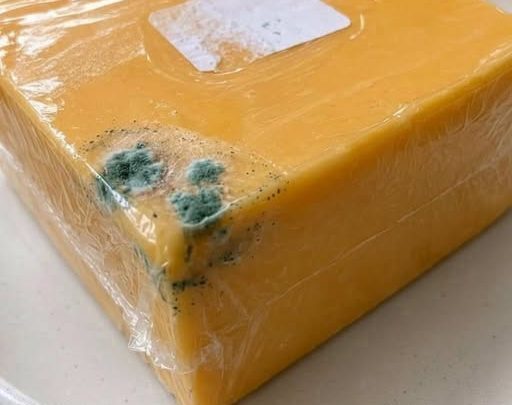

You open the fridge, reach for a block of cheddar, and spot a little green patch. Does mold on cheddar mean the whole thing belongs in the bin? The answer starts with the form of the cheese—not just its name or the color of the spot.
A whole hard block with a small moldy area is different from shredded cheddar, sliced cheese, or a soft cheese. The USDA’s mold guidance allows a generous cut around an affected area on hard cheese, but says to discard moldy shredded, crumbled, or sliced cheese and unexpectedly moldy soft cheese.
Before you reach for a knife, check which category you actually have. A quick scrape is not the rule, and tasting a questionable bit is not a safety test. Here is the useful distinction in plain kitchen language.

Mold on Cheddar: Whole Block or Something Else?
If you have a firm, whole block of hard cheese with a small affected area, it may be possible to remove that area according to the USDA’s instructions.
The dense structure helps limit how far mold spreads compared with softer foods.
That does not mean every product labeled cheddar can be rescued the same way. A bag of shreds, a stack of slices, and a whole block are different situations even if they began with the same variety.
Look at the product in front of you, not the one you remember buying last week. If you cannot confidently classify it, or cannot leave the required margin, discarding it is the safer choice.

The Hard-Cheese Rule Is at Least One Inch
For suitable hard cheese, the USDA says to cut off at least one inch around and below the mold spot. That is about 2.5 centimeters. The margin applies in every direction around the affected area and down beneath it.
Use a clean knife and keep it out of the mold itself so it does not contaminate other parts of the cheese. Remove the affected portion with the required surrounding margin rather than shaving off only what looks discolored.
After trimming, re-cover the remaining cheese in fresh wrapping. Do not put it straight back into the same contaminated packaging. This approach applies to the appropriate hard-cheese situation; it is not a general rescue method for every food with a fuzzy patch.

“Around and Below” Is Not Just a Thin Slice
A spot can look shallow while growth extends beyond the area you can see. That is why the instruction includes a generous margin rather than merely scraping the surface until it looks tidy.
Picture the affected patch as the center of a larger area you are removing.
You need room on the sides and underneath. If the block is too small to do that, the rule is not an invitation to reduce the margin until something remains.
Do not take the neat appearance of the trimmed edge as permission to ignore the measurement. The point is to follow the food-safety instruction, not to make the cheese look presentable while saving the largest possible portion.
Shredded, Sliced, or Crumbled Cheese: Discard It
Mold in shredded cheddar is not the same as a small patch on an intact block. The USDA advises discarding cheeses that are shredded, crumbled, or sliced when mold appears. Contamination can spread through the product and during handling.
Picking out the visibly green shreds does not reliably remove the problem. Neither does lifting out one affected slice and assuming the rest of the package is fine.
This is an easy place to make a mistaken shortcut: “Cheddar is hard cheese, so I can save it.”
The missing part is its form. The cut-away guidance is not a license to sort through a moldy bag of shredded cheese.

Unexpected Mold on Soft Cheese: Also Discard
Soft cheeses such as cream cheese, cottage cheese, and ricotta are another discard situation when unexpected mold appears. Their moisture and structure allow contamination to extend beyond the visible spot.
Scooping a patch from the top of a container does not make the remaining soft cheese reliably safe. Treat the whole affected product as the problem rather than searching for a clean-looking corner to eat.
The source also mentions fresh mozzarella among the soft cheeses needing caution.
If you are uncertain about a particular product, use the manufacturer’s instructions and reliable food-safety guidance rather than guessing based on whether it feels slightly firm when cold.

What About Cheese Made With Mold?
Some cheeses are deliberately produced with selected mold cultures. Blue cheeses and certain surface-ripened cheeses are familiar examples. That intended production process is different from unexpected mold developing on an ordinary product in your fridge.
Do not treat a new green spot on cheddar as homemade blue cheese. You cannot identify the organism or its safety just by deciding that its color looks familiar.
If mold appears where it is not supposed to be on a mold-ripened variety, follow product-specific advice. The rules are not identical for every cheese.
An intentionally mold-made food does not create a blanket exemption for any later growth.
Do Not Sniff Closely or Taste to Decide
Mold color does not tell you which organism is present or whether it produces harmful substances. The source notes that some molds can produce mycotoxins, but a consumer cannot establish that simply by looking at a green or blue patch.
Do not sniff a moldy product to test it. The USDA warns that sniffing can cause respiratory trouble. Do not taste a little piece either; a normal taste would not prove the product safe.
A “seems fine to me” check is not a replacement for the hard-versus-soft and whole-versus-shredded distinctions. When there is real uncertainty, you do not owe a questionable piece of food one last experiment.
Make the Next Fridge Visit Less Surprising
Keep cheese refrigerated according to its label and return it promptly after use. Use clean utensils, suitable wrapping, and the storage instructions for the variety rather than leaving cut surfaces exposed.
When you discard moldy food, contain it so children and animals cannot get to it. Check nearby items and clean the area where it was stored. That makes more sense than removing a spoiled package while leaving residue behind.

Buy an amount you are likely to use and keep track of opened packages. Smaller portions may be more practical than repeatedly hoping a large block lasts indefinitely. Good storage reduces avoidable waste; it does not override a later safety decision.
If you are preparing food for someone else, do not ask them to judge a doubtful piece for you. Choose a clearly suitable product instead. Avoiding waste is a good aim, but it should not turn a shared meal into a guessing game about contamination.
The Short Kitchen Answer
For mold on cheddar, ask what form it is in. A suitable hard whole block may be trimmed at least one inch around and below the affected area, keeping the knife away from mold and using fresh wrapping afterward.
Moldy shreds, slices, crumbles, and unexpectedly moldy soft cheeses should be discarded.
Think of the decision as two separate questions: is this the kind and form of cheese covered by the cut-away guidance, and is there enough sound cheese to leave the full margin? Both answers matter. A yes to only the first does not justify a smaller cut, and a large package of shreds does not become a whole block simply because plenty remains. Keeping those questions separate helps avoid a rescue attempt based mainly on how much food you hope to save.
Thanks for checking before taking a bite. This is general food-safety information, not personal medical or professional dietary advice. When the cheese type or safe margin is uncertain, let that questionable piece go and keep your next snack worry-free.