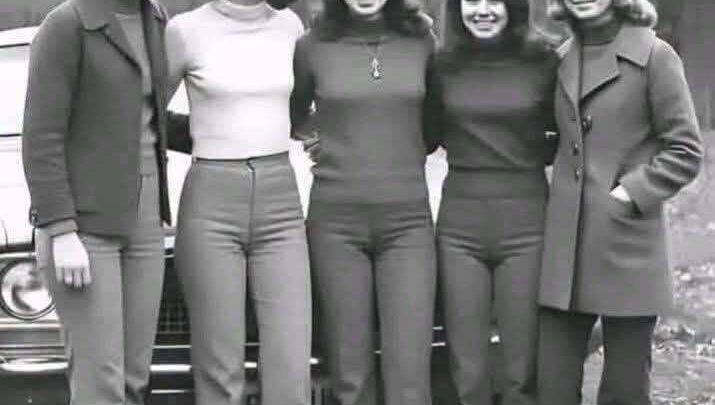
There is something strangely powerful about looking at an ordinary photograph from the 1970s.
At first, you might notice the clothes. The wide-legged trousers. The patterned sweaters. The hairstyles. Perhaps an old family car parked nearby or the unmistakable look of a suburban street.
But then you look again.
And something else begins to stand out.
The people in the photograph seem completely present.
They aren’t looking down at a screen. Nobody appears to be checking a notification, taking a second photograph, or wondering how the moment will look to strangers online. They are simply there—standing beside one another, talking, smiling, waiting, or enjoying an ordinary afternoon.
That is what makes these photographs so fascinating today.
They don’t necessarily show a more perfect world. Life in the 1970s had plenty of challenges, limitations, and difficulties. But these images can reveal something that is easy to overlook in our highly connected age: the experience of being somewhere without simultaneously being somewhere else.
And sometimes, that is what makes an old photograph feel surprisingly modern in its emotional message.
The First Thing People Notice: 1970s Fashion
Look at almost any casual photograph from the decade and clothing immediately becomes part of the story.
High-waisted trousers, flared legs, ribbed sweaters, patterned shirts, denim jackets, long coats, boots, scarves, and carefully styled hair all create a visual signature that is instantly recognizable.
But beyond the nostalgia, there is another interesting detail.
Everyday clothing often appears to have been selected with the expectation that it would be worn repeatedly.
A favorite sweater wasn’t necessarily purchased because it would photograph well on social media. There was no social media.
Instead, clothes were part of a practical wardrobe. People bought things they liked, things they could afford, and things that could work across different occasions.
Some garments were homemade. Others were altered or repaired. Families sometimes passed clothing between siblings or relatives. A good coat could remain part of someone’s wardrobe for years.
That doesn’t mean every garment from the 1970s was exceptionally durable or that people never followed trends. They certainly did.
But fashion moved differently.
Without today’s constant stream of online shopping recommendations, influencer posts, targeted advertisements, and rapidly changing micro-trends, there were fewer opportunities to see a new style every few minutes.
Style could develop gradually.
A person might find a particular combination they liked and continue wearing it for years.
That sense of individual consistency is one reason vintage photographs can feel so distinctive.
Getting Together Required Actually Getting Together
Perhaps the biggest difference between an old photograph and a modern one isn’t clothing at all.
It’s communication.
Imagine making plans with friends in the 1970s.
You might call someone’s house using a landline. If they weren’t home, someone else might answer. You could leave a message with their parent, sibling, or roommate.
Then you waited.
There was no instant messaging.
No location sharing.
No group chat displaying little icons showing who had seen your message.
If you arranged to meet someone at a particular place, you generally had to trust that they would show up.
That uncertainty could be inconvenient.
But it also meant that meeting someone required commitment.
If you told your friends you would meet beside a particular car after school, you couldn’t simply send a message saying, “I’m five minutes away.”
You were either there or you weren’t.
And when everyone finally arrived, the conversation happened face-to-face.
There was no second screen competing for attention.
That doesn’t mean people in the 1970s were magically better conversationalists. They weren’t.
They argued.
They became distracted.
They got bored.
They misunderstood each other.
They had awkward silences.
But boredom itself was part of the experience.
A quiet moment didn’t necessarily need to be filled immediately.
The Telephone Was Connected to a Wall
For younger generations, one of the strangest details of vintage life may be the telephone.
A telephone wasn’t something you carried around.
It lived somewhere in the house.
Many families had a phone mounted on a wall or sitting on a table. Some had long cords that allowed you to walk only so far before reaching the physical limit.
Privacy could therefore become an adventure.
Teenagers sometimes stretched the telephone cord down a hallway or into another room, hoping to have a conversation without the entire family listening.
And if someone called while you were away?
You simply missed the call.
There was no notification waiting for you.
No voicemail transcript.
No message telling you that someone had tried to reach you.
You might return home hours later and discover that a friend had called.
That system was undeniably less convenient.
But it also created natural periods of disconnection.
People could be unavailable without deliberately choosing to be unavailable.
Today, being unreachable can feel unusual.
Back then, it was normal.
A Photograph Was Something You Had to Wait For
Another overlooked difference is photography.
Today, taking a photograph costs almost nothing.
You can take ten pictures in seconds.
Then twenty more.
You can immediately examine them, delete the ones you don’t like, adjust the lighting, crop the image, and take another.
Photography in the 1970s was different.
A roll of 35mm film typically contained a limited number of exposures. Depending on the roll, you might have 24 or 36 opportunities to take a picture.
Every photograph mattered a little more.
You had to frame the shot.
You had to think about lighting.
You had to make sure everyone was looking in approximately the right direction.
Then came the moment of pressing the shutter.
And after that?
You waited.
The film had to be developed.
Sometimes the photographs were beautiful.
Sometimes they were disappointing.
Someone might have blinked.
The image might have been slightly blurry.
The lighting could have been wrong.
A person’s face might have been partially hidden.
There was no instant opportunity to correct the mistake.
Yet those imperfect photographs often became some of the most treasured objects in family homes.
They were placed inside albums, stored in boxes, or tucked into envelopes.
Years later, someone would find them again.
And suddenly an ordinary afternoon from decades earlier became a memory.
The Photograph Didn’t Need to Be Perfect
Modern photography has created enormous possibilities.
People can preserve thousands of moments with almost no effort.
But there is also something emotionally interesting about photographs that were never intended to be perfect.
A person looking slightly away from the camera.
A child caught in motion.
Someone laughing unexpectedly.
A family member standing too close to the edge of the frame.
A car partially blocking the background.
Those details make the photograph feel lived in.
The goal wasn’t necessarily to create a perfect image.
The goal was to remember that the moment happened.
That’s an important distinction.
An old family photograph wasn’t usually created for an audience of hundreds or thousands of people.
It was created for the people in the photograph and the people who would someday look back at it.
The Soundtrack of an Ordinary 1970s Home
The atmosphere inside a typical home also looked and sounded different.
There were physical objects everywhere.
A radio playing in the kitchen.
A television in the living room.
A mechanical clock ticking somewhere in the background.
A kettle heating on the stove.
A record player spinning music.
The telephone ringing.
The sound of someone turning pages in a newspaper.
The household wasn’t necessarily silent.
It simply wasn’t filled with the same kind of digital alerts we experience today.
Evenings often revolved around scheduled television programs.
If you wanted to watch a particular show, you had to know when it was going to be broadcast.
Miss it, and you might not get another opportunity for a while.
There was no endless library of streaming content waiting for you.
That limitation could be frustrating.
But it also created shared routines.
Families might watch the same program at the same time and discuss it afterward.
The television was an event rather than an infinite supply.
Boredom Wasn’t Always Considered a Problem
One of the most fascinating things about older photographs is how often they capture people doing seemingly ordinary things.
Standing around.
Sitting on a porch.
Talking beside a car.
Waiting outside a building.
Walking down a street.
Reading.
Looking out a window.
Today, some of those activities might feel almost incomplete.
We are accustomed to filling spare moments.
Waiting in line?
Check the phone.
Sitting in a waiting room?
Check the phone.
Waiting for a friend?
Check the phone.
Riding in a car?
Check the phone.
Of course, smartphones provide enormous benefits. They help people communicate, navigate, work, learn, photograph important moments, and access information instantly.
But they also make it much easier to eliminate every empty moment.
Older generations experienced more periods when there simply wasn’t anything to consume.
And boredom can sometimes create space for other things.
You might start thinking.
You might notice your surroundings.
You might begin a conversation.
You might daydream.
You might simply do nothing.
Doing nothing can feel uncomfortable today precisely because we have become so accustomed to constant stimulation.
Why These Old Photos Can Feel So Emotional
The emotional impact of vintage photographs isn’t necessarily caused by the decade itself.
It is often caused by the distance between then and now.
A photograph freezes a moment.
We know what happened next.
The people in the photograph didn’t.
That is part of what makes old family images so moving.
A young woman standing beside a car might have no idea that someone would look at the picture fifty years later.
A group of friends laughing together might not realize that the day will eventually become a memory.
A child sitting beside a parent might not understand how quickly childhood disappears.
The photograph captures them before they know what the future will bring.
That’s why ordinary images can sometimes feel more powerful than dramatic ones.
They show life before anyone realized it would become history.
What We Can Learn Without Romanticizing the Past
It is tempting to look at photographs from the 1970s and imagine that everything was simpler and therefore better.
Reality is more complicated.
The decade had serious social, economic, political, and technological challenges.
People had problems that technology couldn’t solve.
Medical treatment was less advanced in many areas.
Communication was slower.
Travel and information were less convenient.
Many people lacked opportunities that later generations would gain.
So nostalgia should be handled carefully.
The goal isn’t to pretend that the past was perfect.
Instead, old photographs can remind us that certain forms of everyday life have value.
Being present has value.
Conversation has value.
Physical photographs have value.
Waiting can have value.
Doing something slowly can have value.
And spending time with another person without constantly checking a device can be surprisingly meaningful.
Bringing a Little of That Feeling Into Modern Life
Fortunately, nobody has to abandon modern technology to recreate some of the atmosphere captured in these photographs.
Small changes can make a difference.
Have a Screen-Free Meal
Put the phones somewhere else during dinner.
Not face down on the table.
Not beside the plate.
Somewhere else.
Give everyone the chance to actually participate in the conversation.
Print Your Photographs
Choose a few favorite photographs every month or every season.
Print them.
Put them in an album.
Write the date and location on the back.
Years from now, those physical photographs may mean far more than thousands of forgotten files sitting in cloud storage.
Make Plans Without Constant Updates
Choose a meeting place and time.
Then try not to send ten messages during the journey.
There is something satisfying about simply arriving.
Spend Time on a Physical Hobby
Cook something from scratch.
Plant herbs.
Work in the garden.
Repair an old piece of furniture.
Write a letter.
Read a physical book.
Bake bread.
Draw.
The activity itself doesn’t matter as much as the experience of doing something with your hands.
Allow Yourself to Be Bored
This may be the hardest suggestion of all.
The next time you have ten empty minutes, don’t immediately reach for your phone.
Look outside.
Listen.
Think.
Let your mind wander.
You may discover that those empty minutes weren’t really empty at all.
The Detail We Miss When We Look at Old Photographs
Perhaps the most important thing hidden in these 1970s photographs isn’t the clothing, the cars, the hairstyles, or the technology.
It’s attention.
The people pictured were living in the moment before the moment had a name.
They weren’t necessarily happier.
They weren’t necessarily healthier.
They weren’t necessarily more connected.
But the photograph reminds us of a time when being physically present was the default.
Today, we have incredible technology that allows us to speak with someone on the other side of the planet within seconds.
That is remarkable.
But convenience doesn’t automatically create connection.
Connection still requires attention.
It requires listening.
It requires showing up.
It requires putting the screen down occasionally and looking at the person sitting across from you.
That’s perhaps why an ordinary photograph from the 1970s can feel unexpectedly emotional in 2026.
We aren’t only looking at old clothes or an old car.
We’re looking at people who didn’t know they were creating nostalgia.
We’re looking at a moment before it became history.
And maybe, for a few seconds, that photograph reminds us of something modern life makes surprisingly easy to forget:
You don’t always have to document a moment to make it meaningful. Sometimes you simply have to be there.