Viral Trump and Natalie Harp Photo Raises New Questions About AI and Online Misinformation
A photograph circulating widely across social media has drawn significant attention after appearing to show U.S. President Donald Trump in an intimate moment with White House aide Natalie Harp during his recent visit to Ireland.
The image spread rapidly online, prompting speculation about the relationship between Trump and Harp and generating a wave of discussion about the president’s personal life. However, a closer examination of the photograph has raised serious questions about its authenticity.
The most important fact for readers is that there is no verified photographic source establishing that the image depicts a genuine encounter between Trump and Harp. Fact-checking investigations found no credible photographer, official White House source, wire-service image, or other independently verified provenance for the picture.
The clearer version of the image also contains visual irregularities that are commonly associated with AI-generated imagery. Among the details highlighted by investigators is the appearance of an extra finger on the woman’s hand. Other elements of the image have also been described as inconsistent or unnatural.
The White House has since addressed the photograph, with an official describing it as “clearly a fake photo.”
The episode offers a timely example of how quickly artificial or manipulated images can move through social media, particularly when they involve well-known public figures and emotionally charged claims.
What the Viral Photograph Appears to Show
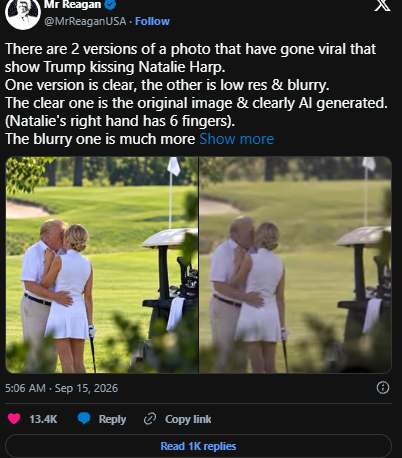
The image circulating online appears to show Donald Trump on a golf course with a blonde woman who has been widely identified on social media as Natalie Harp.
In the photograph, the two figures appear to be standing close together in what looks like an intimate interaction. Because of the way the image was presented online, many users immediately connected it to reports and discussions about Harp’s unusually visible role around the president.
The timing also contributed to the attention.
Trump recently traveled to Ireland, where he visited his golf resort in Doonbeg during a trip that coincided with the Irish Open. Genuine photographs and video from the visit showed Harp among the people accompanying the president.
That real-world context appears to have made the unverified photograph more believable to some social media users.
However, being in the same location does not authenticate a particular photograph. Investigators have found no reliable evidence establishing that the viral image was captured by an accredited photographer or that it records the scene it claims to depict.
Why the Image Came Under Scrutiny
The photograph began attracting questions almost immediately because of several unusual visual details.
The clearest version of the image reportedly shows the woman’s hand with what appears to be six fingers. This is one of the classic visual problems that can occur in AI-generated images, particularly when generative systems attempt to create complicated human hands.
AI image-generation systems have become increasingly sophisticated, but hands, fingers, facial details, text, objects, and complicated interactions can still sometimes reveal inconsistencies.
In this case, the unusual hand became one of the details that encouraged online researchers and fact-checkers to investigate further.
Other questions involved the lack of a credible source for the image.
There was no clearly identified photographer, no established news agency credited with the photograph, and no corresponding image located in major photographic archives examined during fact-checking efforts.
That absence does not automatically prove that an image is fake. An ordinary photograph can originate from a private individual or an unknown photographer. But when an image makes a major claim about a public figure, the absence of reliable provenance becomes an important reason to avoid treating it as authentic.
Two Versions of the Image Circulated Online
Another unusual aspect of the story is that two versions of the photograph circulated.
One version was relatively clear and contained more visible details. The other was much more blurred and lower in resolution.
The higher-quality version provided investigators with more information to examine. According to fact-checking reports, it contained visual abnormalities associated with AI-generated content, including the unusual appearance of the woman’s hand.
The lower-resolution image was more difficult to analyze.
Lead Stories reported that several AI-detection tools did not identify clear AI signals in the blurry version. That finding is important because it demonstrates one of the limitations of automated AI detection: a detector failing to identify AI manipulation does not establish that an image is genuine.
The quality of the source image, compression, cropping, editing, and other factors can all affect automated analysis.
For that reason, investigators also examined the image’s history and searched for earlier versions.
The Importance of Image Provenance
One of the most important lessons from this incident is the role of provenance.
When an image appears online, readers should ask several basic questions:
Who took the photograph?
When was it taken?
Where was it taken?
Was the photographer identified?
Was it published by an established news organization?
Does another independent photograph show the same event?
Can the image be traced to an original source?
In the case of the Trump-Harp photograph, those questions remain significant because the image lacks a clear, independently verified origin.
Lead Stories reported that its search found an early version of the blurry photograph on social media but did not establish a credible photographer or news source behind it.
That distinction matters.
An image being widely shared is not the same thing as an image being independently verified.
What the White House Said
The White House eventually responded to the controversy.
A White House official described the viral image as “clearly a fake photo,” according to reporting from The Daily Beast.
The response came after the photograph had already attracted substantial attention online.
The White House reportedly did not provide genuine photographs of Trump and Harp golfing for direct comparison, but the official response nevertheless rejected the viral image as authentic.
The statement adds an official position to a broader body of evidence questioning the photograph.
At the same time, readers should distinguish between what is known about the viral photograph and what is merely being discussed online about Trump’s relationship with Harp.
The authenticity of the photograph is one question.
Speculation about the private relationship between two people is a separate matter.
Who Is Natalie Harp?
Natalie Harp is a White House aide who has become a recognizable figure because of her frequent proximity to President Trump.
She has worked closely with Trump for several years and has been seen accompanying him during official travel and other public activities.
Harp became known in political media partly because of the way she reportedly provides Trump with printed materials and information from media and online sources. This role has contributed to her nickname, the “human printer.”
Her frequent presence around the president has naturally attracted public attention.
Photographs and video of Harp accompanying Trump are not themselves unusual. Her role involves working closely with him, and she has appeared with him at various events and during travel.
That documented professional proximity is different from claims about a romantic relationship.
What Is Actually Verified About Trump and Harp?
There is verified evidence that Trump and Harp work closely together and that Harp has accompanied him during public appearances and travel.
There is also evidence that Harp was present during Trump’s recent Ireland trip.
What has not been established by credible evidence is that the viral photograph captures Trump and Harp kissing or that the photograph proves a romantic relationship between them.
Fact-checking reports have specifically warned against treating the image as evidence of such a relationship.
This distinction is particularly important because social media posts often combine a genuine piece of information with an unsupported conclusion.
For example, a real photograph of Harp accompanying Trump can be combined with a fabricated image and a caption suggesting that the fabricated image proves something about their personal relationship.
Once the two pieces are presented together, readers may have difficulty separating the verified event from the unverified claim.
Social Media Helped Amplify the Story
The photograph’s rapid spread illustrates the power of social media to amplify emotionally charged content.
Images involving famous political figures can receive enormous attention because users may share them before checking their origin.
The image was reportedly posted and reposted across multiple platforms, including X, Facebook, Threads, and other social media spaces.
Once an image receives thousands or millions of views, its popularity can create an illusion of credibility.
A common assumption is that if something has been seen by a huge number of people, it must have been verified by someone.
That is not how social media works.
A false or manipulated image can become highly visible before professional journalists, researchers, or fact-checkers have enough time to investigate it.
Why AI-Generated Images Are Becoming a Bigger Challenge
The controversy also highlights a broader issue affecting online publishing.
Artificial intelligence has made it easier than ever to create convincing-looking images of real people in situations that never happened.
The technology can be used for harmless entertainment, creative projects, satire, advertising, and many legitimate purposes.
But the same tools can also be used to create misleading representations.
Political figures are particularly vulnerable because photographs of them are already abundant online. AI systems can use existing visual information to produce images that appear superficially believable.
For ordinary social media users, identifying the difference between a genuine photograph and a generated image can be difficult.
That is why provenance and independent verification are increasingly important.
A Six-Finger Detail Can Reveal a Much Bigger Problem
The unusual hand in the photograph became one of the most widely discussed details because it provides a simple example of how AI-generated imagery can sometimes reveal itself.
Human beings instinctively understand what a normal hand should look like.
When an image contains an extra finger or an incorrectly shaped hand, viewers may immediately recognize that something is wrong.
But AI-generated imagery does not always contain such obvious mistakes.
Modern systems can produce highly realistic faces, clothing, backgrounds, lighting, buildings, landscapes, and other details.
As the technology improves, visual inspection alone may become less reliable.
That makes independent sourcing even more important.
Why Viral Claims Require Extra Caution
The story is also a reminder that readers should be especially careful when an image appears alongside a dramatic claim.
A viral photograph can encourage people to form conclusions before they know whether the image is authentic.
The safest approach is to separate three things:
What the image claims to show.
What has been independently verified.
What people are merely speculating about.
In this case, the image claims to show Trump and Harp in an intimate moment.
Independent investigations have not verified that claim.
Instead, multiple reports have identified evidence suggesting that at least the clearer version was AI-generated or digitally manipulated, while the White House has rejected the photograph as fake.
The Ireland Trip Was Real
It is important not to confuse the fake or unverified photograph with Trump’s actual trip to Ireland.
Trump did travel to Ireland and visited his golf resort in Doonbeg. He also attended the Irish Open, where golfer Shane Lowry won the tournament.
The president’s presence in Ireland was extensively photographed and reported by legitimate news organizations.
Harp was also present as part of Trump’s staff.
These real events likely helped create the context in which the unverified photograph gained attention.
But the existence of a real trip does not authenticate an unrelated photograph circulating online.
Why Readers Should Not Treat the Image as Evidence of an Affair
The viral photograph has been used by some social media users to speculate about Trump’s marriage and his relationship with Melania Trump.
However, the photograph itself cannot provide reliable evidence for those claims because its authenticity has not been established.
The fact-checking evidence instead points in the opposite direction: the clearer version contains signs of AI generation, and no credible photographic source has been identified.
Claims about someone’s private relationship should not be presented as established facts without reliable evidence.
This is particularly important for publishers because repeating unsupported allegations can transform online speculation into something that appears to be legitimate reporting.
What This Story Says About the Future of Online News
The Trump-Harp image is part of a much larger transformation in the way people consume information.
For decades, a photograph was generally treated as strong evidence that an event had occurred.
That assumption is becoming less reliable in the age of generative AI.
Today, an image can be created in seconds and distributed around the world before anyone has verified it.
This means digital literacy is becoming an increasingly important part of reading news.
People may need to ask not only, “What does this picture show?” but also, “Where did this picture come from?”
How Readers Can Check a Suspicious Photograph
There