Uncategorized
43 Police Officers Walked Into My Son’s School Performance—What They Did Next Brought the Entire Gym to Tears

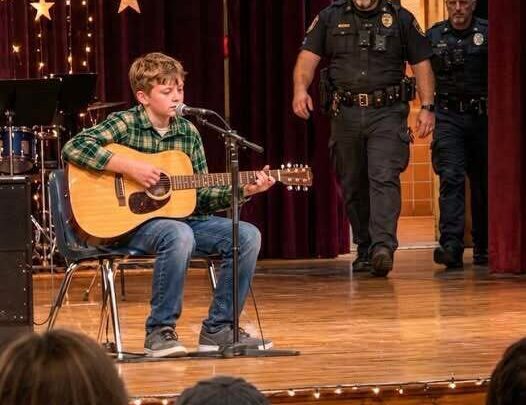
The double doors at the back of the school gym slammed against the wall just as my twelve-year-old son reached the second verse of his song.
For a moment, the entire room seemed to stop breathing.
Caleb stood alone on the small stage, holding his late father’s old acoustic guitar. His voice was quiet and unsteady, but he kept singing. Around four hundred people watched him, many already wiping tears from their eyes.
Then two uniformed police officers walked through the doors.
I recognized the way they moved before I could even see their faces. Their steps were measured and deliberate, their expressions serious. They wore dark blue uniforms, polished badges, and the heavy belts of officers who had spent years on duty.
My stomach tightened.
For eleven years, I had feared receiving that kind of visit. My husband, David, had been a police officer for sixteen years, and I had spent countless nights imagining someone arriving at our door with terrible news.
But David hadn’t died in a patrol car or during a dangerous assignment. He had died in our living room, in a hospital bed surrounded by the people who loved him, after fourteen months of fighting an illness that slowly took away his strength.
Still, grief doesn’t always respond to reason.
When I saw those officers enter the gym, my body reacted as though I were about to lose David all over again.
I stood so quickly that my folding chair fell backward with a crash.
People turned toward me, but I barely noticed. My eyes were fixed on Caleb.
He had stopped playing.
His fingers rested motionless on the guitar strings. His mouth remained slightly open, as if the last word of the song had become trapped somewhere inside him.
The music teacher, Mr. Lowe, rose from his piano bench. Principal Whitfield moved toward the officers, apparently preparing to ask why they had interrupted a school assembly.
Then the officer in front removed his hat.
I knew him immediately.
Ray Delgado.
David’s former patrol partner. His closest friend. The man who had carried one corner of my husband’s casket and stood beside our family through the darkest months of his illness.
He had also been the man I told to stop visiting us nearly three years earlier.
Ray looked toward the stage.
Then he nodded at Caleb.
It was a small gesture, almost invisible from where I stood. But it carried a meaning I could not yet understand.
Before I could process it, the doors opened again.
And more officers began entering.
By the time forty-three of them had gathered around the gym, I understood that this was not an ordinary school performance.
It was something David had arranged before he died.
Something my son had discovered in secret.
And something I had spent three years trying to keep away from our family.
The Boy Who Stopped Talking After His Father Died
My name is Jennifer Morrison. My son, Caleb, was nine when his father died.
I used to think I understood grief. I knew that losing someone hurt. I knew there would be tears, difficult anniversaries, and days when memories arrived without warning.
What I didn’t understand was that grief could make a person disappear while they were still standing right in front of you.
Caleb didn’t cry at David’s funeral.
He sat beside me in a black suit that had been purchased only two days earlier because he had outgrown his church clothes. He watched the officers, the relatives, and the neighbors who came to offer their condolences.
He watched the flag being folded.
He watched the adults cry.
But he didn’t shed a single tear.
When the last visitors left our house that evening, I found him sitting on the stairs.
“Do you want to talk, sweetheart?” I asked.
He shook his head.
“Would you like to sit with me?”
Another shake.
“It’s okay to be sad, Caleb. You don’t have to be strong all the time.”
He looked at me with his father’s serious brown eyes.
“I know, Mom.”
Then he went upstairs and closed his bedroom door.
I told myself he needed time.
He was only nine. I believed that if I gave him enough space, he would eventually tell me what he was feeling.
So I read books about childhood grief. I bought a workbook with cheerful illustrations. I arranged counseling appointments, hoping a trained professional might help him express what he couldn’t tell me.
Caleb attended three sessions.
He answered most questions with “I don’t know,” and eventually the counselor suggested taking a break and trying again when he felt ready.
We never returned.
Little by little, my son withdrew from the life he had known.
His best friend, Tyler, used to spend so much time at our house that I kept his favorite cereal in the pantry. After David died, Caleb stopped inviting him over.
Tyler visited twice. Both times, Caleb said he was tired.
The third time, Tyler’s mother called to ask whether something had happened between the boys.
“Nothing’s wrong,” I told her. “He just needs time.”
I believed that answer myself.
At school, Caleb became increasingly quiet. His teachers described him as polite, intelligent, and well behaved, but they were concerned that he rarely participated in class.
“He seems physically present but emotionally somewhere else,” one teacher explained.
Another said he avoided group activities and often sat alone during lunch.
I listened carefully. I thanked them for telling me. I promised to work with the school.
But I didn’t know where to begin.
I was struggling to get through my own days. I went to work, bought groceries, paid bills, and tried to keep our household running. I made dinner even when neither of us wanted to eat. I answered questions from relatives and smiled when people asked how we were managing.
At night, after Caleb went to bed, I sometimes sat alone in the kitchen and stared at David’s empty chair.
I had lost my husband.
Somewhere along the way, I began to fear that I was losing my son, too.
Yet instead of reaching toward him, I became afraid of asking the wrong question, opening the wrong conversation, or bringing up a memory that might hurt him.
I mistook silence for protection.
And Caleb, being the thoughtful child he was, tried to protect me in return.
Neither of us understood how much that silence was costing us.
The School Flyer I Found in His Backpack
Everything began to change in May, when I found a yellow flyer at the bottom of Caleb’s backpack.
I had been searching for a permission slip for a science field trip. Beneath an overdue library book and a half-eaten granola bar, I discovered a folded sheet of paper.
The heading read:
Lincoln Middle School Father’s Day Assembly.
The event invited students to bring their fathers, grandfathers, uncles, or another special male figure in their lives. There would be readings, musical performances, and refreshments afterward.
At the bottom was a cartoon illustration of a father holding his son’s hand.
I sat at the kitchen table and stared at it for several minutes.
Father’s Day had become a difficult date in our household.
The first year after David died, Caleb and I barely acknowledged it. We stayed home and moved through the day quietly.
The second year, I took him to the movies, hoping a change of scenery would help. He watched the entire film without touching his popcorn.
On the drive home, he finally spoke.
“You don’t have to do that, Mom.”
“Do what?”
“Try to make the day different.”
I didn’t know how to answer him.
The following year, he spent most of Father’s Day in his room.
Now the school was planning an assembly filled with children celebrating the fathers and father figures in their lives.
I imagined Caleb sitting among his classmates, surrounded by families who could still gather together. I imagined the empty space beside him where David should have been.
My first instinct was to protect him from it.
That evening, I placed the flyer on the kitchen table and waited for him to come downstairs.
When he saw it, he stopped in the doorway.
“You went through my backpack,” he said.
“I was looking for your field trip form.”
He picked up the flyer, folded it into a small square, and slipped it into his pocket.
“Caleb, maybe we should talk about the assembly.”
“There’s nothing to talk about.”
“I know it might be difficult. We could stay home that day and do something together.”
He looked down at the floor.
“Maybe we could go to the lake,” I continued. “Or find a movie you want to see.”
“I want to go.”
I paused.
“Are you sure?”
“Yes.”
“Sweetheart, you don’t have to prove anything to anyone.”
“I’m not trying to prove anything.”
His voice was still quiet, but there was a firmness in it I hadn’t heard for a long time.
“I want to go, Mom. Please.”
I studied his face. He seemed nervous, but beneath the nervousness was determination.
“Okay,” I finally said. “We’ll go.”
He hesitated before adding one more thing.
“You have to come.”
“Of course I’ll come.”
He nodded and went upstairs.
I remained at the table, wondering why a school assembly mattered so much to him.
I would eventually discover that Caleb had already made a decision.
He was going to do something that frightened him.
And he was going to do it with the only piece of his father he could still hold in his hands.
The Guitar Behind His Bedroom Door
About a week after I found the flyer, I heard music coming from Caleb’s room.
It was late. The house was dark, and I had already gone to bed.
At first, I thought the sound might be coming from a neighbor’s television. Then I heard the same sequence of notes repeated several times.
A guitar.
Very quietly, almost as if the person playing it didn’t want anyone to know.
I sat up in bed.
David had taught Caleb to play when he was seven. They used to sit on the back porch on warm evenings, David holding his large acoustic guitar while Caleb struggled with a smaller instrument we had bought at a pawn shop.
David taught him the simplest chords first.
“G, C, and D,” he would say. “Get those right, bud, and you’ll be able to play more songs than you think.”
Caleb’s fingers hurt at first. He became frustrated whenever he pressed the wrong string or couldn’t change chords quickly enough.
David never rushed him.
“Everybody’s fingers hurt when they start,” he would tell him. “That’s how you know you’re learning.”
When David became too weak to play, he gave Caleb his own guitar. It was an old acoustic instrument with a small crack near the bottom that David had repaired himself.
His initials were scratched inside the sound hole.
Caleb placed it in the back of his closet after the funeral.
I hadn’t heard him play it since.
Now, those familiar notes drifted through the wall between our bedrooms.
I got out of bed and walked into the hallway. When I reached his door, the music stopped.
I raised my hand to knock.
Then I lowered it.
I told myself that he needed privacy. I told myself I was respecting his process.
The truth was less noble.
I was afraid that if I opened the door, I would see my son trying to bring his father back through music, and I wouldn’t know what to say.
I returned to bed without speaking to him.
Over the next several days, other small mysteries appeared.
Caleb asked permission to walk to the library alone, even though he rarely visited it. He returned hours later and said he hadn’t found the book he wanted.
One evening, I walked into the kitchen and found him using our old landline phone. He hung up quickly when he saw me.
“Who were you talking to?”
“Nobody.”
“Was something wrong?”
“No. It was a wrong number.”
I knew he was hiding something, but I didn’t press him.
A few days later, my cell phone rang while I was at work.
The caller’s name appeared on the screen.
Ray Delgado.
I stared at it until the call ended.
I hadn’t deleted Ray’s number. I had considered doing so many times, but each time I hesitated.
He had been part of David’s life for years. He had been there during the illness, the hospital visits, and the funeral.
Seeing his name brought back memories I wasn’t ready to face.
I let the call go to voicemail.
When the notification appeared, I turned my phone face down on my desk.
I didn’t know that Caleb had already contacted Ray.
I didn’t know that a letter hidden inside his father’s guitar case had given him a reason to reach out.
And I didn’t know that my refusal to answer one more call was about to collide with the courage my son had been quietly gathering.
The Song That Belonged to Our Family
David wasn’t the kind of police officer people usually imagined from television dramas.
He spent most of his career on patrol in our town. He helped elderly residents find lost pets, calmed arguments outside local bars, and repeatedly reminded teenagers that the parking lot behind the bank was not a suitable place for skateboarding.
He remembered people’s names.
He also had a terrible habit of singing the same made-up song whenever he was happy.
We called it the Saturday song.
It had started years before Caleb was born, when David was working long shifts and missing home. He would hum a simple melody in his patrol car, then add words over time.
Some lines were his. Some came from me. A few had been invented by Caleb when he was a little boy.
One verse even mentioned a dog named Pickles, although we had never owned a dog by that name.
The song became part of our family life.
Every Saturday morning, David made pancakes. He burned them almost every time, but he insisted the slightly blackened edges made them taste better.
Caleb would stand on a chair beside the stove, waiting for permission to help.
David would hum while mixing the batter.
Sometimes he sang the words.
Sometimes he simply let the melody fill the kitchen.
The chorus went like this:
Hold the light, hold the light,
I’ll be home before the night.
If you can’t see me, look up high,
I’m the one who waves goodbye.
It wasn’t a polished song. David never claimed it was.
But it belonged to us.
His fellow officers knew it, too.
David sang during night shifts, hummed in the break room, and occasionally pulled out his guitar at department gatherings. The other officers teased him about the melody, but before long, many of them knew the words.
Ray Delgado was especially familiar with it.
He and David had worked together for nine years. They argued about baseball, shared stories about their families, and understood each other in the way people sometimes do after spending thousands of hours side by side.
Ray came to our house for dinner every other Sunday. He taught Caleb how to throw a curveball and became his godfather.
When David grew sick, Ray helped in every way he could.
He drove David to medical appointments when I couldn’t leave work. He waited through hospital procedures and sat beside the bed we had arranged in our living room during the final stage of the illness.
Even after long shifts, he often stopped by to talk.
When David was too weak to answer, Ray still talked about baseball, department gossip, and the ordinary things that made life feel familiar.
Other officers helped with groceries, repairs, and meals. They mowed the lawn and fixed a leaking gutter I had ignored for two years.
For months, my living room seemed to be filled with people wearing blue uniforms.
Then David died.
At his funeral, more than two hundred officers gathered to honor him. They lined the road to the cemetery, stood in silence, and presented our family with the folded flag.
I remember the ceremony only in fragments.
What I remember most clearly is the sight of all those uniforms.
For years, uniforms had represented the danger that came with David’s job. During his illness, they had come to represent the terrible reality that he was dying.
At the funeral, they represented the fact that he was gone.
I couldn’t bear to see them.
I wanted quiet. I wanted the world to stop asking anything of me. I wanted to wake up one morning and discover that the last fourteen months had been a nightmare.
Instead, I began pushing away the people who reminded me of David.
And the first person I pushed away was Ray.
The Day I Told David’s Best Friend to Leave
For several months after the funeral, Ray kept visiting.
He brought food and asked whether Caleb wanted to throw a baseball around. He called on holidays and offered to take us to department events.
I refused almost every invitation.
“He needs time,” I told Ray.
“We’re not going anywhere,” he answered.
At first, I appreciated his patience. Eventually, I began to dread the sight of his car.
Every visit reminded me of the life we had lost.
I knew Ray was trying to help, but I couldn’t separate him from the memories that hurt me.
One Sunday, he arrived carrying a new baseball glove.
It was Caleb’s size.
“Thought he might be getting too big for the old one,” Ray said.
I stood in the doorway and didn’t invite him inside.
“Ray, I need you to stop coming.”
He looked confused.
“Jen, what’s going on?”
“I can’t do this anymore.”
“Do what?”
“See you. See the uniform. Hear the stories. Every time you come here, I’m back in that hospital room.”
His expression softened.
“I know it’s hard.”
“No, you don’t.”
The words came out sharper than I intended.
Ray lowered his eyes.
“I miss him, too,” he said.
That made me angrier, although he had done nothing wrong. His grief was proof that David had existed in a world beyond our house, and I wasn’t ready to accept that world.
“I need you to let us move on,” I said. “Please.”
Ray held the glove in both hands.
“He’s my godson, Jen. I promised David I’d be there for him.”
“David’s gone.”
The sentence landed between us.
Ray flinched.
For several seconds, neither of us spoke.
Then he carefully placed the glove on the porch step, put on his hat, and walked back to his car.
I closed the door and leaned against it.
I slid down until I was sitting on the floor, crying quietly.
When I looked up, Caleb was at the top of the stairs.
He had heard everything.
I waited for him to ask why I had sent Ray away. I waited for him to become angry.
Instead, he turned around and went back to his room.
The following morning, the glove had disappeared from the porch.
I assumed Caleb had thrown it away.
I never asked.
Over time, the invitations stopped. The phone calls became less frequent. Eventually, the only messages I received from Ray were on birthdays, holidays, and the anniversary of David’s death.
I ignored those, too.
I told myself that our family needed to move forward.
What I failed to understand was that Caleb’s family included the people I had spent so much energy avoiding.
I had tried to protect him from grief by removing its reminders.
Instead, I had removed some of the people who could have helped him carry it.
A Shirt, an Old Guitar, and a Decision
On the morning of the school assembly, Caleb came downstairs wearing a light blue button-up shirt.
It took me a moment to recognize it.
The shirt belonged to David.
I had packed most of my husband’s clothes into boxes about a year after his death. I couldn’t bring myself to donate them, but I couldn’t bear to see them every day, either.
The boxes had remained in the garage beneath a tarp.
“That’s Dad’s shirt,” I said.
Caleb poured cereal into a bowl.
“Yeah.”
“Where did you find it?”
“In the garage.”
It was slightly too large for him, especially around the shoulders. He had rolled up the sleeves twice.
“It looks nice on you,” I said.
He shrugged, but his ears turned pink.
Then I noticed the guitar case beside the front door.
David’s old case was black and scuffed, with a faded gas-station sticker that my husband had always meant to remove.
“Are you planning to play today?” I asked.
Caleb took a long time to answer.
“I signed up.”
“You’re going to perform?”
“Maybe.”
“What are you going to play?”
He looked at me, then away.
“You’ll see.”
I wanted to ask more questions. I wanted to know whether he felt prepared, whether he was nervous, and whether he wanted to practice before we left.
But I sensed that he was holding himself together with enormous effort.
“Okay,” I said. “I’ll be there.”
“You have to be.”
“I promise.”
He picked up the guitar case and headed for the car.
As we drove to Lincoln Middle School, I glanced at him several times.
He sat quietly, watching the houses and trees pass outside the window. His father’s shirt was buttoned to the collar, and his hands rested on the guitar case.
I wondered what he had planned.
I wondered whether I should have encouraged him to tell me more.
Mostly, I wondered whether I could bear to watch him stand in front of a room full of families and sing about a father who would never return.
I didn’t know that he was about to do something I had been unable to do for three years.
He was going to let other people remember David with him.
The Performance That Stopped the Room
The school gym smelled of floor polish and coffee.
Rows of folding chairs filled the room. At the back, volunteers had arranged donuts, juice boxes, and paper cups on a long table.
A handmade banner hung above the stage.
HAPPY FATHER’S DAY.
Dads sat beside their children. Grandfathers adjusted their glasses. Uncles waved at students who had spotted them in the audience.
Some parents had clearly come straight from work. Others wore casual clothes and carried cameras, ready to record every moment.
I found two seats near the middle.
Caleb went to sit with his classmates near the stage. He placed the guitar case at his feet.
The chair beside me remained empty for a moment.
A man with a sunburned neck approached and asked whether he could sit there.
“Of course,” I said.
His daughter was scheduled to read a poem. He showed me a packet of tissues he had brought in his jacket pocket.
“She made me promise not to cry,” he said. “I told her I would try.”
I smiled.
Then he asked which child was mine.
I pointed toward Caleb.
“Blue shirt. Next to the guitar.”
“He playing something?”
“I think so.”
The man looked toward the stage, then back at me.
“Dad couldn’t make it?”
I felt the familiar ache in my chest.
“He passed away three years ago.”
His face immediately changed.
“Oh, I’m sorry. I didn’t mean—”
“It’s okay. You didn’t know.”
He reached over and briefly squeezed my hand.
Then he looked back toward the stage without asking another question.
I have never learned his name, but I remember his kindness.
The assembly began with a short speech from Principal Whitfield. Students read poems, performed small skits, and played instruments.
One boy delivered a poem about his father’s old truck. Two girls performed a comedy sketch that involved a fake mustache. A student played the trumpet with such enthusiasm that a baby began crying in the back row.
After every performance, the children searched the audience for familiar faces.
Their fathers waved. Their grandfathers stood to applaud. Their relatives called out encouragement.
I watched Caleb watching them.
He sat straight-backed, his expression carefully controlled. He didn’t turn around to look at me.
For a moment, I considered taking him home.
I imagined the pain he might feel when he realized that every other child seemed to have someone waiting for them.
My hand tightened around my purse strap.
Then Mr. Lowe stepped to the microphone.
“Our next performer is Caleb Morrison, from Ms. Patterson’s seventh-grade class.”
Caleb stood.
He lifted the guitar case and walked onto the stage.
The instrument was large against his small frame. He opened the case, removed the guitar, and settled the strap over his shoulder.
Mr. Lowe brought a stool forward.
Caleb shook his head.
He wanted to stand.
The microphone was too high, so the teacher adjusted it. Then he stepped away.
Caleb looked out at the audience.
For one brief moment, his eyes searched the room until they found mine.
I gave him a small nod.
He turned toward the ceiling.
“This one’s for my dad,” he said.
The gym became silent.
Then he played the first chord.
I recognized the melody immediately.
It was the Saturday song.
The song David used to hum while making pancakes. The song that had filled our kitchen for years. The song I had been unable to hear without remembering the hospital room and the funeral.
Caleb began to sing.
His voice was soft, and it cracked during the second line. He paused, swallowed, and continued.
He sang about Saturday mornings, warm kitchens, burnt pancakes, and a father who felt lucky to have a child beside him.
My hand covered my mouth.
The man beside me reached for his tissues.
Around the gym, people began wiping their eyes.
Caleb reached the chorus.
Hold the light, hold the light,
I’ll be home before the night.
His voice trembled on the word home.
He closed his eyes and sang the next line.
If you can’t see me, look up high,
I’m the one who waves goodbye.
No one moved.
The teachers standing along the walls watched in silence. Principal Whitfield had stopped near the side aisle. Even the students in the front row seemed to understand that this was not simply another school performance.
Caleb began the second verse.
His hands shook slightly, but he kept playing.
And then the double doors at the back of the gym slammed open.
Two police officers entered.
I stood so quickly that my chair crashed to the floor.
I recognized Ray Delgado.
He removed his hat and looked at Caleb.
Then he nodded.
Behind him, the doors opened again.
More officers entered the gym.
One by one, they spread along the back wall and continued down the sides of the room. Some wore their uniforms. Others were dressed in plain clothes, their badges hanging from chains around their necks.
I recognized Officer Hendricks, who had once repaired our gutter. I recognized Sergeant Pruitt, who had led the procession at David’s funeral.
An older retired officer stood near the back, leaning on a cane.
There were young officers I had never met and others who had known David for years.
Later, I learned that forty-three of them had come.
They didn’t rush toward the stage. They didn’t interrupt Caleb again.
They simply stood along the walls, holding their hats.
And every one of them watched my son.
Caleb stopped playing.
He stared at the officers, his face pale.
Then he saw Ray.
Something changed in his expression.
His shoulders began to shake.
Ray placed his hat against his chest.
Then, in a rough, uneven voice, he began to sing.
“Saturday morning, kitchen’s warm…”
For a moment, I wasn’t sure I had heard him correctly.
Then the officer beside him joined in.
Another followed.
Soon, the song traveled down the wall as forty-three police officers sang the words they had learned from their friend.
Their voices were imperfect. Some sang too loudly. Others struggled to remember the melody.
But they knew the chorus.
They had sung it with David on long shifts and at department gatherings. They had carried it with them through years of service and through the loss of the man who had created it.
Now they were singing it for his son.
Caleb made a small sound that was half laughter and half sob.
He wiped his face with his sleeve.
Then he placed his fingers back on the strings and found the next chord.
He began singing again.
This time, his voice was louder.
It was also breaking.
He didn’t try to hide it.
The officers continued singing along the walls, their voices growing stronger as Caleb reached the chorus.
Hold the light, hold the light,
I’ll be home before the night.
The audience joined them.
The man beside me sang through his tears. Dads and grandfathers who had never met David followed the words as best they could.
By the final line, the entire gym seemed to be holding the song together.
If you can’t see me, look up high,
I’m the one who waves goodbye.
Caleb played the last chord.
It rang through the gym and gradually faded.
For one heartbeat, nobody moved.
Then the audience rose to its feet.
The applause was deafening. People clapped, cried, and called out encouragement.
But the officers along the walls did something else.
They stood straight and saluted.
Forty-three officers saluted a twelve-year-old boy who was wearing his father’s shirt and holding his father’s guitar.
Caleb stared at them, overwhelmed.
He looked toward Mr. Lowe, who was crying too hard to offer any help.
Then Caleb raised one shaking hand to his forehead and returned the salute.
I don’t remember crossing the gym.
I only remember reaching the bottom of the stage steps as Caleb hurried down, the guitar bumping against his knees.
He walked straight into my arms.
And for the first time in three years, my son cried.
He cried with the kind of force that makes a child’s whole body shake. He buried his face in my shoulder and clung to me as if everything he had been holding inside had finally become too heavy.
I held him.
I didn’t tell him to stop crying. I didn’t tell him to be brave.
I simply held him while the grief he had carried since he was nine poured out in the middle of a school gym.
When he finally pulled back, his face was red, his eyes swollen, and his father’s shirt was wet with tears.
“Sorry,” he whispered.
“Don’t you dare apologize,” I said.
He gave a small, broken laugh.
Then he looked over my shoulder.
I turned.
Ray was standing a few feet away, his hat held in both hands.
“Hey, Jen,” he said.
I tried to answer, but my voice failed.
Ray looked at Caleb.
“Hey, kid. You didn’t tell me you’d gotten that good.”
Caleb walked toward him and wrapped both arms around his waist.
Ray closed his eyes and placed one hand on the back of my son’s head.
For the first time in years, I looked at Ray without seeing only the hospital room, the funeral, or the worst moments of our lives.
I saw the friend who had loved my husband.
I saw the godfather who had tried to remain part of my son’s life.
And I saw someone who had been grieving, too.
The Letter Hidden Inside the Guitar Case
When I finally found my voice, I asked Ray how he knew about the performance.
“He called me,” Ray answered.
I stared at him.
“Caleb called you?”
“About two weeks ago. He told me about the assembly.”
I remembered the call that had appeared on my phone.
Ray Delgado.
The voicemail I had ignored.
“I didn’t listen to your message,” I whispered.
Ray’s expression softened.
“I figured.”
Caleb stepped away from him and looked at me.
“I asked him not to tell you,” he admitted. “I knew you’d say no.”
“Caleb…”
“You said no to everything, Mom. The barbecue. The baseball game. Everything.”
His voice shook, but he continued.
“You told Uncle Ray to stop coming. I heard you.”
I wanted to explain that I had been hurting. That I had been trying to protect him. That I had never intended to make him feel alone.
But none of those explanations could change what he had experienced.
“They were Dad’s family,” he said. “They were our family, too.”
My eyes filled.
He reached into the pocket of David’s shirt and removed a folded piece of paper.
The paper was old and soft, with creases worn almost white.
“Dad left me a letter,” Caleb said. “I found it inside the guitar case.”
I took it from him with trembling fingers.
David’s handwriting covered the page.
It was shakier than I remembered, the letters slanting unevenly across the paper. I knew he must have written it during the final months of his illness, when even holding a pen had become difficult.
The letter began with the words he used whenever he spoke to Caleb.
Hey, bud.
David explained that he had hidden the letter inside the lining of the guitar case because he knew Caleb would eventually open it again.
He apologized for not being there for the games, concerts, and ordinary school events that would come as Caleb grew older.
Then he wrote something about me.
He told Caleb that I would try to be strong, sometimes so determinedly that I might forget I didn’t have to carry everything alone.
He explained that my fear would not mean I loved Caleb any less. It would mean I was frightened of losing anything else.
David asked our son to be patient with me.
Then came the most important part.
If there’s ever a day when you need a dad in the room, call Ray. His number is at the bottom. He’ll bring the guys. I already made them promise.
David had told the officers that if Caleb ever needed them, they should be there.
They had agreed before he had even finished asking.
The letter ended with three simple lines.
You’re not alone, bud. You never were. Not for one day.
Hold the light.
Dad.
At the bottom of the page, David had written Ray’s telephone number twice.
I read the letter again.
Then a third time.
And finally, I sat down on the curb outside the school and cried harder than I had at the funeral.
Caleb sat beside me.
After a while, he leaned his shoulder against mine.
“When did you find it?” I asked.
“In April. One of the guitar strings broke, and I went to look for the extra ones. The lining was coming loose.”
He looked down at his hands.
“I read it over and over. I didn’t know what to do until the flyer came home.”
“And then you called Ray.”
“I went to the library first. I wanted to make sure I had the right number.”
He admitted that he had used the landline because he didn’t want the call to appear on my cell phone.
“So that wasn’t a wrong number,” I said.
He looked at me sideways.
“No.”
I laughed through my tears.
“I knew it.”
“You didn’t check.”
“No,” I admitted. “I didn’t.”
Ray joined us on the curb.
He told us that when Caleb called, he had been driving home after a shift. He hadn’t recognized the number at first.
Then he heard a small voice say, “Uncle Ray? It’s Caleb. My dad said to call you.”
Ray had pulled his car over because he could no longer see clearly through his tears.
“He told me about the assembly,” Ray said. “He asked if I could come. Just me.”
“But David made a promise with all of you,” I said.
Ray nodded.
“About a month before he died, he asked several of us to gather at your house. You were out at the pharmacy. He was very weak by then, but he wanted to make sure we understood.”
Ray paused.
“He said, ‘Don’t let them be alone. Even if she pushes. Especially if she pushes.’”
I closed my eyes.
“And we let you push us away,” Ray continued. “I should have kept checking in. I should have found other ways to help. When you told me to leave, I thought I was respecting what you needed.”
He looked at me.
“I didn’t realize how much Caleb needed us, too.”
I turned toward him.
“I’m sorry, Ray. Every time I saw you, I saw the worst year of my life. I couldn’t separate you from the memories, and I made Caleb live with that.”
“You were hurting,” Ray said.
“That doesn’t mean it was right.”
Caleb leaned against my shoulder.
I put one arm around him and looked at the man who had once been my husband’s closest friend.
“I’m sorry,” I repeated.
Ray nodded.
It wasn’t a magical moment in which every hurt disappeared. Three years of silence couldn’t be undone by one conversation.
But it was the first honest conversation we had shared in a long time.
And it was a beginning.
The Baseball Glove He Had Kept for Three Years
Before we left the school parking lot, Ray reached into his jacket.
“I’ve got something that belongs to you, bud.”
He pulled out a small baseball glove.
It was the glove he had brought to our house nearly three years earlier, the one he had left on the porch after I refused to let him inside.
Caleb stared at it.
Ray explained that the glove had disappeared from the porch the following morning. About a week later, it had appeared in Ray’s mailbox.
There had been no note.
“I figured it was your way of telling me to keep it,” Ray said. “So I did.”
Caleb took the glove and turned it over.
It was far too small for him now.
“I outgrew it,” he said.
His voice cracked.
“Yeah,” Ray answered gently. “Guess we’d better get you a new one.”
Caleb held the glove against his chest for a moment.
I watched him and thought about all the things I hadn’t noticed during those three years.
The visits he had missed.
The friendships he had lost.
The people he had wanted to see but had been afraid to ask for.
The child who had sat on the stairs after his father’s funeral and decided, in his own small way, that his mother’s pain was something he needed to protect her from.
I had thought I was the adult in our family, the one responsible for holding everything together.
But my son had been trying to hold me together, too.
He had been carrying far more than I realized.
That night, after Caleb went to bed, I sat on the edge of my mattress with my phone in my hand.
There were twelve voicemails from Ray Delgado.
I had never listened to them.
I pressed play on the first one.
His voice sounded awkward and tired.
“Hey, Jen. Merry Christmas. Just wanted you to know we’re thinking about you. The guys sang the Saturday song at the party. Didn’t sound quite right without David. Call if you need anything.”
I listened to the next message.
It was Caleb’s tenth birthday.
“Tell the kid happy birthday from his Uncle Ray. Tell him I’ve still got the glove.”
Another message came on the anniversary of David’s death.
Ray was quiet for several seconds before speaking.
“I miss him, Jen. I don’t know who else to say that to.”
Then the message ended.
I sat there listening to three years of attempts to reach us.
Some messages were short. Some were little more than an invitation. Others contained stories about David, offers of help, or reminders that Ray and the other officers were still thinking of us.
The final voicemail was from two weeks earlier.
Ray told me that Caleb had called him about the school event. He explained that he wanted to respect Caleb’s request for privacy, but he also believed I deserved to know.
He asked me to let our son perform.
“I think David would want him to,” Ray said. “Please call me back.”
I placed the phone beside me.
Then I walked down the hall to Caleb’s room.
His door was open slightly.
He was asleep on top of his covers, still wearing his father’s shirt. The old baseball glove rested beside him.
I stood in the doorway for a long time.
I had spent three years believing that if I kept the world outside our house, nothing else could hurt us.
But grief had not made us safer.
It had made our world smaller.
I had tried to protect Caleb from the pain of remembering his father, and in doing so, I had pushed away people who could have helped him remember.
I had locked the door because I was afraid of losing more.
And my son had been waiting on the other side, trying to find a way to open it.
The First Saturday Morning Without Fear
The next morning was Saturday.
I woke early and went downstairs before Caleb.
Without planning it, I took out the mixing bowl and began making pancake batter.
I hadn’t made pancakes on a Saturday since David died.
The familiar smell brought back so many memories that I had to pause with the bowl in my hands.
I poured the batter into the pan.
Then I burned the first pancake.
It turned dark around the edges and filled the kitchen with smoke.
I stared at it.
Then, unexpectedly, I started laughing.
I laughed until I had to put down the spatula.
“Mom?”
Caleb appeared in the doorway wearing pajamas, his hair sticking up on one side.
“What happened?”
“I burned it.”
He looked at the pan.
“Dad would be proud.”
I laughed harder.
Caleb walked over and dragged a chair toward the stove. He was far too tall to need it, but he climbed onto it anyway.
“You have to wait until the bubbles pop,” he explained. “Dad always said that.”
“I know.”
“You don’t make pancakes.”
“Apparently, I shouldn’t.”
He took the spatula from my hand and waited until the bubbles appeared. Then he flipped the pancake.
It landed perfectly.
For a moment, we simply watched it cook.
Then Caleb began to hum.
It was the Saturday song.
I joined him.
Neither of us sang the words, but we didn’t need to. The melody was enough.
The kitchen felt different that morning.
The memories were still there. The sadness was still there. David’s absence hadn’t become any less real.
But for the first time in years, remembering him didn’t feel like opening a wound we had to hide.
It felt like inviting someone we loved to sit with us for breakfast.
We ate the pancakes at the kitchen table.
We talked about the school assembly, about Ray’s singing voice, and about how badly some of the officers had missed the notes.
Caleb laughed when he remembered the way Ray had held his hat against his chest.
Then he grew quiet.
“I miss Dad,” he said.
I reached across the table and took his hand.
“I miss him, too.”
It was the simplest conversation we had shared in years.
And it was more important than either of us knew.
Rebuilding the Family We Had Pushed Away
Things didn’t change overnight.
Grief doesn’t disappear because someone sings a song in a school gym. It doesn’t vanish because a letter offers comfort or because a group of people reminds a family that it is loved.
There were still difficult mornings.
Caleb sometimes came downstairs and barely spoke. I still had evenings when a memory caught me off guard and left me unable to finish what I was doing.
But now we began talking about those days instead of pretending they weren’t happening.
When Caleb said he missed his father, I stopped trying to distract him.
When I felt overwhelmed, I tried to tell him rather than insisting that everything was fine.
We also began letting people back into our lives.
The following Sunday, Ray came to dinner with his wife, Lucia, and their two teenage daughters.
The house became loud almost immediately.
The girls argued about music. Lucia asked whether I needed help in the kitchen. Ray told a story about David that involved a misplaced set of car keys and a very embarrassed supervisor.
I laughed so hard that I had to step into the pantry to catch my breath.
After dinner, Ray took Caleb outside with a new baseball glove.
They threw the ball back and forth until the light began to fade.
Caleb missed more throws than he caught, but he was laughing.
I watched through the kitchen window.
For years, I had believed that allowing the officers back into our lives would force us to relive David’s death.
Instead, I began discovering stories about the life he had lived.
I learned about the time he had helped a stranded family change a tire during a storm. I heard about his habit of carrying extra snacks in his patrol car for children who were waiting with their parents. I learned that he had once spent an entire lunch break trying to convince a nervous new officer that it was perfectly acceptable to ask for directions.
Some stories made me laugh.
Others made me cry.
But all of them reminded me that David had been more than the illness that took him from us.
He had been a friend, a colleague, a father, and a person who had made other people’s lives a little easier.
I had lost the ability to see those parts of him because I had become trapped in the final chapter of his life.
Slowly, I began remembering the whole story.
A few weeks later, the department held its annual summer barbecue.
They had invited us every year since David died.
This time, I said yes.
I nearly changed my mind when we arrived. I sat in the car and watched officers in shorts and T-shirts prepare food, chase children, and arrange folding chairs.
My hands were shaking.
Caleb looked at me.
“You okay?”
“I don’t know,” I admitted. “I’m scared.”
He nodded.
“Me too.”
Then he unbuckled his seat belt.
“Let’s go anyway.”
So we did.
Officer Reyes, whom I had met briefly at the school assembly, brought me a lemonade. Sergeant Pruitt told a story about David getting a raccoon trapped inside his patrol car.
I had never heard that story.
By the time he finished, I was laughing so hard that I nearly spilled my drink.
Later, someone brought out a guitar.
Several officers looked toward Caleb.
He shook his head immediately.
“No. Absolutely not.”
Ray grinned.
“Come on, kid. We sang backup for you. You owe us one.”
Caleb looked at me.
I didn’t tell him what to do.
I simply nodded.
He took the guitar and sat on an overturned cooler in the middle of the group.
The officers gathered around him on the grass, picnic tables, and folding chairs.
Caleb began playing the Saturday song.
This time, his hands didn’t shake.
His voice still cracked occasionally, as any twelve-year-old boy’s might, but he sang the entire song.
When they reached the line about the imaginary dog named Pickles, several officers laughed.
Ray sang the wrong note so loudly that Caleb stopped playing for a second.
“Uncle Ray!”
“What? I’m adding character.”
The group burst into laughter.
For a moment, I could almost imagine David sitting among them, smiling at the chaos.
When the song ended, Ray clapped Caleb on the shoulder.
“That’s your dad’s song,” he said. “But it’s yours now, too. Keep it going.”
Caleb looked down at the guitar.
“I will.”
This time, I believed him.
The Phone Call That Changed My Understanding of Grief
That fall, Caleb’s teacher called me again.
I answered with my stomach tightening, expecting another conversation about his withdrawal from class.
Instead, she told me something I hadn’t expected.
“Caleb volunteered to play guitar during our class presentation,” she said. “In front of everyone. He has never volunteered for anything like this before.”
I sat down.
She also explained that Caleb had begun eating lunch with students from the music program.
He and Tyler, his old best friend, had worked together on a science project and earned a good grade.
I nearly cried when I heard Tyler’s name.
That afternoon, I went to the grocery store and bought his favorite cereal.
I hadn’t kept it in the pantry for years.
A few days later, Tyler came over.
He stood awkwardly in the kitchen doorway, taller than I remembered, with a backpack hanging from one shoulder.
“Hi, Mrs. Morrison.”
“Hi, Tyler. Would you like something to eat?”
He looked toward the pantry.
“Do you still have the cereal with the marshmallows?”
I didn’t.
But I made sure I bought it before his next visit.
The boys sat at the kitchen table, eating cereal and talking about school. Their conversation was ordinary and sometimes ridiculous.
I listened from the other side of the room, trying not to interrupt.
For the first time in years, our house sounded like a home with a twelve-year-old boy living in it.
Caleb still had hard days.
Sometimes he said very little. Sometimes he became angry about his father’s death, and sometimes he seemed embarrassed by his own feelings.
One evening, he sat beside me on the back porch and admitted that he was angry at David for dying.
“I know that’s stupid,” he said.
“It isn’t stupid.”
“But he didn’t choose to die.”
“No,” I answered. “He didn’t.”
I thought for a moment.
“And I’m angry, too.”
Caleb looked at me in surprise.
“You are?”
“Sometimes. I know your dad didn’t want to leave us. But that doesn’t mean I never wish things had been different.”
He leaned back against the porch railing.
We sat together for a while, letting the feeling exist without trying to correct it.
I began attending a grief support group on Thursday evenings at a church downtown. Officer Reyes had told me about it after the assembly.
The first night, I barely spoke.
The second night, I introduced myself.
By the fourth meeting, I told the group about the gym, the forty-three officers, and the song about burnt pancakes.
A woman across the circle began crying. Then she laughed through her tears.
“I’m sorry,” she said. “I just really needed to hear that.”
Her response stayed with me.
I had spent years believing that talking about grief meant reopening something painful.
I was learning that sharing a memory could also allow someone else to carry part of its weight.
I wished I had learned that lesson earlier.
But I was grateful to be learning it at all.
One Year Later, the Doors Opened Again
A year after Caleb’s performance, Lincoln Middle School held another Father’s Day assembly.
Caleb was thirteen by then and preparing for eighth grade.
He refused to perform.
“Once was enough,” he said. “I don’t need the seventh graders thinking I’m trying to be famous.”
I laughed.
But when I asked whether he wanted to attend, he said yes.
We found seats near the middle of the gym, in almost the same place where I had sat the previous year.
This time, Caleb sat beside me instead of joining his classmates at the front.
He claimed it was because he didn’t want to embarrass himself by waving at me.
I suspected there was another reason.
Just before the assembly began, the double doors at the back of the gym opened.
I didn’t jump.
Ray walked inside wearing jeans and a plaid shirt. He carried a box of donuts under one arm.
He had come without the other officers.
He walked down the aisle and stopped beside the empty chair on Caleb’s other side.
“Is this seat taken?” he asked.
Caleb grinned.
“Yeah. It’s yours.”
Ray sat down.
Caleb immediately reached into the donut box.
“Take one,” Ray said.
Caleb took two.
“Hey!”
“You brought them for the family.”
“Not the entire family at once.”
Their argument continued for several minutes, growing louder and more ridiculous until I found myself laughing.
I looked at the two of them sitting beside me.
Ray had been part of David’s life for years. Caleb had been his godson since he was a baby. Their relationship had been interrupted by my grief, but it hadn’t disappeared.
It had waited.
I thought about the letter hidden inside the guitar case.
I thought about the promise David had asked his friends to make.
And I thought about how close I had come to allowing my fear to become the only thing my son remembered about the years after his father’s death.
Then I looked toward the ceiling.
The lights flickered once.
It was probably the old wiring.
I knew that.
But Caleb noticed, too.
He followed my gaze toward the high metal beams and the caged lights above the stage.
Then he lifted one hand slightly and waved.
I didn’t ask whom he was greeting.
I raised my own hand and waved with him.
I don’t know whether David could see us. I don’t know whether the universe sends signs or whether the flickering lights were simply the result of an aging school building.
What I do know is that, for the first time in years, looking upward didn’t hurt.
It reminded me of a song.
It reminded me of a father who had loved his son enough to make a plan for the days he would miss.
It reminded me of a group of friends who had kept a promise.
And it reminded me that grief doesn’t have to be carried alone.
What I Learned From the Forty-Three Officers
For three years, I believed that keeping people away would protect my son from more pain.
I thought silence was a kind of shelter.
I was wrong.
Grief is complicated, especially for children. A child may not cry when adults expect tears. They may become quiet, withdraw from friends, avoid conversations, or appear to be coping when they are struggling to understand a loss they cannot yet put into words.
That doesn’t mean every child grieves in the same way. Some talk openly. Others need time, patience, and support from trusted adults. Many need different kinds of help at different stages of growing up.
Caleb needed space, but he also needed connection.
He needed someone to tell him that missing his father was normal. He needed permission to be angry, confused, sad, or even happy without feeling guilty.
He needed his mother to understand that protecting him did not mean removing every reminder of the person he had lost.
Most importantly, he needed to know that the people who had loved David were still there.
Ray and the officers could not replace my husband. They never tried to.
They offered something different: memories, friendship, guidance, and the steady presence of people who had known David in ways Caleb and I had not.
Their support helped us remember that a family can change shape after a loss without losing every connection that made it a family.
I also learned that adults who are grieving need support themselves.
I had been so focused on surviving each day that I failed to recognize how much my isolation affected Caleb. I had treated my own fear as though it were a rule everyone else needed to follow.
When I finally began talking about what I felt, I discovered that I didn’t have to be perfectly strong to be a good mother.
I could admit that I was hurting.
I could ask for help.
And I could let other people love my son without feeling that I was surrendering my place in his life.
The forty-three officers who walked into that gym didn’t take away our grief.
They didn’t make David’s death less painful.
They simply reminded us of something we had forgotten.
We were still surrounded by people who cared.
David had understood that when he wrote his letter. He had known that there might come a day when Caleb needed more than a memory, a guitar, or a few lines of handwritten advice.
He wanted his son to have people he could call.
And when Caleb finally made that call, those people answered.
I still think about the moment Ray removed his hat and nodded toward the stage.
I think about Caleb’s shaking hands, the sound of forty-three officers singing a song about pancakes, and the way my son returned their salute.
But the moment I remember most clearly comes afterward, when Caleb sat beside me on the parking-lot curb and leaned his shoulder against mine.
He didn’t need me to solve anything.
He didn’t need me to explain why his father had died or promise that the pain would disappear.
He needed me to stay.
So I stayed.
And when the next difficult day arrived, I stayed then, too.
We learned to talk about David without treating every memory like a danger. We learned to laugh at his terrible pancakes, his homemade song, and the ridiculous stories his friends remembered.
We learned that missing someone and enjoying life are not opposites.
We learned that a person can be gone and still leave behind a thousand small ways of being present.
And we learned that sometimes the first step toward healing is as simple as opening a door.
If you have ever watched someone you love withdraw after a loss, remember that silence doesn’t always mean they want to be alone. A gentle invitation, a patient conversation, or the offer to listen can matter more than you realize.
And if you are the person carrying the grief, you don’t have to wait until you feel strong enough to ask for help.
You can begin with one phone call.
One honest sentence.
One person you trust.
Sometimes, the people who love you are waiting just beyond the door.
They may not know how to reach you.
They may be afraid of making things worse.
But when you are ready, they can help you carry what feels too heavy to hold alone.
David’s letter ended with two words that had followed our family for years.
Hold the light.
I used to think those words meant waiting for someone to come home.
Now I understand them differently.
They mean keeping a little hope alive when the road ahead is difficult. They mean remembering that love can continue through friendship, family, stories, and the people who show up when they are needed.
They mean looking up, even when you cannot see the person you miss.
And sometimes, they mean allowing yourself to be held by the people who are still here.
Have you ever experienced a moment when someone’s kindness helped you through a difficult time? Share your thoughts or memories with someone who might need the reminder that they don’t have to face grief alone.