For weeks, my husband had controlled almost every part of my life.
Where I slept.
When I ate.
Who I spoke to.
Whether I could leave the house.
Even when I could see my own family.
But I still had one thing he didn’t know about.
A phone.
It was old, damaged, and nearly useless.
But hidden beneath a loose panel in the basement floor, it became the one connection between me and the outside world.
And eventually, it became the evidence that brought everything crashing down.
The Cage in the Basement
When the police finally arrived, I could barely lift my head.
I had been trapped behind welded metal for weeks.
The basement had become my entire world.
There was no sunlight. No normal conversation. No freedom.
Only concrete walls, cold floors, and the sound of footsteps above me.
Then I heard someone shouting.
The basement door opened.
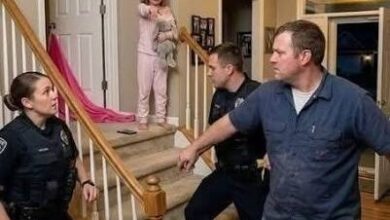
A uniformed officer appeared at the top of the stairs.
Behind him stood another officer, a paramedic, and my husband, Marcus.
I remember the first thing the detective did.
He looked at the cage.
Then he looked at the welds.
Then he looked directly at me.
“Ma’am, can you hear me?”
I nodded.
“My name is Detective Harris. Your sister contacted us.”
My eyes immediately filled with tears.
“Lena?”
Harris nodded.
“She received the location and the audio recording.”
Marcus suddenly laughed.
It wasn’t a natural laugh.
It sounded nervous and desperate.
“You’re making a mistake,” he told the detective. “She’s my wife. She has problems. She locked herself down here.”
Detective Harris slowly turned toward him.
“You welded the cage shut?”
Marcus said nothing.
For the first time, I watched him struggle to find an answer.
Then his mother appeared at the top of the stairs.
She was holding the gold key.
The key to my cage.
For weeks, that tiny piece of metal had represented everything Marcus had taken from me.
My freedom.
My ability to leave.
My access to food and water.
My dignity.
Now it hung from his mother’s neck while police officers stood between us.
“Marcus,” she whispered.
The detective immediately pointed toward her.
“Ma’am, stay where you are.”
She stopped.
The paramedic moved toward the cage.
“We need to get her out.”
Marcus stepped forward.
“No.”
His voice was quiet.
Everyone looked at him.
“No one touches her.”
Detective Harris moved between Marcus and the cage.
“You’re finished.”
Something changed in Marcus’s expression.
For the first time, I saw fear.
Not fear for me.
Fear for himself.
The Secret Beneath the Floor
The paramedic crouched beside the cage.
“Ma’am, we’re going to get you out. We’re going to take care of you and the baby.”
I swallowed.
“There are records.”
The paramedic looked at me.
“What kind of records?”
“The phone.”
Detective Harris immediately focused on me.
“What phone?”
“My sister… the audio…”
He understood.
“Don’t touch anything yet.”
He crouched beside the cage and examined the floor.
There was a loose metal panel beneath me.
My hands trembled.
“It’s there.”
Harris carefully lifted it.
The old phone was still inside.
Its screen was cracked.
The battery showed one percent.
One percent.
That tiny device had been my last connection to the outside world.
Harris reached for it.
Marcus suddenly lunged forward.
The detective stopped him.
“Hands behind your back.”
“You don’t understand!” Marcus shouted.
“I understand enough.”
“You have no right!”
“I have a victim in a welded cage.”
The handcuffs clicked into place.
Marcus began shouting.
His mother started crying.
But I barely heard them.
Another contraction had started.
The paramedic immediately turned her attention toward me.
“Okay. We’re moving now.”
I grabbed the bars.
“Get the key.”
Detective Harris looked toward Marcus’s mother.
“Give me the key.”
She slowly touched the gold chain around her neck.
Her hands were shaking.
For three weeks, she had carried food down those stairs.
She had seen my condition.
She had heard me beg.
She had known what her son was doing.
And she had remained silent.
Now she walked toward the cage.
“I’m sorry,” she whispered.
I stared at her.
“You’re sorry?”
She lowered her eyes.
“I didn’t think he would go this far.”
I felt something inside me harden.
“You watched him.”
She closed her eyes.
“You watched.”
Detective Harris took the key from her hand.
He unlocked the cage.
The door opened.
I stared at it.
For weeks, I had dreamed about that moment.
Yet when it finally happened, I could barely understand what I was seeing.
An open door.
A real open door.
The paramedic wrapped a blanket around me.
Then another.
“Don’t try to stand.”
I didn’t.
My legs were too weak.
They carefully moved me onto a stretcher and carried me toward the stairs.
Just before I reached them, I heard a phone ringing.
It wasn’t mine.
It was Marcus’s.
Detective Harris pulled it from his pocket.
The screen displayed one name.
Victor.
Harris answered.
“Detective Harris.”
There was silence.
Then a man’s voice came through.
“Where is Marcus?”
Harris looked toward my husband.
“You tell me.”
The call ended.
The detective stared at the phone.
“Who is Victor?”
Marcus didn’t answer.
His mother did.
“My husband.”
“Marcus’s father?”
She nodded.
Then she looked at me.
And something in her expression made my stomach tighten.
“He owns the company.”
“What company?”
She swallowed.
“The company Marcus has been trying to take over.”
I suddenly realized something.
Maybe the cage hadn’t only been about control.
Maybe Marcus had another reason for keeping me hidden.
And if that was true, then my nightmare was only the beginning.
The Hidden Room
I woke up in a hospital room.
For several seconds, I didn’t know where I was.
There was a white ceiling above me.
Machines beside my bed.
A nurse standing nearby.
Then everything came back.
The basement.
The cage.
Marcus.
I immediately put my hand over my stomach.
The nurse noticed.
“Your baby is still with us.”
I started crying.
“Is she okay?”
The nurse smiled.
“She’s strong.”
A daughter.
My daughter was alive.
Marcus had spent weeks telling me that nothing mattered anymore.
But he had been wrong.
A few minutes later, Lena rushed through the door.
She looked exhausted.
Her eyes were red from crying.
She grabbed my hand.
“Oh, thank God.”
“You got the message.”
She nodded.
“I got the location.”
“What about the recording?”
Her expression changed.
“I heard everything.”
I looked away.
“You heard him?”
“Yes.”
She squeezed my hand.
“You don’t have to explain anything.”
I whispered the words I had been afraid to say.
“He said you’d never find me.”
Lena’s eyes filled with tears.
“He was wrong.”
A short time later, Detective Harris entered.
He carried a folder.
“We found something in the house.”
“What?”
“A hidden room.”
My heart began beating faster.
“Where?”
“Behind the basement shelving.”
I remembered that shelving.
Marcus had always been strangely protective of that section of the basement.
Once, I had asked what was behind it.
He had become furious.
After that, I never asked again.
Harris opened the folder.
“We found financial documents. Contracts. Property records. Bank statements.”
I frowned.
“What does that have to do with me?”
He looked at me carefully.
“Your husband wasn’t only abusing you.”
He paused.
“He was stealing from his father’s company.”
My mouth went dry.
“How much?”
“Millions.”
Lena stared at him.
“Millions?”
“Possibly more.”
Suddenly, many things about Marcus made sense.
The secret phone calls.
The passwords.
The documents he never allowed me to see.
The constant fear that someone was watching him.
I had always thought his obsession with control was simply part of his personality.
Now I realized there was something much larger behind it.
The Daughter He Thought He Could Take Away
Two days later, my daughter was born.
She arrived just before sunrise.
She was tiny, red-faced, and loud.
Beautiful.
When the nurse placed her against my chest, I cried.
I whispered to her:
“You survived.”
Her tiny fingers curled around mine.
“You survived, baby.”
Lena stood beside me, crying too.
“What are you going to name her?”
I looked down at my daughter.
I thought about the darkness.
The cage.
The night I had believed I might never see another sunrise.
Then I looked at her.
“Hope.”
Lena smiled.
“Hope.”
“Yes.”
Because Hope was something Marcus had never been able to take from me.
Victor’s Confession
Three days later, Victor Carter walked into my hospital room.
Marcus’s father.
I had met him only a couple of times during my marriage.
He had always been distant and businesslike.
Now he stood beside my bed looking older than I remembered.
“I owe you an apology,” he said.
I didn’t answer.
He looked toward Hope’s crib.
“I knew something was wrong.”
“With Marcus?”
He nodded.
“Months ago, I discovered money disappearing from the company.”
“How much?”
“Enough to put the entire business at risk.”
I stared at him.
“And you thought Marcus did it?”
“I knew he was involved.”
“Then why didn’t you stop him?”
Victor looked down.
“Because I believed I could solve it quietly.”
I felt anger rising.
“Quietly?”
My voice shook.
“You were trying to protect your company while your son was destroying my life.”
He lowered his head.
“You’re right.”
Then he told me about an investigator he had hired.
Marcus had apparently been moving money through companies connected to his mother.
His mother hadn’t simply known what was happening.
She had signed documents.
She had helped.
Then Victor revealed something even more disturbing.
Marcus had discovered that I was named as a beneficiary on several financial accounts.
I stared at him.
“I don’t have a trust.”
“You did.”
He showed me the document.
My name was there.
My date of birth.
My signature.
Everything appeared legitimate.
Except one detail.
“I never signed this.”
Victor nodded.
“We know.”
Detective Harris stepped forward.
“The signature was forged.”
I felt sick.
“Why would he do that?”
Victor answered quietly.
“Because if you disappeared, he could control the trust.”
I looked at Hope.
Suddenly, I understood.
Marcus hadn’t simply wanted me gone.
He had wanted control over everything.
My identity.
My finances.
My future.
Even my child.
The Woman in the Photograph
Then Detective Harris placed another photograph on the bed.
It showed Marcus entering a bank.
Beside him was a woman I recognized.
The same woman he had used to make me believe he was having an affair.
“Who is she?” I asked.
“His business partner.”
I stared at the photograph.
“The affair was fake?”
“We believe so.”
“Why?”
“To make you believe he had no emotional attachment to you.”
The realization was devastating.
All those humiliating moments.
All those arguments.
All those things Marcus had done to make me feel worthless.
They may have been part of a larger plan.
He wanted me broken.
He wanted me to believe I had no one.
He wanted me too exhausted to fight.
But he had made one mistake.
He had left me alive.
And I had recorded him.
The Evidence That Changed Everything
Six months later, I stood outside the courthouse holding Hope’s hand.
Marcus was inside.
His mother was inside too.
The investigation had grown far beyond the original case.
The hidden phone became important evidence.
So did the financial documents.
The forged records.
The bank transfers.
The contracts.
The photographs.
Piece by piece, the truth became harder to hide.
Marcus eventually stopped denying everything.
His mother accepted responsibility for her role in the financial scheme.
Victor cooperated with investigators.
The company survived.
But I never returned to the old house.
Not once.
The basement was demolished.
The cage was removed.
The walls that had once represented my imprisonment were torn down.
I watched from across the street as workers carried the metal frame away.
For a long time, I couldn’t speak.
Then Hope began crying in my arms.
I looked down at her.
“It’s gone.”
The cage was gone.
The basement was gone.
And although the memories remained, the place no longer controlled me.
Healing Didn’t Happen Overnight
For a long time, I believed freedom would feel like a single dramatic moment.
I thought the day Marcus was sentenced would magically make everything inside me whole again.
It didn’t.
Healing was much quieter.
There were mornings when I woke up safely in my own bedroom and still expected to hear footsteps.
A key turning in a lock could make me freeze.
Certain smells reminded me of the basement.
Sometimes I couldn’t eat apples.
Sometimes silence made me uncomfortable.
I hated myself for being afraid even though I was safe.
Then a therapist told me something I never forgot.
“Surviving something doesn’t mean your body immediately understands that it’s over.”
That changed the way I looked at myself.
I stopped demanding that I recover according to someone else’s timetable.
I learned to sleep with my bedroom door open.
I learned to eat when I was hungry.
I learned to say no without explaining myself.
Most importantly, I learned that surviving wasn’t the same as living.
I wanted to live.
For Hope.
And for myself.
A New House With No Basement
Two years later, I bought a small house.
It wasn’t luxurious.
It didn’t have an enormous dining room or an impressive staircase.
And it didn’t have a basement.
That was intentional.
The house had a small garden and large windows.
Sunlight filled the kitchen every morning.
Hope had a place to draw on the porch.
There was a quiet feeling about the property that I had never known before.
The first night we slept there, I left the interior doors open.
Hope was still young.
She came into my room carrying her stuffed rabbit.
“Mommy?”
“Yes?”
“Can I sleep here?”
“Of course.”
She climbed into bed.
After a few minutes, she asked:
“Is Daddy coming?”
My heart tightened.
“No.”
“Why?”
I thought carefully.
“Because some people make choices that mean they can’t be part of our home.”
She looked at me.
“Are we safe?”
I looked around the room.
The windows were open.
The hallway light was on.
The front door was locked.
For the first time, I didn’t have to force myself to believe the answer.
“Yes.”
She smiled.
“Good.”
Then she fell asleep.
I stayed awake for a while.
Not because I was afraid.
I was listening.
There were no footsteps.
No shouting.
No keys.
No cage.
Only my daughter’s breathing and the ordinary sounds of a peaceful home.
That sound became my definition of freedom.
The Apple Tree
Years passed.
Hope grew into a bright, determined teenager.
One afternoon, when she was thirteen, we sat beneath a tree in our garden.
She asked about the night she was born.
“Was I really born that night?”
“Yes.”
“Were you scared?”
I looked at her.
“Very.”
“Did you think we were going to die?”
I didn’t lie.
“Yes.”
She squeezed my hand.
“But we didn’t.”
“No.”
“Aunt Lena found you?”
“She never stopped looking.”
Hope thought for a moment.
Then she asked:
“What did Daddy do?”
I looked toward the garden.
For years, I had avoided saying his name.
But eventually, I realized that speaking about the past didn’t give it power.
Silence sometimes did.
“He hurt me.”
Hope’s expression changed.
“Why?”
“I don’t know.”
“Did you do something wrong?”
The question broke my heart.
“No.”
I squeezed her hand.
“Never believe that someone hurts you because you weren’t good enough.”
She nodded.
Then she asked:
“Why did he do it?”
“Because his choices were his.”
She leaned against my shoulder.
Then she pointed toward the garden.
“Mom, look.”
She had planted a tiny apple tree.
I stared at it.
For a moment, I couldn’t breathe.
An apple.
The memory came rushing back.
The basement.
The cage.
The humiliation.
Something once associated with control had become something completely different.
A symbol of life.
The first apple appeared the following summer.
It was small and imperfect.
Hope picked it carefully.
“Should we eat it?”
I laughed.
“Absolutely.”
We cut it in half.
She took one bite.
Then made a face.
“It’s sour.”
I laughed so hard I cried.
She started laughing too.
And standing beneath that tree, I realized something.
Marcus had once used food to remind me that he controlled whether I survived.
Now my daughter and I were standing in our own garden, eating fruit from a tree we had planted ourselves.
No one was counting.
No one was watching.
No one was holding a key.
Something ordinary had become a reminder of freedom.
Turning Survival Into a Voice
Years later, I returned to the courthouse.
Not for Marcus.
For someone else.
A local support organization had invited me to speak at an event for people affected by abusive relationships.
I almost refused.
Then I remembered the woman I had once been.
The woman who believed nobody would believe her.
The woman who thought her voice didn’t matter.
So I went.
When I stepped onto the stage, my hands were shaking.
I looked at the audience.
Then I began.
“I used to think strength meant not being afraid.”
The room became silent.
“I was wrong.”
I took a breath.
“Strength can mean being terrified and still reaching for the phone.”
I continued.
“Strength can mean surviving one more night.”
My voice cracked.
“And sometimes strength is simply believing that tomorrow deserves a chance.”
When I finished, the room remained silent for several seconds.
Then the applause began.
But I wasn’t thinking about applause.
I was thinking about the basement.
The cold floor.
The hidden phone.
The one-percent battery.
The tiny piece of hope that had survived beneath that metal panel.
I finally understood something.
I hadn’t survived because I was fearless.
I survived because some small part of me refused to believe the cage was the end of my story.
Sometimes, that small part is enough.
The Last Letter
Years later, Marcus sent one final letter.
I almost threw it away.
Instead, I opened it.
He wrote about his regrets.
His loneliness.
His lost career.
His ruined reputation.
He said he had spent years thinking about what happened.
At the bottom was one sentence:
“I hope someday you can forgive me.”
I stared at those words for a long time.
Then I folded the letter.
I didn’t tear it up.
I didn’t burn it.
I didn’t answer.
Because forgiveness did not mean giving someone access to my life.
It didn’t mean forgetting.
It didn’t mean pretending.
And it certainly didn’t mean reopening a door I had fought so hard to close.
I placed the letter in a box.
Then I closed the lid.
That was enough.
Some doors don’t need to be slammed.
They simply need to stay closed.
A Life Beyond the Cage
One evening, years after everything happened, I sat beneath the apple tree with Hope.
She was nearly grown.
She rested her head against my shoulder.
“Mom.”
“Yes?”
“I’m glad you survived.”
My eyes filled with tears.
“Me too.”
We sat together until the sun disappeared.
I thought about the woman I had been that night.
Pregnant.
Weak.
Terrified.
Locked behind steel.
Listening to people upstairs while believing nobody knew where I was.
That woman thought she was fighting for one more breath.
She didn’t know she was fighting for an entire future.
She didn’t know her sister was searching.
She didn’t know the phone would survive.
She didn’t know the door would eventually open.
She didn’t know her daughter would live.
She didn’t know that one day she would sit beneath an apple tree with that same daughter, watching the sunlight disappear behind the horizon.
She didn’t know.
But she kept fighting.
And that was enough.
Marcus thought the cage was the end of my life.
It wasn’t.
It was the place where my old life ended.
The moment that door opened was the moment I began building a new one.
A life where nobody owned my choices.
A life where my daughter knew she was loved.
A life where the doors stayed open because I wanted them open.
A life where an apple was simply an apple.
And when the wind moved through the branches above us, I closed my eyes.
For a moment, I could almost hear the basement again.
The metal.
The footsteps.
The lock.
Then I opened my eyes.
There was only sunlight.
Only trees.
Only my daughter.
Only freedom.
And when I heard a door close somewhere inside the house, I didn’t flinch.
I smiled.
Because I finally understood something Marcus never had.
A door can close without becoming a cage.
Sometimes a closed door simply means the past is finally behind you.
And I had spent years walking toward the light.
I wasn’t going back.