Three days a week for eleven years, I volunteered with a hospice support program on the east side of Grand Rapids.
Most people wanted ordinary things. A hot meal that didn’t come off a hospital tray. Clean sheets put on the bed while they sat in a chair by the window. Somebody in the room who wasn’t checking a chart.
Mrs. Delacroix, who was ninety-one, wanted me to paint her toenails red because her late husband had liked them that way. Mr. Haskins wanted me to read him the Tigers box scores out loud every morning, even after the season ended and there weren’t any new ones. A retired bus driver named Earl wanted someone to sit on his porch with him while he smoked a cigar his doctor had absolutely forbidden.
I did all of it. I painted the toenails, read the old box scores, and sat on the porch with the window cracked so the smoke would drift away from the oxygen tank.
That’s the job. You find out what someone wants, and you do it without making them feel like they had to ask.
Carl wanted to play Scrabble.
He was thirty-six. He was thin the way treatment makes people thin, with his collarbones showing under his T-shirt and his wrists like broom handles. He lived alone in a narrow rental house on Baldwin Street that had more books than furniture.
There were paperbacks stacked on the radiator. Hardcovers were holding up one corner of the couch where a leg had gone missing. There were books on the kitchen counter, on the bathroom windowsill, and in a laundry basket by the front door, as if he’d been planning to wash them.
The intake sheet our coordinator, Gloria, handed me said: Carl Reeves. 36. Stage IV pancreatic. No family listed. No emergency contact listed. Patient requests companionship visits, 3x weekly.
And then, in Gloria’s handwriting at the bottom: Specifically requested you. Not sure how he knows your name. Maybe from the roster?
I didn’t think anything of it. People see the volunteer list. Sometimes they pick a name they like the sound of.
On my first visit, before I’d even gotten my coat off, he pointed at a board that was already set up on the kitchen table.
The tiles were in their little wooden racks. Two racks. Two cups of tea, already poured, already going cold.
“Do you know how to play?” he said.
“Yes.”
“Do you cheat?”
“Only when necessary.”
He looked at me for a long second. He really looked, the way you look at someone when you’re deciding something.
“We may get along,” he said.
We did.
I brought soup. Vegetable, mostly, because his stomach couldn’t handle much else. I washed the dishes in his sink. I made tea in a chipped blue mug he insisted was the only acceptable mug in the house.
“There are six other mugs in that cabinet,” I said.
“Those are decorative.”
“They’re from the Dollar Tree.”
“Decorative,” he said, “is a state of mind.”
And within about three weeks, Carl knew everything I liked.
He knew I take my tea with too much honey and no milk. He knew I can’t stand cilantro, and that I’d been trying to like it for ten years out of pure stubbornness. He knew my left knee acts up in the cold, and he’d tell me to take the chair with the cushion before I ever asked.
He knew I hated it when people said “irregardless.” He knew I liked the window cracked even in November. He knew I hum when I’m washing dishes and that I didn’t know I did it until he told me.
“You hum the same four bars of the same song,” he said. “Every time. I don’t think it’s a real song.”
“It’s a real song.”
“What’s it called?”
I opened my mouth. I closed it.
“I don’t know,” I said.
He looked very pleased with himself.
At the time, I thought, what an observant man.
It was only much later that I understood the right word wasn’t observing.
It was remembering.
Carl had stage four cancer, and he never once pretended otherwise.
He didn’t do what so many people do, talking about the next scan like it was a plot twist that might go their way. He didn’t say “when I beat this.” He didn’t say “the doctors are optimistic.” He’d been told what was coming and he’d made his peace with the schedule.
“Six months,” he told me on the second visit. Matter-of-fact. Laying down the word FERN for nine points. “Maybe less. Dr. Patel is a very honest woman. I appreciate that about her.”
“Are you scared?” I asked.
He considered it. He rearranged his tiles.
“Of the end? No. Of the middle? Yes.”
“What’s the middle?”
“The part where I can’t do things anymore,” he said. “And somebody has to watch.”
What he refused to do was let it become the biggest thing in the room.
When the pain came, and it did come, usually mid-afternoon, I learned to see it arriving in his jaw before he said anything. A tightening. A small shift in the way he sat.
He’d stop talking. Close his eyes. Wait it out.
And then he’d pick the sentence back up exactly where he’d dropped it. Not somewhere near where he’d dropped it. Exactly.
“—which is why,” he’d say, four minutes later, eyes still half closed, “the second act of that book has no business working at all.”
I’ve sat with a lot of people in a lot of pain. I’ve never seen anybody do that before or since.
Except one time.
We were mid-game. A Thursday in late September. He was up eighteen points and being insufferable about it.
“You could concede,” he said. “There’s no shame in it.”
“I’m not conceding.”
“I’m just saying. The option exists.”
He started telling me about a teacher he’d had. A Mr. Whitcomb. Ninth grade English. Who apparently kept a big glass jar of gum on his desk and gave a piece to anybody who asked a genuinely good question.
“Not a regular question,” Carl said. “A good one. He was very strict about it. You’d ask, ‘Is this on the test?’ and he’d just look at you. But if you asked something real, something you actually wanted to know, he’d reach over without even looking and unscrew the lid. And you’d hear that—”
He stopped.
His mouth was open. The sentence was right there behind his teeth, and it wouldn’t come out.
His illness had started affecting his speech about a month before. The tumor had spread. The doctors said it was a combination of things: the medication, the fatigue, the disease moving where it wanted to move. It was a slow, cruel thing that came and went and always seemed to show up at the worst moment.
And the harder he pushed, the more locked up it got.
That’s how it works. Effort makes it worse. It’s the most unfair mechanical fact I know of.
His hand closed around the edge of the table. His knuckles went pale.
His face went red. Then white. His eyes were fixed on the Scrabble board, not on me. Like he couldn’t stand to have me looking at him.
I’ve sat with a lot of dying people. You develop a reflex, and the reflex is to lean in. To help. To finish the sentence for them. To say take your time, to put your hand on their arm and make a soft, sympathetic face.
I have never once seen that reflex do a person any good.
So I looked out the window at the neighbor’s garbage cans and said, in a completely normal voice:
“Did I tell you what happened at the center yesterday?”
He shook his head. Barely.
So I launched into the single stupidest story I know. It was about a new volunteer named Denise who had locked herself inside the supply closet at the center. Instead of knocking, she spent eleven minutes trying to text for help from a closet with no cell signal. A maintenance man finally found her, and at first he thought she was a raccoon.
I embellished it. Considerably.
I added a whole section about the raccoon theory, how the maintenance man went and got a broom and a laundry basket and was very carefully approaching the closet door, sweating, talking to it in a soothing voice. None of which had, strictly speaking, happened.
I did the maintenance man’s voice. I did Denise’s voice. I did the voice of the imaginary raccoon.
And while I talked, I watched his shoulders come down from around his ears.
I watched his hand let go of the table.
I watched his breathing slow down.
By the time I got to the part where Denise came out holding a package of paper towels like a shield, Carl was smiling.
He looked down at the Scrabble board.
And he said, very quietly:
“You did that on purpose.”
“Did what?”
He was quiet for a moment.
“Nothing,” he said.
Then he just sat there. He had an expression I couldn’t read at all, something still and calculating and far away. He looked like a man doing arithmetic he’d been putting off for years.
I didn’t understand it.
I understand it now. I understand it so well it takes the air out of me.
He finished the Mr. Whitcomb story ten minutes later. The gum was Juicy Fruit. You’d hear the lid unscrew, and that was how you knew you’d asked a good question.
“I asked him one once,” Carl said. “In October. I’d never asked a question in class in my life. I couldn’t. My… I had trouble talking. But I wrote it on a piece of paper and walked up and put it on his desk.”
“What was the question?”
Carl rearranged his tiles.
“I asked him why people are kind to strangers,” he said. “When they don’t get anything for it.”
“What did he say?”
“He unscrewed the lid,” Carl said. “He gave me two pieces. And he said, ‘Son, that’s the only question worth spending your life on.’”
A week later, I let myself in with the spare key, like always.
He was sitting at the same kitchen table in a pressed blue button-down shirt.
Pressed.
This was a man who could barely stand at the sink. Who needed both hands on the counter to brush his teeth. And somehow, he’d gotten a shirt ironed.
I found out later he’d paid the teenager next door twenty dollars to do it.
There was a small velvet box next to his tea.
“Carl?”
“Marry me, Selena.”
I almost dropped a bag of groceries on his kitchen floor.
I remember a can of chicken noodle soup rolling under the table. Neither of us went after it.
He gave me a tired smile.
“I’m aware of how that sounds,” he said.
“We’ve known each other four months.”
“Four very competitive months,” he corrected.
I didn’t laugh.
And when he saw I wasn’t going to, he folded his hands on the table. The humor went out of his face completely.
“I filled out hospital paperwork this morning,” he said. “Dr. Patel’s office. For the end. There’s a line on it that says next of kin. There’s another one for emergency contact. There’s a third one about who makes decisions if I can’t.”
He turned the velvet box a quarter turn with one finger.
“All three were blank,” he said. “Selena, I’m not asking you for a life. I don’t have one to offer. I’m asking whether the last chapter of mine can have somebody holding my hand in it.”
I sat down across from him.
The can of soup was still under the table. I could see it by my foot.
“You deserve better than pity, Carl.”
“I agree completely.”
“Then why me?”
He looked over at the bookcase for a moment before he answered. At the rows and rows of paperbacks.
“Because you have never once made kindness feel like charity,” he said.
Something opened up behind my ribs and ached.
I want to be careful here. I’ve spent more than a decade around dying people, and I know the trap.
Compassion sometimes wears love’s coat. It sits down in love’s chair. It fools smart people all the time. The hospice program has a whole training module about it. Gloria runs it every spring. It’s called “Boundaries and the Caregiving Relationship,” and it comes with a laminated handout.
I’d taken that training eleven times.
But what I felt sitting in that kitchen wasn’t obligation. And it wasn’t the high of being needed.
It felt like walking into a house I’d never been in and finding a room I already knew.
I looked at the box.
I looked at him. In his pressed blue shirt. With his hands folded on the table so I wouldn’t see them shaking.
“All right,” I said.
He closed his eyes.
He sat there for a long moment without moving.
Then he said, very quietly, “Thank you.”
And then, because he was Carl, he opened his eyes and said, “You should probably pick up that soup.”
I called Dana that night.
Dana Kowalski. My best friend since community college. A labor and delivery nurse at Spectrum Health. She’s seen everything. Nothing surprises her.
This surprised her.
“You’re WHAT?”
“I’m marrying him. Tomorrow.”
“Selena. Honey. Is this a boundaries thing? Are you having a boundaries thing? Because Gloria has a handout.”
“I know about the handout.”
“Laminated, Selena.”
I didn’t say anything for a long time.
“Do you love him?” Dana said finally.
I thought about it.
I thought about the chipped blue mug. About the chair with the cushion. About the four bars of a song I didn’t know the name of.
“I don’t know what to call it,” I said. “But I don’t want him to die alone. And I don’t want to be anywhere else.”
Dana was quiet.
“Okay,” she said. “What time tomorrow? I’ll bring tissues.”
A priest from St. Andrew’s Cathedral married us in Carl’s living room the next afternoon.
Father Tomasz. Seventy-something. Polish. He’d been visiting Carl every Sunday since the diagnosis. Carl wasn’t Catholic. He wasn’t anything. But he liked arguing with Father Tomasz about Thomas Aquinas.
We stood between a stack of encyclopedias and a lamp that didn’t work.
There were four people present, including the priest. Me. Carl. Father Tomasz. And Dana, who cried harder than either of us.
Carl stood for the whole thing. He insisted. He held onto the back of a chair with one hand and held my hand with the other.
He was wearing the blue shirt again.
When it came time for the ring, Carl’s hand shook so badly that he couldn’t get it anywhere near my finger.
He tried once.
His hand jerked. The ring almost slipped.
He tried again.
His face went tight. His jaw clenched. I watched him get frustrated. I watched the frustration make his hands shake harder.
I put my hand around his.
I didn’t say anything. I didn’t make a soft face.
I just put my hand around his, and I guided it.
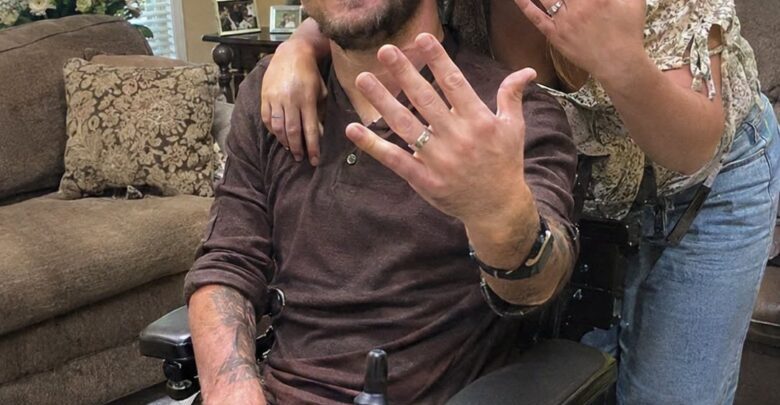
The ring slid onto my finger.
He let out a breath like a man who had finally gotten his feet under him in shallow water.
Father Tomasz pronounced us married.
Dana blew her nose so loudly that Carl laughed.
For ten days, I was his wife.
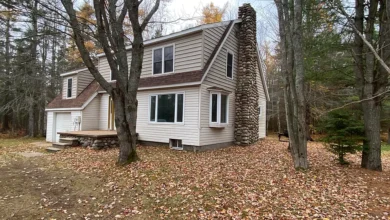
I moved into the house on Baldwin Street. I slept on a cot next to his hospital bed in the living room. The hospice service had brought the bed in the week before. It took up half the room. We moved the couch with the missing leg into the kitchen to make space.
I cooked while he directed me from a chair, with the confidence of a man who hadn’t personally cooked anything since 2011.
“More garlic.”
“There’s already four cloves in it.”
“There’s no such thing as too much garlic.”
“Carl, you can barely taste anything.”
“Then it’s for you,” he said. “You like garlic. I’m being generous.”
We watched old movies. He had opinions about all of them, especially the westerns.
“John Wayne,” he said, “couldn’t act his way out of a paper bag.”
“He won an Oscar.”
“For one movie. Out of a hundred and seventy. That’s a terrible batting average.”
I read out loud in the evenings once his eyes got too tired to follow a page. Steinbeck. Dickens. A mystery novel about a dead body in a lighthouse that he said was the worst book he’d ever heard and made me finish anyway.
We finished four games of Scrabble.
He won three.
I have never stopped being irritated about the third one. He played QI on a triple word score and argued that it was a legitimate word for eleven minutes. It is. I knew that. But he’d spent the whole game telling me it wasn’t, so I’d been saving my Q.
“You lied,” I said.
“I bluffed,” he said. “There’s a difference.”
“What’s the difference?”
“Bluffing,” he said, “is lying with style.”
On the fifth day, I had a birthday.
I didn’t tell him. I haven’t really celebrated my birthday since I was a kid. It’s not a sad thing. It’s just a habit. I don’t think about it much.
But when I came in from the kitchen that morning, there was a cupcake on the tray table next to his bed.
A single cupcake. Chocolate. From the Wealthy Street Bakery. With one candle stuck in it, unlit.
“Happy birthday,” Carl said.
I stared at it.
“How did you know?”
He smiled. He didn’t answer.
“The teenager next door went and got it,” he said. “Cost me another twenty dollars. That kid is getting rich off me.”
I didn’t think anything of it.
I thought it must have been on my volunteer file. On the paperwork at the center.
I lit the candle with a kitchen match. I blew it out. We split the cupcake. He could only eat two bites.
“What did you wish for?” he asked.
“I’m not telling you.”
“Was it about Scrabble?”
“It might have been about Scrabble.”
He laughed until he started coughing.
On the eighth night, I came in from the kitchen and found him lying back against the pillows with a paperback held flat against his chest with both hands.
The cover was worn down to almost nothing. The title was scuffed away. The spine was white with creases. The corners were soft as cloth.
“What book is that?” I asked.
“My favorite.”
“Can I see it?”
He pressed it tighter against his chest, like a kid hiding a report card.
“Not yet,” he said.
I teased him about it. I said a man who’d shown me his medical chart, his bank statements, and the inside of his refrigerator was drawing the line at a paperback.
He smiled.
He didn’t hand it over.
That night, I woke up around three in the morning on my cot.
The living room was dark except for the little nightlight by the hospital bed. Carl was awake. He was lying on his side, facing me.
He was holding the book.
He was looking at me.
“Carl?” I whispered. “Are you okay? Do you need something?”
He didn’t answer right away.
“No,” he said. “I’m good. Go back to sleep.”
“What are you doing?”
He was quiet for a long time.
“Just making sure,” he said.
I didn’t ask making sure of what.
I was half asleep. I rolled over and closed my eyes.
I wish I’d asked.
Two mornings later, Carl died with my hand under his.
It was a Sunday. Early. Before sunrise. Gloria had come by the night before and said it would probably be soon. His breathing had changed. Long pauses between breaths. Then a gasp. Then another pause.
I sat next to the bed all night.
I held his hand. I didn’t talk. I didn’t need to.
Around five-thirty, his eyes opened.
He looked at me.
He squeezed my hand. Very weakly. Just once.
His lips moved.
I leaned in.
I couldn’t hear what he said.
I’ve wondered every day since.
Then he closed his eyes.
His last breath went out so gently that I sat there for a while afterward, still holding on. It took me a while to understand that the room had gone quiet in a different way than before.
There were eighteen people at the service.
I counted. It seemed important to know.
It was at St. Andrew’s. Father Tomasz did it. A plain pine casket at the front. Carl had picked it himself. He’d said anything fancier would be “a waste of a perfectly good tree.”
Most of the people were friends of his I’d never met. And former students. Grown people now, some of them in their thirties. A woman in scrubs. A man in a mechanic’s uniform with his name stitched on the pocket. A young guy in a suit that didn’t fit, who kept tugging at his collar.
Several of them came up to me after the service and said some version of he was my favorite teacher, and then couldn’t say anything else.
One of them, the young guy in the suit, stood in front of me for a long time.
“I didn’t know he got married,” he said.
“Ten days ago.”
He nodded.
“He never talked about anybody,” he said. “Not once. In four years. We used to tease him about it. ‘Mr. Reeves, you got a girlfriend?’ And he’d just say, ‘I’m waiting for someone to stop by.’”
He tugged at his collar.
“We thought it was a joke,” he said.
Somebody left a paper lunch bag beside the casket.
Just a plain brown bag. Folded over at the top. The way you’d fold it if you were putting it in a backpack.
Somebody else left a blue birdhouse.
Small. Handmade. Painted a bright, ridiculous robin’s-egg blue. With a little white door painted on the front.
I stood there looking at both of those things and had absolutely no idea what either one meant.
Driving home, I thought I’d done a decent thing.
I thought I had given a very lonely man ten days of belonging at the end of a hard life. I thought that was the shape of the story.
I had it completely backwards.
I just didn’t know that yet.
Around seven that evening, somebody knocked on my door.
I was back in my own apartment. A one-bedroom on the second floor of an old house on Cherry Street. I hadn’t been there in ten days. It smelled stale. There was a stack of mail on the floor inside the door.
I was sitting on the couch in my funeral dress. I hadn’t taken off my shoes.
The man on my porch was maybe sixty. He was wearing a charcoal overcoat and carrying a leather briefcase that had clearly been carried for a very long time. The handle was worn smooth. One of the brass latches was missing.
“Selena?”
“Yes.”
“My name is Baron. Elliot Baron. I was Carl’s attorney.”
I stepped back to let him in.
He stayed exactly where he was on the porch.
“When I met with him,” he said, “it was nine days ago, the day after the wedding, he made me promise not to come to you until after the funeral. I knew he didn’t have much time. I didn’t expect that to be the last conversation I’d ever have with him.”
“Why after the funeral?”
Mr. Baron opened the briefcase and took out a sealed envelope. It was thick, and my name was on the front.
In handwriting I recognized immediately. Small and careful. The same handwriting from the Scrabble score sheets.
“He said,” Mr. Baron said, “that you needed to grieve the man you knew before you found out who he’d been.”
My fingers went stiff around the paper.
“What does that mean?”
He let out a long breath. For a second, he looked like a man who wished somebody else had gotten this job.
“It means,” he said, “that he made me wait until today to tell you who he actually was.”
I opened it standing in my own front hallway.
Mr. Baron finally stepped inside and stood by the door, holding his briefcase in both hands.
Carl’s handwriting was careful and small at first. It got shakier as the pages went on. I’ve read those pages so many times since that I don’t need them in front of me anymore.
Selena,
Our meeting was not an accident.
Before I was your husband, I was the awkward kid who lived two houses down from you and spent every autumn hoping you’d stop by Arthur’s workshop.
My knees went out from under me.
Mr. Baron caught my elbow. That’s the only reason I didn’t hit the floorboards. The letter fell out of my hand and slid across the hallway floor.
Two houses down.
Arthur’s workshop.
A narrow alley between two garages. The smell of sawdust and bicycle grease and the particular rubber smell of new inner tubes.
The whole thing opened up in my chest so fast I couldn’t get air behind it.
“Silver Oak Street,” I whispered.
Mr. Baron nodded once.
I lived on Silver Oak Street until I was fourteen years old.
A little white house with green shutters on the west side of Grand Rapids. Two bedrooms. A porch with a swing that squeaked. A maple tree at the corner where the alley opened out.
My father worked at the Steelcase plant. My mother worked the front desk at a dentist’s office on Leonard Street. They were ordinary people. They were good people.
Then, on a Tuesday afternoon in March, a man ran a red light on US-131. My parents were on their way home from my school conference. Mrs. Bremmer, eighth grade math, had wanted to talk about whether I was ready for advanced algebra.
They died at the scene.
I went into foster care.
That night, a woman from the county picked me up from my best friend’s house. She took me to an office downtown with fluorescent lights and gray carpet. She gave me a garbage bag and told me to put my clothes in it.
Strangers packed up our house. Everything. My bedroom. My mother’s kitchen. My father’s workbench in the garage. They put it all in boxes and took it somewhere I never saw again.
I sat in that county office holding a black garbage bag with my clothes in it until two in the morning, waiting for somebody to come take me somewhere.
I went to four foster homes in four years.
One in Wyoming, Michigan. One in Kentwood. One in Holland. One in Muskegon.
Some of them were fine. One of them wasn’t.
I aged out at eighteen. I went to community college. I worked at a Meijer stocking shelves at night. I got a job at the Grand Rapids Public Library. I’ve been there twelve years now. I started volunteering with hospice at twenty-four, after the woman who ran my last foster home died and nobody came to sit with her.
I never went back to Silver Oak Street.
Not once.
Not because of trauma, exactly. There was just nobody there. There was nothing to go back to.
And after a while, not going back becomes something you’re doing on purpose, even though you never decided to.
Mr. Baron got me into a chair in my living room.
I sat there with my hands in my lap. The letter was still on the hallway floor.
“There was a boy,” I said slowly. “Quiet. Dark hair. He lived with his grandfather.”
“Carl,” Mr. Baron said.
“No,” I said.
It came out too fast. We both heard it.
Because the boy on Silver Oak Street barely spoke to anyone.
He fixed bicycles behind his grandfather’s house, in a shed with a hand-lettered sign. He had a bad stutter that got worse when people looked at him. He kept his eyes down. He wore the same brown jacket every day. He walked to school alone, ten minutes early, so he wouldn’t have to walk with anybody.
The other kids on the street called him Ca-Ca-Carl.
I never did. But I never stopped them either.
And the man I’d just buried argued about books. He laughed at his own jokes. He once spent forty minutes explaining to me why he considered a particular Scrabble word to be a moral failing.
The word was ZA.
He said abbreviations had no business being in the dictionary and the people at Merriam-Webster should be ashamed of themselves.
“They’re not the same person,” I said.
Mr. Baron lowered himself into the chair across from me.
“Carl lost both his parents when he was seven,” he said. “A house fire. In Kalamazoo. He was at a sleepover. Arthur was his mother’s father. Arthur raised him from then on.”
He set the briefcase down on the floor.
“Carl spent the next twenty-nine years becoming somebody,” Mr. Baron said. “He worked at it like a job. Speech therapy. Toastmasters. A debate club at Grand Valley he was terrified of. He used to practice talking in front of a mirror for an hour every night. When he was in college, he read every book on the shelf of the public library on Lake Drive. Out loud. To himself. To get his mouth used to the words.”
I put my hand over my mouth.
“He told me once,” Mr. Baron said, “that every sentence he ever said out loud without stopping felt like crossing a bridge he’d built himself.”
Arthur.
I could see his hands.
Cracked across the knuckles. Permanently stained with grease. Always moving. Always fixing something.
He had a voice like a low radio. Warm. Crackly. He hummed Hank Williams songs while he worked.
He built birdhouses in the winter, when nobody needed a bicycle fixed. He painted them ridiculous colors and gave them away. To neighbors. To the church. To the mailman. To anybody who walked by and said they liked them.
Blue ones, mostly.
Robin’s-egg blue. With little white doors painted on the front.
I sat in my chair and thought about the blue birdhouse next to the casket.
I had to put my hand over my mouth.
I remembered bringing Arthur soup one January when he had the flu.
My mother made it. Chicken noodle. She handed me the pot wrapped in a dish towel and said, “Take this to Mr. Reeves. Nobody should have to eat alone when they’re sick.”
That sentence has been in my head my whole life.
Nobody should have to eat alone when they’re sick.
It’s why I started doing hospice. I’ve said it to Gloria a hundred times. I’ve said it in volunteer trainings.
I’d never once thought about where it came from.
And I remembered, faintly, like something at the far end of a long hallway, a shape behind the workshop door while I stood there in the doorway talking to Arthur.
A kid. Watching.
And then it all started coming back.
The sawdust.
The rack out front with three bikes chained to it.
The hand-painted sign. REEVES BIKE REPAIR. FAIR PRICES. HONEST WORK.
The coffee can of loose bolts on the workbench that Arthur would rattle when he was thinking.
The old radio on the shelf, tuned to the country station out of Muskegon.
And one Saturday in October.
I was thirteen.
I’d walked down the alley to see if Arthur had fixed my chain yet. My bike was a purple Huffy with white streamers on the handlebars. The chain kept slipping off.
There was a customer in the workshop.
A man in his forties. In a hurry. Unhappy about something. Wearing a Michigan State windbreaker and an expensive watch. His kid’s bike wasn’t ready, or wasn’t right.
And Arthur wasn’t there. He’d gone to the hardware store on Bridge Street for a part.
Carl was the only one in the shop.
Carl opened his mouth to explain.
And it locked.
Completely.
He got the first sound out. “M-m-m—”
And then nothing else would come.
He tried again. “M-m-m-m—”
It got worse. His face went red. His hands were shaking.
And the man’s face went through impatience into something meaner than that.
“Jesus Christ, kid,” the man said. “Spit it out.”
Carl tried again.
Nothing.
“Forget it,” the man said.
He pulled the bicycle out of Carl’s hands so hard that Carl stumbled backward into the workbench. The coffee can of bolts fell off and spilled across the concrete floor. Hundreds of bolts, rolling everywhere.
The man walked out with the bike.
He let the door bang.
Carl went out the back before anybody could say a word.
I stood there for a second in the doorway, looking at the bolts all over the floor.
Then I went after him.
I found him about a minute later. Sitting on the curb at the mouth of the alley. Under the big maple tree at the corner. With his forearms on his knees. Staring at the pavement.
I was thirteen years old.
I had no idea what to say to him.
So I sat down on the curb about two feet away.
And I didn’t say it wasn’t your fault.
And I didn’t say that guy was a jerk.
And I didn’t say are you okay.
I said, “Okay, so there’s a kitten under our porch.”
And I told him the whole saga.
It wouldn’t drink milk, which I had been led to believe was impossible for a kitten. It was obsessed with shoelaces to a degree that seemed medically concerning. It had bitten my father on the thumb, and my father had said a word I wasn’t supposed to hear and then pretended he hadn’t.
I told him my mother wanted to call it Mittens, which was boring, and my father wanted to call it Thumb-Biter, which was mean, and I didn’t know what to call it.
I talked for probably ten minutes about a cat.
At some point, Carl said something.
Very quietly. Without looking up.
“B-b-b… Biscuit.”
I looked at him.
“Biscuit?”
He nodded. Still looking at the pavement.
“It l-l-looks like a b-b-biscuit,” he said. “Under the p-porch. All c-curled up.”
I thought about it.
“That’s perfect,” I said. “Biscuit. That’s way better than Mittens.”
And by the time we got up off that curb and walked back around to the front of Arthur’s shop, Carl was smiling.
We picked up all the bolts together. It took twenty minutes. We didn’t talk much.
When Arthur came back from the hardware store, he found us sitting on the workshop floor sorting bolts by size into little piles.
He looked at us for a long time.
He didn’t say anything.
He just went over to the radio and turned up the Hank Williams.
I forgot that afternoon within a month.
It never once crossed my mind again in twenty-two years.
We named the kitten Biscuit.
She lived with us until March. When the county took me, they took her to the shelter.
I never found out what happened to her either.
He didn’t forget that afternoon for one day of his life.
Mr. Baron picked the letter up off my hallway floor and put it back in my hands.
I kept reading.
You talked to me like nothing had happened.
I was thirteen, and I was completely certain that one bad minute had permanently changed how every person on that street would look at me for the rest of my life. I believed that. I want you to understand that I believed it the way you believe the floor is solid.
I’d already decided I wasn’t going back to school on Monday. I’d already decided I wasn’t going to talk anymore. To anyone. Ever. Not at the shop. Not at school. Not at home. I’d figured out that if I didn’t talk, nobody could watch me fail at it.
And then you sat down on a curb and asked me whether I thought the kitten needed a name.
And I gave it one.
Do you understand what that means? I said a word. Out loud. To a girl. Ten minutes after I’d decided I was never going to speak again.
You gave me an ordinary afternoon when pity would have finished me.
I pressed the paper against my mouth and cried in front of a man I’d known for twenty minutes.
Mr. Baron opened his briefcase again.
He took out a leather journal. Soft-cornered. The cover gone dark where hands had held it.
“This is yours,” he said. “He was very specific about the word. Not for you. Yours.”
Inside the front cover, in Carl’s careful handwriting, was my name.
Selena.
Just that.
The first dated entry was from the year after I left Silver Oak Street.
The handwriting was a teenager’s. Messy. Pressed hard into the paper.
Selena, age 15.
I hope high school is kinder than last year was.
I turned the page.
Age 16. I hope somebody in that house asks her how her day went and actually waits for the answer.
I had to stop.
The house in Holland. The year I was sixteen. Nobody asked how my day went. Not once. For nine months.
Age 17. I hope she still has a bike.
Age 18. I hope she finds a place where nobody packs her life into bags.
Age 20. I hope somebody laughs when she laughs.
Age 23. I hope she isn’t still doing everything alone out of habit.
Age 25. Grandpa died today. Not today. In March. But I’m writing this on her birthday, the way I always do. I hope she has someone to call when bad things happen.
Age 27. I hope she has a chair that’s hers. A specific one. I hope people know not to sit in it.
Age 30. I got my own classroom this year. Room 214. I hope she has work that matters to her.
One entry a year. Every year. For twenty-one years.
He would open the journal on my birthday, write down one hope, close it, and go back to his life.
That was the whole ritual. That was the entire arrangement he had with a girl he’d known for maybe eighteen months when he was thirteen years old.
The cupcake.
The cupcake from the Wealthy Street Bakery. With the one candle.
How did you know?
He’d smiled. He hadn’t answered.
He’d been writing in this journal on my birthday for twenty-one years.
Of course he knew.
“He became a history teacher,” Mr. Baron said. “Ninth and tenth grade. At Ottawa Hills High School. Twelve years at the same school.”
I thought about Mr. Whitcomb and the jar of Juicy Fruit gum.
And I understood something about the shape of a life.
“He kept extra lunches in his desk drawer,” Mr. Baron went on. “Every day. Peanut butter and jelly. An apple. A bag of chips. In brown paper bags. He made them himself every morning. Three or four of them.”
He looked at his hands.
“He never made a thing of it,” he said. “Kids just knew that if you didn’t have one, you could go ask Mr. Reeves, and he’d act like you were doing him a favor by taking it off his hands. He’d say, ‘Oh, thank God. I made too many again. You’d be helping me out.’”
The paper lunch bag beside the casket.
Folded over at the top.
I put my head in my hands.
“He stayed after school,” Mr. Baron said. “Every day until at least five. Not for tutoring. For the kids who didn’t want to go home yet. He’d grade papers and let them sit in his room and he wouldn’t ask them anything. Some of them did homework. Some of them slept. Some of them just sat.”
He paused.
“And in the winter,” he said, “he’d teach them to build birdhouses. Out of scrap wood. In the back of the art room. With Arthur’s old tools.”
The blue birdhouse.
“He painted them blue,” Mr. Baron said. “All of them. Every year. He said it was a family tradition.”
He paused again.
“Selena,” he said. “I want to be clear about something, because I think you’re going to get this wrong if I’m not. He did not center his life on finding you. That’s not what this was. He centered his life on becoming the kind of person that one afternoon taught him it was possible to be.”
My tears went straight down onto the open journal. I had to lift it away from my face so the ink wouldn’t run.
“Why didn’t he ever contact me?”
“He tried,” Mr. Baron said. “Once.”
He took a yellowed envelope out of the briefcase.
It was addressed in a teenager’s messy handwriting. To Selena. At a foster home in Holland, Michigan. Care of the Michigan Department of Human Services.
It had been stamped. And then stamped again by the post office.
RETURN TO SENDER. NO LONGER AT THIS ADDRESS.
Unopened.
“He was seventeen,” Mr. Baron said. “It took him two years to find out which county you’d gone to. He called every Department of Human Services office in West Michigan. Pretending to be your cousin. One of them finally gave him an address.”
He looked at the envelope.
“By the time the letter got there,” he said, “you’d already been moved to Muskegon.”
I took the envelope.
I didn’t open it.
I just held it.
“After that came back,” Mr. Baron said, “Arthur sat him down. And told him something I think Arthur believed was kind. He said a girl who’d lost everything deserved to build a new life without the old neighborhood reaching in and pulling on her sleeve.”
Mr. Baron looked at his hands.
“Arthur was wrong,” he said. “But he wasn’t cruel. And Carl was seventeen. And he believed him.”
And then it hit me.
The Scrabble game.
His mouth open, and nothing coming out. His hand on the edge of the table. His knuckles going white.
And me, looking out the window. Telling him a ridiculous story about a woman locked in a supply closet who’d been mistaken for a raccoon.
You did that on purpose.
He hadn’t been guessing.
He’d been confirming.
Mr. Baron handed me the next page of the letter.
Carl had written it all out himself.
When you changed the subject that afternoon, time folded in half.
I was thirteen again. And you were sitting on a curb beside me, talking about a kitten. Because you’ve understood since you were a child that sometimes the gentlest thing you can do for a person is refuse to look directly at their pain.
You didn’t remember.
That made it more beautiful, not less. You weren’t being kind to someone with a history. You were just being who you are, to a stranger, on a Thursday.
I knew then that I had to ask you to marry me.
Not because I wanted you to remember. Because I wanted you to choose me without remembering. I wanted to know if the girl on the curb would pick the man in the chair, with no history to push her. Just him. Just the last four months.
You did.
I looked up at Mr. Baron.
“How did he find me?” I said. “After all that time?”
Mr. Baron reached into the briefcase one more time.
He took out the faded paperback.
The one Carl wouldn’t show me. The one he’d held against his chest on the eighth night. The one he was holding at three in the morning while he watched me sleep.
Just making sure.
He set it on my coffee table.
“He didn’t find you all at once,” he said.
He opened it about two-thirds of the way through.
Between the pages lay a maple leaf.
It had been red once. Now it was rust-brown, brittle as a moth’s wing, and pressed perfectly flat.
I knew what it was before my fingers got there.
The fall I was thirteen, a few weeks after the afternoon on the curb, I borrowed a book off the shelf in Arthur’s front room.
It was Carl’s. His favorite. A beat-up paperback copy of To Kill a Mockingbird. He’d read it eleven times. He told me that. Or he tried to. It took him a while.
I kept it a week.
When I brought it back, I’d picked up a leaf off the sidewalk under the maple tree on the way, a big red one, and slid it between the pages.
“There,” I told him. “Now you’ll never lose your place.”
It was a joke. It took four seconds.
I said it, handed him the book, and went home for dinner.
He kept it for twenty-two years.
Something burned in my throat and wouldn’t go down.
“Arthur died when Carl was twenty-five,” Mr. Baron said quietly. “And by then, Carl had convinced himself that reaching out would be strange. A grown man looking up a girl he knew for a year and a half when he was thirteen. He had a whole speech about why it would be inappropriate. I heard it twice.”
He looked at the leaf.
“He used to say, ‘She’s had enough people show up in her life uninvited. I’m not going to be one more.’”
“So he never looked for me,” I said.
“He never looked for you,” Mr. Baron said. “Not after the letter. Not once. For eighteen years.”
He paused.
“And then, last spring, he got the diagnosis. And the oncology social worker at Spectrum handed him a pamphlet for hospice volunteer services. With a list of volunteers on the back. Names and first initials. And there you were.”
He shook his head slowly.
“That’s it,” he said. “That’s the whole thing. Somebody handed him a list, and there you were. Selena M. Third from the bottom.”
“And he made exactly one request,” Mr. Baron said.
“What did he ask for?”
“He said, ‘Her. If she’s willing.’”
Mr. Baron smiled for the first time all evening.
It was a sad, warm thing.
“And Selena,” he said, “he didn’t ask for you so he could tell you who he was. He never intended to tell you at all while he was alive. He asked because after twenty-two years of quietly hoping you were all right, he finally had one chance to actually find out.”
He looked at the journal in my lap.
“He wanted to meet the woman you’d turned into,” he said.
Carl had expected the question.
Of course he had. He’d had four months to write the thing.
I didn’t ask for you because I expected gratitude. You’d owe me nothing even if you remembered. And you didn’t remember, which was always the most likely outcome, and the one I’d prepared for.
I wanted to know whether life had been kind to you. That’s all. That was the whole ambition.
Then you came through my door with vegetable soup. You moved a laundry basket full of books without once making me feel like an invalid. And you argued for eleven minutes that QI is a legitimate word. Which it is. Which I knew. Which I disputed purely to see what you’d do.
I knew it was you right away. Not because you looked the same. You don’t, particularly. Your hair is shorter. You don’t wear the yellow barrette anymore.
I knew because you made the room easier to stand in. You’ve always done that. I don’t think you know you’re doing it. I think that’s why it works.
I turned to the back of the journal.
Age 34. I hope she knows that ordinary kindness is never ordinary to the person who needed it that day.
And then, the last entry.
Dated three days after our wedding.
My birthday.
The day of the cupcake.
The handwriting was so bad by then that I had to hold it up to the lamp to read it.
Age 35.
She did.
And underneath, in even shakier letters, one more line he’d clearly gone back and added later:
And so did I.
I sat in my living room and cried until my ribs hurt.
Mr. Baron sat across from me. He didn’t say anything. He didn’t lean in. He didn’t put his hand on my arm. He didn’t make a soft, sympathetic face.
He just looked out my window at the street.
I’m almost certain Carl told him to do that.
When I could finally breathe again, I understood why Carl had proposed the way he did.
With no explanation. No history. No context at all.
If he’d told me first, I would have said yes.
Immediately. Out of guilt. Out of grief. Out of the terrible weight of finding out that a dying man had been quietly hoping I was okay since we were both children.
He didn’t want that yes.
He wanted the other one.
The free one.
So he kept the biggest thing about himself locked in a drawer for four months. And he let me choose him based on nothing but those four months.
I’ve thought a lot about how much restraint that took.
Four months. Sitting across the Scrabble board from me. Watching me drink tea out of his chipped blue mug. Listening to me hum four bars of a song I didn’t know the name of.
Knowing the whole time.
And never saying a word.
I don’t think I have it in me.
I don’t think most people do.
Mr. Baron left around ten.
At the door, he stopped.
“There’s one more thing,” he said. “He left you the house. On Baldwin. It’s a rental, but he’d been buying it on a land contract from the owner for six years. It’s paid off. And his books. And a little money. Not much. A teacher’s pension. A small life insurance policy.”
He looked at me.
“He said you’d know what to do with the books,” he said.
“Mr. Baron,” I said. “That morning. When he died. He said something. Right before. I couldn’t hear it.”
Mr. Baron looked at me for a long time.
“I don’t know what he said,” he said. “But I know what he told me he wanted to say. At the end. He practiced it. For weeks. In my office. Over and over. Like he used to practice in front of the mirror.”
“What was it?”
Mr. Baron smiled again.
“Biscuit,” he said.
I found out about the lunch bag the next week.
The young man in the suit that didn’t fit. His name was Darnell Washington. He’s twenty-six now. An EMT with the Grand Rapids Fire Department.
He called the library. He asked for me by name. He’d seen the obituary.
We met at a coffee shop on Wealthy Street.
“I left the bag,” he said. “At the funeral. I’m sorry if it was weird.”
“It wasn’t weird.”
He turned his coffee cup around on the table.
“My mom was sick my whole freshman year,” he said. “Kidney failure. Dialysis three times a week. My dad wasn’t around. I was taking care of her and my two little sisters. We didn’t have money for groceries half the time.”
He looked out the window.
“I came to school without lunch every single day for a year,” he said. “And every single day, Mr. Reeves would find me in the hallway before fifth period and say, ‘Darnell, thank God. I made too many again. Please take one. You’re saving me.’”
He swallowed.
“Every day,” he said. “For a year. Peanut butter and jelly and an apple and a bag of Doritos. And he never once asked me why I didn’t have lunch.”
He looked at me.
“I didn’t even know he knew,” he said. “Until my senior year. When I found out he’d been doing it for like ten other kids too.”
He reached into his jacket. He took out a folded piece of brown paper.
The top of a lunch bag. Torn off. Old. Soft.
There was handwriting on it. Small and careful.
Darnell — Good luck on the bio test. You’re smarter than you think. — Mr. R.
“I kept them,” Darnell said. “All of them. He wrote something on every single one. I’ve got like a hundred and eighty of these in a shoebox.”
He put it back in his jacket.
“He kept me alive that year,” he said. “I’m not being dramatic. I mean it. He kept me going.”
I didn’t say anything.
I just sat there with my coffee.
Ordinary kindness is never ordinary to the person who needed it.
The woman who left the birdhouse found me a few days after that.
Her name was Rosa Mendez. Thirty-one. An art teacher now. At an elementary school in Wyoming, Michigan.
Five minutes from my first foster home.
She’d built the birdhouse when she was fifteen. In the back of the art room. After school. With Arthur’s old tools.
“He taught me how to use a coping saw,” she said. “And how to sand the edges so they don’t splinter. And how to paint the little door on the front so it looks like it opens.”
She smiled.
“I asked him why all the birdhouses had to be blue,” she said. “He said his grandpa always made them blue. He said blue was the color of a sky you could actually reach.”
She looked at me.
“I didn’t have a good home,” she said quietly. “I’m just going to say that. I didn’t want to go home after school. Ever. And he knew. He never asked me about it. Not once. He just let me sit in his classroom until five o’clock every day for three years and build birdhouses.”
She wiped her eyes.
“I teach my kids to build them now,” she said. “Every winter. Blue. With little white doors.”
Autumn came in that year the way it does in Michigan.
All at once. With a cold front on a Thursday.
Six weeks after the funeral, I drove out to Silver Oak Street on a Saturday morning.
With Carl’s paperback on the passenger seat.
Arthur’s house was gone.
So was the workshop.
There’s a squat three-story apartment building there now. Beige siding. With a parking lot where the alley used to be. The bike rack is long gone. The sidewalk has been replaced with the smooth kind that doesn’t crack.
My own old house is still standing.
Somebody painted it gray and put a basketball hoop over the garage. The porch swing is gone. The green shutters are gone. There’s a plastic Big Wheel on the front walk.
I didn’t stop.
But the maple was still there.
Bigger. A lot bigger. But unmistakably the same tree. At the corner where the alley used to open out. Its trunk was thick and gray. Its branches spread out over the sidewalk and the street.
It was doing exactly what it does every October.
Burning red.
I parked my car.
I sat down in the grass underneath the tree. On the curb. About where Carl had been sitting twenty-two years ago, with his forearms on his knees, staring at the pavement.
I put the book in my lap.
When I opened it, the pressed leaf came loose and slid down onto my knee.
I sat there for a long time, thinking about what that leaf had actually been.
For twenty-two years, whenever life gave Carl a reason to doubt whether small kindnesses mattered, he had opened that book.
When a kid didn’t take the lunch. When his stutter locked up in front of a room of ninth graders. When the letter came back from Holland unopened. When Arthur died. When the doctor said stage four. When he got old enough to wonder whether the whole business of being decent was just something people said.
And there inside was one ordinary October afternoon.
A girl on a curb. A kitten that wouldn’t drink milk. A red leaf shoved between two pages as a joke.
Nothing heroic.
Nothing I ever thought about again.
It became the thing he steered by.
I put my hand flat over the leaf on my knee.
“You spent your whole life thanking me,” I said out loud, “for something I never knew I gave you.”
I said it to a tree. In front of an apartment building. On a Saturday morning in October.
A woman walking a dog went by on the sidewalk and looked at me.
I didn’t care one bit.
The branches moved overhead.
Red leaves came down across the sky above me. Hundreds of them. Like small bright letters somebody had thrown up into the air.
I thought about putting the leaf back between the pages, where it had lived since I was thirteen years old.
Instead, I set it down in the grass at the base of the trunk.
Not thrown away.
Returned.
Then I closed the book and carried it home.
It sits on my nightstand now. Next to the leather journal. Next to an unopened envelope addressed in a seventeen-year-old’s handwriting to a foster home in Holland, Michigan.
I’ve never opened that letter.
I don’t think I need to.
I think I already know what it says.
I moved into the house on Baldwin Street in November.
I kept all the books. Every single one. The paperbacks on the radiator. The hardcovers holding up the corner of the couch. The ones in the laundry basket by the front door.
I fixed the couch leg. With a piece of scrap wood and some wood glue and a coping saw. Rosa came over and showed me how.
I bought a cushion for one of the kitchen chairs.
It’s mine. Nobody sits in it.
The chipped blue mug is in the cabinet.
I drink my tea out of it every morning. With too much honey and no milk.
And in January, I started something.
At the library. In the community room. On Tuesday afternoons. From three to five.
I call it the After-School Room. Any kid can come. No sign-up. No questions. There are books. There are board games. There’s a Scrabble set. There’s a basket of brown paper lunch bags on the table by the door. Peanut butter and jelly. An apple. A bag of chips.
On every bag, I write something on the top fold.
You’re smarter than you think.
I’m glad you came today.
Take your time.
Most days, six or seven kids show up.
Some of them do homework. Some of them read. Some of them sleep with their heads on the table.
Some of them just sit.
I don’t ask them anything.
In February, a skinny boy of about thirteen started coming. Dark hair. Eyes always down. He had a stutter. A bad one. He didn’t say a word for the first three weeks.
On the fourth week, he sat down at the Scrabble board by himself and started moving tiles around.
I sat down across from him.
I didn’t say anything.
I just picked up a rack of tiles.
He looked at me.
He opened his mouth.
“D-d-do you ch-ch-cheat?” he said.
I looked at him for a long second. The way you look at somebody when you’re deciding something.
“Only when necessary,” I said.
He smiled.
He laid down his first word.
I’ve gone back to hospice too. Three days a week, like before.
Gloria still runs the Boundaries training every spring. With the laminated handout. I still go. Every year.
But I’ve started doing something I never did before.
I no longer assume the person in that chair is a stranger.
Not completely.
Because you never know what you did once, on some ordinary afternoon you’ve completely forgotten.
You never know who’s been carrying it around ever since.
That’s the thing about ordinary kindness.
It’s never ordinary to the person who needed it.