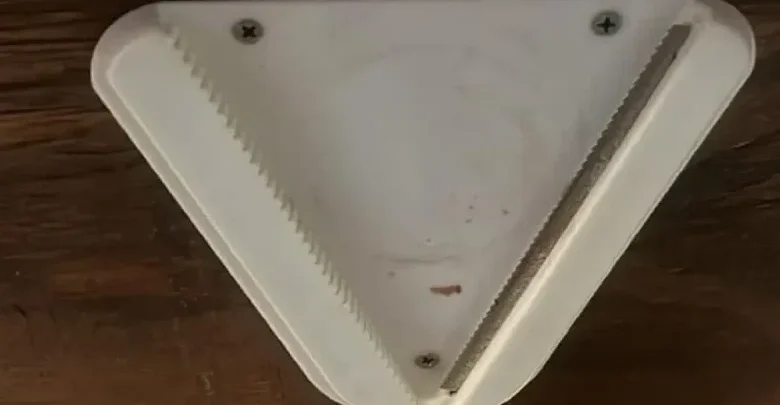
A woman moved into a new house, looked under a kitchen cabinet, and found a little metal device already fixed to the underside. She had no idea what it was. The object looked jagged and circular, with a row of teeth, and it was just sitting there as if it belonged to the cabinetry itself. She posted a picture in a housewives’ group and asked the obvious question: what is this?
The group had an answer. According to the write-up that spread the photo, the mystery object is an under-cabinet jar opener, a kitchen tool that was common in the late 1980s and early 1990s. It is not a decoration, a hook, or a leftover piece of hardware. It is a tool for lids that will not budge.

Once you know what it is, the design makes a lot of sense. The opener lives out of the way, screwed to the bottom of a cabinet, so it does not take up drawer space or sit on the counter.
You only notice it if you happen to look up. When a pasta-sauce or pickle lid is sealed tight, you bring the jar to the opener instead of hunting for a rubber grip or tapping the lid on the edge of the counter.
How the Under-Cabinet Jar Opener Works
The idea is simple. The opener is mounted below the cabinet and stays there, ready whenever you need it. You lift the jar so the lid meets the gripper. The teeth, or a rubber edge, depending on the model, catch the lid. Then you hold the jar and twist. Some models want a slight pull and turn at the same time. A few have a small lever or a rotating piece.
In every case, the point is the same: the cabinet holds the opener steady so you can put more force on the lid than you might manage with your hands alone.
That extra grip is the whole reason these things existed. A lid that feels hopeless in your palm can pop loose once it is held still from above. After the seal breaks, you finish unscrewing the lid by hand, the way you would with any ordinary jar.

Most of the openers described in the original write-up are adjustable. They are not one-size-fits-all, because jar lids come in a surprising range of diameters. Some models have a knob you turn to tighten or loosen the opening.
Others have sliding teeth that you move until they match the lid. You set the grip to the size you need, then lift the jar into place. It is a small adjustment, but it is the step people skip when the tool first looks confusing.
If You Want to Keep One, Mount It With Care
If the opener in a new house is already screwed in and feels solid, you may not need to move it. If you are putting one up yourself, the first job is choosing a spot that is easy to reach and not in the way. You do not want it in a place where you lean over to chop food, or so far back that you have to stretch every time a lid sticks. You also want a patch of cabinet underside that is clean.
Kitchen grease collects in odd corners, and a greasy surface is a poor place for screws.
The original write-up says the opener is mounted with screws. A new one usually comes with them. A used one may not, so you have to use hardware that actually holds. This is not a job that calls for special training, but it does need to be secure. If the opener wobbles or feels as if it could rip out when you twist a stubborn lid, it is not ready. Tighten it, or move it to a sounder piece of wood, before you put real force on it.
The triangular white opener in the photo that started this conversation has a toothed edge and a metal gripping strip, with screws visible in the corners. Other versions, including some still sold as under-cabinet openers, are round plates with a sliding grip.
They do not all look identical, but they share the same basic job: hold the lid still while you turn the jar.

It also helps to keep your expectations in line with the tool. An under-cabinet opener is built for screw lids, the kind you find on sauce, pickles, jam, and peanut butter. It will not help with a can that needs a key or a pull ring, and it will not replace a careful grip if the lid is greasy. Wipe the lid first if it is slippery, set the opener to the right diameter, and then lift the jar straight up into the grip.
If the teeth slip, stop and adjust rather than forcing the jar at an angle, which can chip a lid or loosen the mount.
People who inherit one of these often wonder whether a stained, older model is still worth keeping. If the plastic is intact, the screws hold, and the gripper still catches a lid, a thorough wash is usually enough. A toothbrush helps around the teeth. Dry it well so hidden rust does not get a head start on the hardware. If the mount is cracked or the opener shifts when you twist, it is safer to retire it than to test it on a heavy jar.
What to Do If You Find One in a New Home
If you are lucky enough to find one of these already installed, the advice from the original write-up is simple: do not rip it out on the first day.
Give it a cleaning, check that the screws are snug, and leave it in place. It may save you the next time a jar of sauce is sealed tighter than you expected.
That small wave of recognition is part of why the photo traveled. Plenty of people had walked past the same device for years, or had lived with one in a parent’s kitchen, without having a name for it. A single picture of a toothed white triangle under a cabinet was enough to bring the tool back into the conversation. No Wi-Fi, no extra gadget on the counter, no new skill required. It just sits there until a lid refuses to move.
So, if you have just moved in and you are staring at a metal or plastic ring with teeth on the underside of a cabinet, you are probably looking at an under-cabinet jar opener.
That is the answer the original post confirmed. It is a modest piece of older kitchen design, and once you have used it on a stubborn lid, it is hard to see it as junk.
Thank you for hanging in with this little kitchen mystery. This is for general interest and entertainment only, and it is not a repair guide or a product recommendation.