“THIS POOL IS BASICALLY COMMUNITY PROPERTY!” HOA Karen Climbed My Locked Fence to Swim—Then the Blue Dye Exposed Everything
PART2
I have a theory about entitlement.
The obvious kind is easy.
Someone screams.
Someone demands.
Someone threatens.
They announce exactly what they think they deserve, and you know immediately what you are dealing with.
The quieter kind is more difficult.
That version grows slowly.
A favor happens once.
Then twice.
Then regularly.
Nobody objects.
Years pass.
Eventually the person receiving the favor stops thinking of it as generosity.
It becomes routine.
Routine becomes expectation.
Expectation becomes entitlement.
And after long enough, entitlement can feel so natural that the person carrying it genuinely no longer understands why anyone would object.
That was Patrice Winslow.
My name is Joel Ferrara.
I moved onto Clearwater Court in the spring of 2017.
I bought the house partly because of the pool.
Actually, “partly” is too mild.
The pool was one of the main reasons I signed the papers.
It wasn’t huge.
Kidney-shaped.
In-ground.
Concrete surround.
Small attached hot tub on the south end.
Wrought-iron fence surrounding the pool area with a locked gate.
The kind of backyard setup that looked less impressive in listing photographs than it felt when you actually stood there late in the afternoon with the sun coming through the trees.
The previous owners had maintained it exceptionally well.
Clear water.
Solid filtration.
Coping in good condition.
Plumbing clean.
Pump recently serviced.
Before closing, I paid for an independent pool inspection.
The inspector walked around for almost an hour.
Checked the shell.
Tested the equipment.
Inspected the heater.
Looked at plumbing.
Then said, “Whoever owned this took care of it.”
That mattered to me.
I was willing to maintain a pool.
I did not want to inherit someone else’s neglected concrete money pit.
The first summer became a crash course.
Pool ownership looks effortless when you are visiting somebody else’s house.
The water is blue.
You swim.
You leave.
When it belongs to you, suddenly you know words like alkalinity, stabilizer, free chlorine, combined chlorine, backwashing, calcium hardness, circulation time.
I learned.
And, unexpectedly, I enjoyed learning.
By August, I knew the pool well enough to notice small changes before the test strips confirmed them.
After a week of extreme heat, I knew the chlorine would need attention.
After heavy rain, I knew where the pH would probably move.
I knew exactly how long to backwash the filter.
I knew how much debris collected beneath one particular tree after a windy afternoon.
It became routine.
Not a burden.
There was something satisfying about maintaining water properly.
Put in the attention.
The water stayed clear.
Ignore it.
The pool reminded you quickly.
Patrice lived two houses down.
Late fifties.
Recently retired from some type of insurance work.
She had been on Clearwater Court around six years when I arrived.
Patrice knew everybody.
Not just names.
Everything.
Who had refinanced.
Whose daughter was changing colleges.
Which couple argued too loudly in the driveway.
Who had replaced a roof without using the contractor she recommended.
Who was fighting with the HOA over a shed.
She welcomed me with a bottle of wine.
Good wine, actually.
Then spent thirty minutes giving me what she clearly considered the essential political briefing for Clearwater Court.
“Barbara at number eight is lovely, but she overreacts about parking.”
“Curtis across from you works from home. Very useful if you ever need someone to keep an eye on things.”
“The Hendersons before you were wonderful.”
That last sentence meant nothing to me at the time.
I thanked her.
She smiled.
“If you need anything, I’m right there.”
Then she pointed two houses down.
“I know how this street works.”
That sentence should have warned me.
During my first year, Patrice and I were cordial.
She waved.
I waved.
We talked near the mailbox occasionally.
She complained about HOA decisions.
She talked about landscaping.
She commented once that I kept the pool “beautiful.”
I said thank you.
Nothing strange.
Nothing hostile.
Nothing that suggested she believed she had any relationship with the water behind my locked fence.
Because I had no idea she had been using it for years.
The previous owners were a couple named the Hendersons.
They had moved for work.
Apparently they were easygoing people.
They traveled often.
At some point, Patrice began checking on the house while they were away.
Maybe watering plants.
Maybe collecting mail.
And, according to what I later learned, the Hendersons told her she could use the pool.
A nice neighborly arrangement.
No paperwork.
No formal agreement.
No easement.
Nothing recorded.
Just:
We’re away.
If you want to swim, go ahead.
They gave her a gate key.
She learned their pool schedule.
She knew when maintenance happened.
Over several years, occasional permission became regular permission.
Regular permission became something Patrice stopped seeing as permission.
By the time the Hendersons sold, she had been swimming there long enough that, emotionally, she apparently believed the property transaction did not change her access.
Nobody told me.
Why would they?
A neighbor having previously been allowed to use someone’s private pool was not a title issue.
It was not part of the deed.
It was not a lease.
The Hendersons sold.
I bought.
I received the keys belonging to the property.
I moved in.
As far as I knew, that was the end of every informal arrangement they had ever made.
A little more than a year passed.
Then came the second June.
I was at work.
Tuesday.
Around midmorning, my phone vibrated.
I had installed a security camera on the rear exterior of the house.
It covered the pool deck and gate.
Mostly I wanted it for insurance and safety.
Pools create liability.
If somebody fell in, climbed the fence, or if neighborhood kids somehow entered, I wanted to know.
The notification said:
MOTION DETECTED.
I opened the live feed.
At first, my brain did not register what I was looking at.
There was a person in the water.
Swim cap.
One-piece suit.
Moving calmly from one end of my pool to the other.
Then she turned.
Patrice.
I stared at my phone.
She completed one leisurely breaststroke length.
Reached the wall.
Turned.
Pushed off.
Came back.
Towel on one of my chairs.
Sandals beside the pool steps.
Nothing about the scene looked furtive.
That was what made it so strange.
If she had been sneaking, maybe I would have understood it faster.
But Patrice looked completely comfortable.
She had entered my locked backyard while I was at work, arranged her belongings, and started swimming as though she had paid club dues.
I checked the gate on camera.
Closed.
I tried calling my house even though I lived alone, mostly because my brain was still searching for some explanation.
No answer, obviously.
Then I called Curtis Webb.
Curtis lived across the street.
Worked from home.
We had become actual friends over the previous year.
He answered immediately.
“Everything okay?”
“Look out your upstairs window.”
“Why?”
“Toward my backyard.”
Pause.
I could hear movement.
Then:
“Joel?”
“Yes?”
“There is a woman in your pool.”
“That’s Patrice.”
Another pause.
“She’s actually swimming.”
“Yes.”
“Does she have permission?”
“No.”
Curtis was quiet.
Then:
“That is extraordinary.”
“I’m aware.”
“What do you want me to do?”
“Nothing.”
“Nothing?”
“I’m leaving work.”
“You want me to go tell her?”
“No. I don’t want confrontation while I’m not there.”
“All right.”
“Just keep an eye on it.”
“Oh, I’m definitely doing that.”
I left work forty-five minutes early.
By the time I arrived, Patrice was gone.
The gate was locked.
Towel gone.
Sandals gone.
Only a damp patch on the concrete near the steps showed anybody had recently climbed out.
I checked the camera recording.
There it was.
Patrice walked to the gate.
Used a key.
Entered.
Swam.
Got out.
Dried herself.
Then used the same key to leave and lock the gate behind her.
She had a key.
I stood there staring at the pool.
People underestimate how invasive something can feel simply because nothing was stolen or damaged.
She hadn’t broken furniture.
Hadn’t vandalized anything.
Hadn’t hurt anyone.
But someone had let themselves into my fenced backyard and used my pool without asking.
That space had been private all morning.
Then, without my knowledge, it wasn’t.
I walked two houses down.
Patrice answered.
Dry clothes.
Hair still damp around her temples.
She smiled.
“Joel. Hi.”
No nervousness.
No “I can explain.”
No sign of guilt.
“What brings you over?”
“I need to talk about my pool.”
Her expression barely changed.
“Oh. I hope everything is okay with it. It looked wonderful this morning.”
There are moments when a person confirms an entire problem in one sentence.
That was one.
“I know you were in it.”
She paused.
Not because she had been caught.
Because she apparently hadn’t realized I might care.
“Oh.”
“Yes.”
“I stopped by for a quick swim.”
“I saw.”
“I hope that’s all right.”
“No.”
That surprised her.
“The Hendersons always let me use it.”
“The Hendersons don’t live there.”
“I know.”
“I do.”
She smiled slightly.
“I didn’t think you’d mind.”
“I do.”
The smile disappeared.
“I’ve been swimming there for years.”
“That was between you and the Hendersons.”
“They gave me a key because I watched the house when they traveled.”
“Please give me the key.”
She studied me.
“Seriously?”
“Yes.”
“Joel, I’m not some random person.”
“I didn’t say you were.”
“You know me.”
“Yes.”
“Then I don’t see why this has to become uncomfortable.”
I almost laughed.
“You entered my locked backyard while I was at work.”
“I used a key I was given.”
“By someone who no longer owns the property.”
“The Hendersons never cared.”
“I’m not the Hendersons.”
That sentence would become a theme.
She looked irritated now.
Not furious.
More like I was disappointing her.
Then she said, “Fine.”
She went inside.
Returned with the key.
Handed it over.
“I apologize for the misunderstanding.”
Misunderstanding.
I took the key.
“Thank you.”
“Maybe in the future you’ll feel differently.”
“Maybe. But unless I tell you that, do not use the pool.”
She nodded.
I went home.
The next day, I changed the lock anyway.
There could be copies.
I had no idea.
New lock.
New key.
Problem solved.
Or so I believed.
For about a month.
Then another Tuesday notification appeared.
I opened the camera.
Patrice.
Again.
Same swimsuit style.
Same towel.
Same calm breaststroke.
But she had not used the gate.
I rewound the footage.
And that was when the entire situation changed.
Patrice came around the side of my house carrying a folding step stool.
She walked to the wrought-iron fence.
Set the stool against it.
Climbed.
Carefully swung one leg over.
Then the other.
Dropped into my pool enclosure.
Picked up the stool.
Pulled it over the fence.
Set it inside so she could later climb back out.
Then started swimming.
I watched the video twice.
A key could be explained as old habit.
She had been given it years earlier.
Maybe she genuinely believed permission had transferred.
But a step stool?
That required thought.
The new lock was not an accident.
She knew why I changed it.
I had explicitly told her she could not use the pool without permission.
Then she went home.
Faced the physical evidence that I had changed access.
And solved that problem by bringing climbing equipment.
I called Curtis.
“You near a window?”
“Why?”
“She’s back.”
“No.”
“Yes.”
“How?”
“Step stool.”
Long silence.
“She climbed your fence?”
“Yes.”
“With equipment she brought from home?”
“Yes.”
Another silence.
“Joel.”
“What?”
“You have a different situation than I thought.”
“I know.”
I left work.
Again.
This time Patrice was still swimming when I arrived.
I unlocked the side gate.
Walked through.
She looked up.
“Oh. Joel.”
“Get out.”
She treaded water.
“What?”
“You climbed my fence.”
“You changed the lock.”
“Yes.”
“Well, I needed another way in.”
She said it like a completely reasonable chain of events.
I stared at her.
“I changed the lock because I told you not to enter.”
“I thought you meant using the key.”
“No.”
“Well, you didn’t specifically say—”
“Patrice.”
She stopped.
“You do not have permission to be here.”
“I have used this pool for six years.”
“I have owned this house for more than a year.”
“The Hendersons understood—”
“I’m not the Hendersons.”
She looked annoyed.
I pointed to the steps.
“Out.”
She climbed out.
Wrapped herself in the towel.
Put on sandals.
Picked up the stool.
Before leaving, she turned.
“I think you’re making this much more adversarial than it needs to be.”
“You climbed my fence.”
“Because you locked me out.”
“Yes.”
She shook her head.
“You really don’t hear yourself.”
Actually, I did.
That was the problem.
I heard how straightforward the situation was.
I had revoked permission.
She kept entering.
I watched her leave.
Then stood beside the pool.
The water moved from where she had been.
Small waves reflecting sunlight.
I remember thinking:
This isn’t about swimming.
Not anymore.
This was about Patrice’s belief that history had given her a claim.
The old owners had said yes for long enough that my no did not register as a decision she needed to respect.
It registered as an obstacle.
Locks were obstacles.
Ownership was an obstacle.
My words were obstacles.
That afternoon, I called Marcus Trent.
Marcus was an old friend.
Chemist by training.
Worked in water treatment.
He loved chemistry in a way that was occasionally exhausting.
At one dinner party, he spent twenty-five minutes explaining why most people misunderstand chlorine.
Nobody had asked.
I told him everything.
First unauthorized swim.
Key.
Conversation.
Lock change.
Step stool.
Second confrontation.
When I finished, Marcus said:
“She brought her own step stool.”
“Yes.”
“Specifically to climb your fence.”
“Yes.”
“And you already told her no.”
“Yes.”
“Interesting.”
“That’s not the word I’d use.”
“No. Chemically interesting.”
“What does chemistry have to do with this?”
He went quiet.
I knew that silence.
Marcus was solving something.
Then he said, “You need the pool itself to communicate the boundary.”
“I have a fence.”
“She climbs it.”
“I have a lock.”
“She climbed around that.”
“So your barrier isn’t the problem.”
“What are you suggesting?”
“Something harmless.”
“That is a concerning opening.”
“Completely harmless.”
“What?”
“Indicator dye.”
I had never heard of it.
He explained that certain pool-safe dye products could be used as visible indicators when they contacted specific compounds associated with skin oils and other organic material.
The precise chemistry mattered less to me than his larger point.
The treated water could appear normal.
Someone entered.
A color reaction became visible.
Some formulations also left temporary staining on skin and hair.
Not permanent.
Not toxic.
Not painful.
Just extremely obvious.
“How obvious?”
“Very.”
“How long?”
“Depends on formulation, skin, concentration, washing. Several hours. Potentially into the next day as it fades.”
“So if someone entered…”
“They might come out visibly blue-green.”
I was quiet.
Marcus said, “You’re smiling, aren’t you?”
“No.”
“You absolutely are.”
“Is it safe?”
“That is the only reason I’m even suggesting it.”
“No irritation?”
“Not if you use the right product at the correct concentration.”
“No damage to the pool?”
“No.”
“Filtration?”
“It’ll clear.”
“Can you help me dose it properly?”
“Obviously.”
That Saturday, Marcus came over.
He brought the product.
We reviewed the pool volume from my inspection records.
He explained everything twice because he knew I would ask anyway.
Correct concentration.
Distribution.
Filtration.
Expected appearance.
Temporary staining.
He emphasized safety repeatedly.
“This is not industrial pigment.”
“I know.”
“No improvising.”
“I know.”
“You don’t add extra because you want her to look more blue.”
“I know.”
“I’m serious.”
“So am I.”
The goal was deterrence.
Not harm.
No skin injury.
No ruined hair.
No permanent dye.
I wanted Patrice to climb out knowing that the pool she had repeatedly entered without permission had finally made the consequences visible.
Sunday evening, I applied the dye through the return flow.
By Monday morning, nothing looked unusual.
Pool clear.
Water blue.
Normal.
I stood at the edge.
Could not tell anything was different.
Marcus texted:
Looks normal?
I replied:
Completely.
He sent:
Good. Now do nothing stupid.
I went to work.
Monday.
Nothing.
Camera showed leaves moving.
A squirrel.
Neighbor’s cat on the fence.
No Patrice.
Tuesday.
Nothing.
I began wondering if the entire plan was unnecessary.
Maybe the second confrontation had worked.
Maybe she finally listened.
Wednesday.
8:47 a.m.
My phone buzzed.
MOTION — POOL FENCE
I already knew.
There she was.
Step stool.
Patrice approached the same section.
Set it down.
Climbed.
Dropped inside.
Pulled the stool after her.
I watched from my desk.
She had brought a different swim cap.
Yellow.
Small flower near one side.
She set the towel neatly on a chair.
Sandals beside it.
Adjusted her cap.
Walked down the pool steps.
For a moment, I felt almost disappointed.
Not because the dye wasn’t working.
Because she really had come back.
Again.
After two conversations.
A key surrender.
New lock.
Fence climb.
Direct order.
None of it mattered enough.
She began swimming.
One length.
Turn.
Second length.
Slow breaststroke.
Comfortable.
Around three minutes, nothing obvious.
Fourth minute.
I leaned closer to the screen.
There.
Subtle darkening around her arms.
Not bright paint.
Just the water changing tone.
More saturated.
A blue-green halo.
Fifth minute.
Definitely visible.
Patrice continued.
Then stopped.
Mid-pool.
She looked down.
At first I think she assumed it was lighting.
She moved one hand.
Looked again.
The color moved with her.
She raised her arm above the surface.
Stared.
Even through the camera, I could see the difference.
Her forearm had picked up a teal tint.
Patrice rubbed it.
Nothing.
She rubbed harder.
Then looked at her other arm.
That was when she moved fast.
She swam to the steps.
Got out.
Stood on the deck.
Looked down at her legs.
Then her hands.
Touched her face.
Examined her fingertips.
She grabbed the towel.
Wiped one arm.
The towel developed blue staining.
Her arm stayed visibly tinted.
Patrice stared at the towel.
Then the pool.
Then back at herself.
I wish I could say I remained completely emotionless.
I didn’t.
There was satisfaction.
Not because she was hurt.
She wasn’t.
Because for the first time, the trespass had created a consequence she could not explain away privately.
The locks had inconvenienced her.
My words had irritated her.
Now the behavior had marked itself.
She put on her sandals.
Picked up the stool.
Tried wiping her legs again.
No meaningful improvement.
Then she climbed back over the fence.
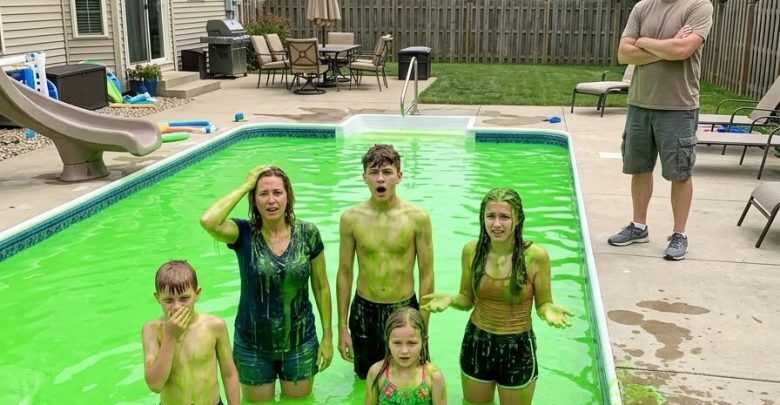
A blue-tinted woman carrying a folding step stool.
I closed the app.
Sat there for a moment.
Then went to get coffee.
Marcus texted fifteen minutes later.
Anything?
I replied:
Very blue.
Three dots appeared.
Then:
DO NOT SEND ME VIDEO WHILE I AM IN A MEETING.
I smiled.
Curtis called around noon.
“I need an explanation.”
“About?”
“I didn’t see her enter.”
“Okay.”
“But I saw her leave.”
“Okay.”
“Joel.”
“Yes?”
“Why was Patrice blue?”
I told him.
Silence.
Longer silence.
Then he said:
“You turned her blue.”
“The dye reacted with normal skin chemistry.”
“You turned her blue.”
“Temporarily.”
“I understand the science is important to you right now.”
“It is safe.”
“I believe you.”
“No irritation.”
“I believe you.”
“Temporary.”
“Joel.”
“What?”
“I’m appreciating it.”
I laughed.
Curtis continued.
“She brought the stool again?”
“Yes.”
“She climbed the fence after you told her not to?”
“Yes.”
“Then your pool basically issued its own trespass notice.”
“That is not legally how I’d phrase it.”
“That is exactly how I’m phrasing it.”
At 2:30, Curtis called again.
“Update.”
“What?”
“She got the mail.”
“So?”
“Still blue.”
“How blue?”
“Enough.”
I leaned back.
“Who saw?”
“Barbara.”
Of course.
Barbara lived at number eight.
Fourteen years on Clearwater Court.
Not a gossip exactly.
But deeply observant.
Curtis said, “Barbara looked at her once. Then twice.”
“Did they talk?”
“Briefly.”
“What happened?”
“Patrice went back inside.”
Then Curtis lowered his voice dramatically.
“The neighborhood chat has started.”
“Already?”
“Barbara asked whether anyone else had noticed anything unusual about Patrice.”
“How many responses?”
“Seven.”
“What are they saying?”
“Mostly asking whether she’s okay.”
“She is.”
“I know.”
“Physically completely fine.”
“I know.”
The problem for Patrice was obvious.
She needed an explanation.
But the truthful explanation was:
I climbed over Joel Ferrara’s fence with a step stool to swim in his private pool after he twice told me not to, and the pool contained harmless temporary indicator dye.
That was not an explanation Patrice wanted to offer.
So she created another one.
According to what reached me through Curtis and later Barbara, Patrice claimed she had been “helping test my pool chemistry.”
Apparently she got some pool treatment on herself.
Neighborly favor.
Simple accident.
Surface-level plausible.
Until you thought about it.
Why would Patrice be testing my water?
Why would she enter the fenced backyard without telling me?
Why would testing require her whole body to become blue?
And how had she entered a locked enclosure?
Barbara texted me that evening.
Joel, I hope everything’s okay. Patrice mentioned she was over at your house today. She seemed upset.
I read it.
Then replied carefully.
I was at work today. Patrice did not have permission to enter my property. My security camera recorded her climbing over the locked pool fence with a folding step stool at 8:47 a.m.
Nothing.
Four minutes.
Then:
Over the fence?
Yes.
Another pause.
With a step stool?
Yes.
Then:
This is not the first time, is it?
I called her.
Better than texting everything.
I told Barbara the history.
Previous owners.
Key.
First swim.
Conversation.
Key returned.
New lock.
Fence climb.
Second confrontation.
Continued entry.
Indicator dye.
Barbara barely interrupted.
When I finished, she said:
“I need to call Patrice.”
“That’s your decision.”
“What she told me was not accurate.”
“No.”
“She said she was helping.”
“She was swimming.”
“You have footage?”
“Yes.”
“She actually climbed the fence?”
“Yes.”
“With a stool?”
“Yes.”
Barbara took a breath.
“All right.”
“Barbara.”
“Yes?”
“I’m not trying to start a neighborhood campaign against her.”
“I understand.”
“I want this to stop.”
“I understand that too.”
She hung up.
Thirty seconds later, Curtis texted:
Barbara just walked past my house looking like she is about to depose someone.
I replied:
Stay out of it.
He sent:
I have popcorn.
Most neighborhood conflicts do not end in one giant confrontation.
They shift.
One conversation.
Then another.
One person learns the accurate version.
Then someone else.
The person controlling the story loses a little ground each time.
That was what happened.
Barbara called Patrice.
I was not present.
The next morning, Barbara came to my door.
“I spoke with her.”
“How did it go?”
“She initially maintained that she was testing the water.”
“Of course.”
“I asked why testing required getting into the pool.”
I smiled.
“And?”
“She said she wanted to check the temperature.”
“That’s creative.”
“I said a thermometer could do that.”
“What next?”
“She said the Hendersons had always allowed her access.”
“There we go.”
Barbara nodded.
“I told her the Hendersons moved.”
“What did she say?”
“That was beside the point.”
I laughed.
Barbara did not.
“I asked how ownership changing could possibly be beside the point.”
“And?”
“She said she had a long-standing understanding.”
“With people who no longer own the pool.”
“Yes.”
Barbara adjusted her glasses.
“Then she said something I thought you should hear.”
“What?”
“She called your pool a community resource.”
I stared.
“Those exact words?”
“Yes.”
“My private pool?”
“Yes.”
“Behind my fence?”
“Yes.”
Barbara finally smiled slightly.
“I told her that was one of the more creative definitions of community property I’ve heard in fourteen years on this street.”
I liked Barbara.
A lot.
Then she became serious.
“Joel, you need to formalize this.”
“I agree.”
“Not another conversation.”
“No.”
“She still thinks she has some kind of moral entitlement.”
“I know.”
“Then make sure there is no legal ambiguity.”
That was exactly what I did.
First call:
Sandra Park.
My attorney.
Property and contract law.
Sandra had the useful ability to write letters that were polite enough to frame and sharp enough to end conversations.
I gave her the story.
When I reached the step stool, she interrupted for the first time.
“She brought her own stool?”
“Yes.”
“To climb over a fence?”
“Yes.”
After I finished, Sandra said, “Fascinating.”
“That doesn’t sound reassuring.”
“I mean fascinating from an entitlement perspective.”
“What do we do?”
“We make the next boundary impossible to misunderstand.”
Sandra drafted a formal letter.
It documented the key access.
The conversation revoking permission.
The lock replacement.
The subsequent fence climb.
The second direct instruction.
The additional documented trespass.
It stated clearly that no informal arrangement between Patrice and prior owners created any continuing right of access.
It warned that future unauthorized entry would result in escalation through appropriate HOA procedures, law enforcement reports, and civil remedies if needed.
It also included costs.
Pool treatment.
Security improvements.
Any damage.
Anything caused by future unauthorized use.
The best paragraph was simple:
Past permission from a previous owner is not present permission from the current owner.
Sandra sent it certified.
Return receipt.
Four days later:
Signed.
Next, I upgraded surveillance.
Another camera aimed specifically at the fence section Patrice had been climbing.
Motion-triggered floodlight.
Cloud backup.
A bright light that would activate immediately if anyone approached the fence at night.
I informed Patrice through written neighborhood communication that the fence line was under video surveillance.
No secret trap.
No ambiguity.
Then I contacted the HOA.
Not with a demand.
Not yet.
I asked for the process.
“What is the procedure if a resident repeatedly enters another owner’s property after being told not to?”
The HOA coordinator became quiet.
Then asked:
“Do you have documentation?”
“Yes.”
“How much?”
“Camera footage.”
“Dates?”
“Yes.”
“Written notice?”
“Now, yes.”
She hesitated.
Then said, “I can’t discuss other homeowners’ complaints, but I can tell you concerns have previously been raised regarding Ms. Winslow and her approach to neighbors’ amenities.”
That interested me.
“What kind of concerns?”
“I can’t share details.”
“I understand.”
“But your documentation would be relevant if you submit a formal complaint.”
I wrote that down.
Patrice appeared at my front door six days after signing the attorney letter.
No blue tint anymore.
Completely normal skin.
Carefully dressed.
Controlled.
But tired.
I opened the door.
“Patrice.”
“Joel.”
“What can I do for you?”
“I’d like to talk.”
“We can talk.”
She looked past me.
“Inside?”
I considered.
Then stepped aside.
We sat at my kitchen table.
Before she began, I said:
“If this involves legal claims or disputes with the letter, you need to contact Sandra.”
She frowned.
“Do we really need lawyers for a conversation between neighbors?”
“We didn’t need lawyers after the first conversation.”
That landed.
She looked down.
“I understand.”
“I’m going to document what we discuss.”
“That seems very formal.”
“I think formal is appropriate now.”
Patrice clasped her hands.
“I understand that I overstepped.”
There it was.
Overstepped.
Not trespassed.
Not ignored you.
Not deliberately climbed your fence after being told not to.
Overstepped.
I stayed calm.
“Patrice, I want to be clear.”
She looked at me.
“This was not an accidental overstep.”
“I know.”
“No. I need you to hear the difference.”
She waited.
“You entered using an old key.”
“Yes.”
“I told you permission ended.”
“Yes.”
“You returned the key.”
“Yes.”
“I changed the lock.”
She nodded.
“Then you brought a folding stool.”
Her face tightened.
“I should not have.”
“You climbed the fence.”
“Yes.”
“I came home and personally told you again not to enter.”
“Yes.”
“And you came back.”
Silence.
“Multiple times.”
She looked at the table.
“Do you understand why I involved an attorney?”
“Yes.”
“Why I installed cameras?”
“Yes.”
“Why I treated the water?”
She looked up.
“That was humiliating.”
“I imagine it was.”
“People saw me.”
“I did not send anyone to look at you.”
“You knew it would stain.”
“Temporarily.”
“You knew.”
“Yes.”
She looked angry again.
I continued.
“It was safe.”
“That isn’t the point.”
“What is the point?”
“You wanted to embarrass me.”
“I wanted you to stop climbing my fence.”
“There were other ways.”
“I tried them.”
She had no answer.
I said, “The dye would have done nothing to you if you had stayed outside my property.”
Silence.
“It only became relevant because you climbed the fence again.”
She looked away.
That was the moment I think she finally saw the problem in a form she could not reorganize.
Everything she disliked about what happened followed from a decision she had complete control over.
Do not climb fence.
No blue dye.
Simple.
She said quietly, “The Hendersons were different.”
“I know.”
“They liked having people around.”
“Good.”
“They thought a neighborhood should be open.”
“That was their choice.”
“You’re more private.”
“Yes.”
“You don’t see that as unfriendly?”
“No.”
She looked genuinely confused.
So I explained.
“Private does not mean hostile.”
She listened.
“I invite people over.”
“I know.”
“I have friends here.”
“I know.”
“If someone knocks, I answer.”
“Yes.”
“If someone asks to swim and I say yes, they can swim.”
She frowned.
“So why not me?”
“Because you didn’t ask.”
She stopped.
“And after I said no, you decided my answer didn’t count.”
Patrice opened her mouth.
Closed it.
That was the truth she had been avoiding.
The issue was never whether I might have let her use the pool.
If she had come to my door the first summer and said:
Joel, the Hendersons used to let me swim here occasionally. Would you be comfortable continuing that?
I might have said yes.
Maybe set limits.
Maybe Tuesdays.
Maybe when I was home.
Maybe not.
But she never gave me the chance.
She assumed.
Then when I corrected the assumption, she rejected the correction.
That changed everything.
Patrice said, “There won’t be another incident.”
“I hope not.”
“There won’t.”
“Then the matter ends.”
She stood.
Walked toward the door.
At the doorway she stopped.
“The Hendersons were more flexible.”
I almost smiled.
“I know.”
She turned slightly.
“I suppose that mattered to them.”
“Yes.”
“And this matters to you.”
“Yes.”
She left.
I watched her walk home.
Then went to the backyard.
By then, the dye had fully cleared through normal filtration.
Marcus had told me it would.
The pool looked exactly like it had before.
Clear.
Balanced.
Still.
I tested the chemistry.
pH.
Chlorine.
Alkalinity.
Stabilizer.
Everything normal.
I made one minor adjustment.
Put away the test kit.
That ordinary task felt surprisingly good.
For weeks, the pool had become a conflict.
Now it was a pool again.
August confirmed it.
No more Patrice.
No stool.
No fence climbing.
No camera alerts except cats, squirrels, birds, and once a raccoon that looked directly into the camera for several seconds like he was considering whether the terms of the attorney letter applied to him.
The neighborhood changed too.
Not dramatically.
There was no campaign against Patrice.
I did not want one.
Barbara shared the accurate story when people asked.
That mattered.
Because Patrice’s “water testing” explanation had circulated first.
Once neighbors learned the full sequence, curiosity settled into understanding.
Previous owner permission.
New owner says no.
Old key returned.
Lock changed.
Fence climbed.
Repeated entry.
Temporary dye.
That was all.
Nobody needed to hate Patrice.
They just needed to stop treating my response like a bizarre attack that had happened without context.
Curtis saw Patrice at the mailbox later that month.
He texted:
She acted completely normal.
I responded:
Good.
He wrote:
Like none of it happened.
Also good.
Then:
Doesn’t that bother you?
I thought about it.
Then replied:
No. The behavior stopped.
Curtis called immediately.
“That is an annoyingly mature answer.”
“I’ve had a long summer.”
“If somebody turned me blue, I would probably move.”
“I didn’t turn her blue.”
“Oh, we’re back to chemistry?”
“Yes.”
He laughed.
Then became serious.
“You handled it well.”
“I don’t know about that.”
“You never screamed.”
“I wanted to.”
“You documented.”
“Yes.”
“You gave her chances.”
“Yes.”
“Then you used the weirdest pool product I’ve ever heard of.”
“Yes.”
“And now it’s over.”
“Hopefully.”
“Your pool is fine.”
I looked through the back window.
“My pool was always fine.”
Curtis paused.
“Yeah.”
Then:
“That was never the problem.”
Exactly.
The pool was never the problem.
The fence wasn’t either.
The lock wasn’t.
The step stool certainly wasn’t.
The problem was a person refusing to recognize that permission can end.
That summer taught me something about boundaries.
People often treat a boundary as if the person setting it owes an explanation.
Why don’t you want me there?
Why does it bother you?
What harm am I causing?
Why are you being territorial?
Those questions can be useful between people who respect each other.
But sometimes they are simply ways to convert your no into the beginning of a negotiation.
I did not need a dramatic reason.
It was my backyard.
I did not want someone entering while I was away.
That was enough.
If I wanted privacy because I liked swimming alone, enough.
If I wanted privacy because I stored embarrassing inflatable flamingos near the pump, enough.
If I wanted privacy for no reason I could articulate, enough.
Ownership did not make me morally superior.
But it did make the decision mine.
At the end of August, I hosted a small gathering.
Not a giant party.
Eight people.
Curtis.
His wife.
Barbara.
Phil from three houses down.
A few others.
String lights.
Drinks.
Food.
Pool light glowing under the water.
Nobody climbed a fence.
Everyone came through the gate because I opened it.
That felt important.
At one point Barbara raised her glass.
“To the most educational pool on Clearwater Court.”
Curtis said, “I would like to propose a toast specifically to the pool.”
Someone else said, “The pool that bites back.”
Everyone laughed.
I raised my glass.
I did not need to say anything.
Patrice’s house was dark that evening.
She had gone to visit family.
Barbara mentioned it.
I hoped she was enjoying herself.
I meant that.
Once a conflict is finished, you do not have to keep feeding it resentment to prove you were right.
I did not need Patrice miserable.
I needed Patrice out of my pool.
Those were very different objectives.
The step stool sat in my garage for a while.
After the second confrontation, Patrice had apparently left it inside the pool enclosure in the confusion.
I moved it into the garage.
Sandra advised me not to create unnecessary direct contact while the matter was being formalized.
So there it sat.
Small folding aluminum stool.
Completely ordinary.
Every time I saw it, I laughed a little.
Not because trespassing was funny.
Because it perfectly represented the entire problem.
Patrice had encountered a lock.
Instead of asking herself why the lock had changed, she found a tool to bypass it.
Some people do that emotionally their entire lives.
They encounter another person’s no and immediately search for a step stool.
I eventually donated it.
October.
By then the pool was closed for winter.
Cover stretched across the surface.
Pump winterized.
Furniture stored.
The cameras stayed.
The floodlight stayed.
Sandra’s letter remained in my files.
Everything else returned to normal.
Leaves at the curb.
Porch lights at dusk.
Music somewhere down the street on Friday evenings.
People walking dogs.
Curtis complaining about delivery drivers.
Barbara knowing things before everybody else.
Normal neighborhood life.
One afternoon in November, Patrice drove past while I was outside.
She waved.
I waved.
She did not stop.
Neither did I.
Nothing needed saying.
That was one of the most satisfying parts.
A boundary can become ordinary after conflict.
Eventually you do not have to defend it every day.
People simply learn where it is.
The pool reopened the following May.
I was nervous the first week.
Not because I thought Patrice would immediately reappear.
But behavior leaves expectation.
Every camera notification made me check.
Bird.
Cat.
Wind.
No Patrice.
Then June.
Nothing.
July.
Nothing.
The boundary held.
One evening, Curtis came over.
We sat by the water.
He asked, “Still have the dye?”
“Yes.”
“You planning to use it?”
“No.”
“Why keep it?”
“Why not?”
He smiled.
“Insurance.”
“Something like that.”
“You know, if she ever sees that bottle in your garage, she may move.”
“I doubt she’s coming into my garage.”
“Fair point.”
We drank beer.
The pool light came on.
For the first time since the previous summer, I realized I had stopped thinking about Patrice when I looked at the water.
That was the real end.
Not the attorney letter.
Not the blue skin.
Not the final conversation.
The moment the pool became mine in my mind again.
Conflict has a way of occupying spaces.
A driveway can become the place somebody yelled at you.
A kitchen table can become where legal bills piled up.
A backyard can become where you watch cameras instead of enjoying summer.
The behavior may stop before the space feels normal again.
It takes time.
Eventually the ordinary returns.
I started doing my early morning swims more consistently.
6:00.
Sometimes 5:45.
Water cool.
Street quiet.
Just movement.
That was what I had wanted from the house all along.
Not a neighborhood battle.
Not a legal case.
Not a viral story about dye.
A place to swim.
Private.
Quiet.
Mine.
Barbara eventually told me more about the old Henderson arrangement.
Apparently Patrice had not started by swimming whenever she wanted.
At first, she asked.
Then the Hendersons told her she did not need to ask every time.
Then they gave her the key.
Then they traveled more.
Then Patrice began using the pool regularly even when they were home.
Nobody objected.
Years passed.
You can see the progression.
That is what made me understand her better.
Not excuse her.
Understand.
Patrice had not woken up one morning and decided:
I am entitled to another person’s private pool.
Her entitlement had been trained.
Repeated permission removed the feeling of needing permission.
That is why people need to be careful with informal arrangements.
Generosity is good.
But clarity matters.
The Hendersons should have told Patrice:
This permission belongs to us.
It ends when we sell.
Maybe they thought it was obvious.
Legally, it was.
Emotionally, Patrice had built something else.
She thought the access belonged to the pool.
Not the owner.
As though the house came with a neighborhood tradition attached to the water.
That mistake became visible when I arrived.
I once asked Sandra whether Patrice could ever have had a legitimate claim.
Sandra said, “Based on what you described? No.”
“No easement by long use?”
“Not under these circumstances.”
“No permanent license?”
“No written license.”
“What if the Hendersons promised her forever?”
“Then Patrice could take that up with the Hendersons, but a casual personal promise does not automatically burden a later buyer’s property.”
I nodded.
Sandra looked at me.
“You know what’s interesting?”
“What?”
“You never actually needed most of this legal analysis.”
“Why not?”
“Because she did not sue you.”
“True.”
“She behaved as though her confidence was the legal document.”
That was exactly right.
Patrice did not need paperwork because, in her mind, six years of routine was stronger than paperwork.
That is why my words seemed weak to her.
The new lock should have been stronger.
Instead, it was merely another obstacle.
The dye worked psychologically because it converted an invisible violation into a visible consequence.
She could tell herself:
Joel is being unreasonable.
She could tell herself:
The lock is unnecessary.
She could tell herself:
The Hendersons would have allowed this.
What she could not easily tell herself while staring at blue arms was that nothing had happened.
Something had.
It was temporary.
Harmless.
But obvious.
Her behavior followed her home.
That mattered.
Still, I did not rely on embarrassment as the long-term solution.
That would have been foolish.
The dye got her attention.
The attorney letter created the durable boundary.
The cameras documented it.
The HOA process made consequences clear.
Those were the pieces that ended the behavior.
Not color.
That distinction matters.
If somebody repeatedly trespasses, the answer is not to build some escalating prank war.
The answer is documentation.
Clear notice.
Security.
Legal channels.
Appropriate authorities if necessary.
My dye solution worked because it was safe and temporary and because Marcus understood the product.
The paperwork worked because it removed uncertainty.
Years later, I remember Sandra’s letter more fondly than the dye.
That probably means I am getting old.
The neighborhood eventually turned the whole thing into folklore.
Not maliciously.
Someone would make a joke at a cookout.
“Ask before getting in Joel’s pool unless you want to become a Smurf.”
I hated that phrase.
Mostly because the color had been teal.
I would correct them.
Nobody cared.
Curtis exaggerated constantly.
In his version, Patrice glowed.
She did not glow.
Barbara remained more accurate.
One new neighbor heard part of the story and asked me whether Patrice had been seriously injured.
I said, “No.”
“Allergic reaction?”
“No.”
“Chemical burn?”
“No.”
“Then what happened?”
“Temporary staining.”
“How long?”
“Several hours. Faded afterward.”
He laughed.
“That’s unbelievable.”
“It was very believable when she walked to the mailbox.”
He laughed harder.
The laughter eventually became harmless.
Patrice herself rarely participated in it.
Understandably.
But she also stopped acting defensive.
That was another form of progress.
We had a brief conversation one spring several years later.
I was cleaning the filter.
She walked by.
“Pool open?”
“Yes.”
“Looks good.”
“Thanks.”
She hesitated.
Then said, “I was ridiculous.”
I looked up.
That was more direct than anything she had said before.
“I appreciate you saying that.”
“I really thought because the Hendersons let me use it, I had some kind of standing.”
“I know.”
“I didn’t.”
“No.”
She laughed at herself softly.
“I brought a stool.”
“You did.”
“That was insane.”
“A little.”
“A lot.”
“Yes.”
We both smiled.
She continued walking.
That conversation did more for me than I expected.
Not because I needed validation.
But because people rarely revisit their own entitlement honestly.
She had.
Maybe time made it easier.
Maybe distance.
Maybe several years without pool access proved the world had not ended.
Whatever the reason, I respected it.
And I think that is why the story never remained bitter.
Patrice had done something wrong.
Repeatedly.
Then eventually stopped.
She did not become some lifelong enemy.
She remained a neighbor who had made an extraordinary series of decisions involving a private swimming pool and a folding stool.
That was enough.
The larger lesson stayed with me.
Favors need boundaries.
If you let someone use something regularly, be clear what the permission means.
If circumstances change, say so.
If ownership changes, prior permission does not automatically survive.
And if somebody tells you no, do not arrive the next week with climbing equipment.
That last one seems obvious.
Apparently it needed saying.
I also learned that staying calm can be more effective than performing anger.
The first time I saw Patrice in the pool, I wanted to leave work and explode.
I didn’t.
I waited.
Talked.
Changed the lock.
Second time, I was angrier.
I still made her get out without shouting.
Then I documented.
The result was better because I did not hand her a competing story about my behavior.
She could not tell neighbors:
Joel threatened me.
Joel screamed.
Joel grabbed me.
Joel damaged my property.
None of that happened.
The facts stayed simple.
I said no.
She returned.
I changed the lock.
She climbed the fence.
I said no again.
She returned again.
That simplicity mattered.
Barbara understood instantly once she heard it.
The HOA coordinator understood.
Sandra understood.
Even Patrice eventually understood.
The clearest case is the easiest case.
Sometimes people make their own position worse by reacting so dramatically that the reaction becomes the new dispute.
I was lucky not to do that.
Maybe age helped.
Maybe pool maintenance teaches patience.
Water punishes overcorrection.
Add too much of something too fast and you create a different problem.
Small adjustments.
Test.
Wait.
Retest.
Maybe I learned more from the pool than I realized.
The year after everything happened, Marcus came over.
The chemist.
He wanted to see the pool.
Not because anything was wrong.
Because he remained absurdly proud of his role.
He looked at the water.
“Perfect.”
“Of course.”
“Still using my product?”
“No.”
“You should.”
“Why?”
“Scientific interest.”
“I’m not turning invited guests blue.”
“Coward.”
I laughed.
We sat by the water.
I asked him whether the product had been created specifically for pool contamination detection.
He explained the history for twenty minutes.
I regretted asking.
Then he said:
“You know what the actual deterrent was?”
“What?”
“Not the dye.”
“I know.”
“Being seen.”
I looked at him.
He continued.
“People behave differently when they believe an action is private.”
“That’s true.”
“She probably thought every unauthorized swim existed only between you and her.”
“Until she turned blue.”
“Exactly.”
“The consequences became public.”
“Yes.”
I thought about that.
The cameras had technically made the behavior visible from the beginning.
But only to me.
The color made it visible to Patrice herself.
Then to anyone who saw her.
Maybe that was why it broke through.
Patrice could dismiss my interpretation.
She could not dismiss her own reflection.
Still, I would never pretend humiliation is always a good teacher.
Sometimes it makes people worse.
That is why I was relieved she eventually recalculated rather than retaliated.
She could have escalated.
Filed complaints.
Made accusations.
Started a neighborhood war.
Instead, once the formal letter arrived and the social story collapsed, she backed away.
That was the right decision.
The HOA never had to formally sanction her.
Police never needed to become involved.
No court case.
No permanent feud.
The possibility of escalation was enough.
I preferred that.
I had no interest in seeing a neighbor arrested over a swimming pool if behavior could stop without it.
But I also would not have tolerated another incident.
The next one would have been documented and reported.
Sandra had made that clear.
So had I.
Fortunately, there was no next one.
Clearwater Court eventually went through other dramas.
Every neighborhood does.
A tree dispute.
A barking dog.
A teenager who parked an enormous lifted truck where two homeowners hated looking at it.
An argument about holiday lights.
Suddenly the pool story seemed almost quaint.
Barbara once told me:
“I miss the blue summer.”
I said, “I don’t.”
“You have to admit it was interesting.”
“I prefer boring.”
Curtis said, “That’s because you weren’t watching from my window.”
He may have had a point.
But boring remained my goal.
Every May, I opened the pool.
Every September, I closed it.
Routine.
Chemicals.
Cleaning.
Swimming.
Friends.
Sometimes neighborhood kids came over.
Invited.
Their parents asked.
I opened the gate.
Nobody needed step stools.
That was the thing Patrice had never understood at the beginning.
I wasn’t against sharing.
I was against being denied the choice.
Those concepts are easy to confuse if you are the person receiving the benefit.
From the outside, the practical result may look identical.
Pool used.
Pool not used.
But consent is the difference.
If I invite ten neighbors over, the pool is still private.
If one person enters after I say no, that private boundary has been violated.
The number of people swimming is irrelevant.
Who decided is what matters.
One August evening years later, I hosted another pool gathering.
More people this time.
String lights.
Food.
Music low enough not to annoy anybody.
Curtis brought too much beer.
Barbara brought dessert.
Marcus brought nothing useful and claimed chemistry expertise was his contribution.
At some point, somebody asked about Patrice.
Not in a cruel way.
Just wondering whether she still lived two houses down.
“She does.”
“Did you invite her?”
“No.”
“Would you?”
I looked toward the street.
Then thought.
“Maybe.”
Curtis nearly dropped his drink.
“Really?”
“If she asked?”
Barbara smiled.
“That’s the difference, isn’t it?”
Exactly.
Maybe I would say yes.
Maybe no.
But the answer would be mine.
I never ended up inviting her to swim.
She never asked.
That was probably healthiest for both of us.
We settled into ordinary neighborliness.
Wave.
Brief conversation.
Package accidentally delivered to wrong address.
Nothing more.
Nothing less.
I eventually replaced the original pool camera.
Technology changed.
The new one had better resolution.
Smarter motion detection.
No subscription.
The old footage stayed archived for a while.
Then one weekend I found myself cleaning digital files.
There was Patrice.
Yellow swim cap.
Entering.
Water changing.
The moment she saw her arm.
I hovered over the delete button.
For years, that video had been evidence.
Sandra had a copy in the case file.
I had backups.
But no case existed anymore.
No dispute.
No behavior.
I deleted my extra copy.
Kept only what Sandra recommended preserving with the formal records.
It felt good.
Evidence is useful during conflict.
Keeping every piece forever can also keep the conflict alive.
I did not need the whole thing living on my phone.
The story was already clear.
Patrice knew.
I knew.
The neighborhood knew enough.
The boundary held.
That was sufficient.
The folding stool had been easier.
Donation center.
Gone.
I sometimes wonder who bought it.
Probably someone using it to reach a kitchen cabinet.
A completely innocent second life.
Good.
Objects do not deserve guilt.
People make choices.
The stool did exactly what it was designed to do.
Help someone reach over something.
The problem was what Patrice chose to reach over.
The pool itself is older now.
New pump.
Updated heater.
Replaced one section of coping.
A few stains in the plaster that weren’t there when I bought it.
Normal aging.
I know it even better than I did that first summer.
Sometimes I float in the deep end late at night.
Look at the fence.
Think about how absurd the whole thing was.
A woman believed a pool two houses down remained partly hers because another family had once been generous.
Then a lock challenged that belief.
She chose a stool.
A stool led to dye.
Dye led to neighborhood questions.
Questions led to truth.
Truth led to paperwork.
Paperwork finally created the clarity the original conversation should have created on day one.
All because one person struggled to understand the simplest sentence in the entire story:
I’m not the Hendersons.
They could say yes.
I could say no.
Both decisions were legitimate because both were made by the owner at the time.
That was all.
The last meaningful conversation Patrice and I had happened at the mailbox.
Years after the blue summer.
She was sorting through envelopes.
I was carrying a package.
She looked at me.
“Joel?”
“Yeah?”
“I always wondered something.”
“What?”
“Did you know exactly how blue I’d become?”
I laughed.
“Not exactly.”
“You watched?”
“Camera alert.”
“You watched the whole thing?”
“Yes.”
She shook her head.
“I looked ridiculous.”
“You looked confused.”
“I took four showers.”
“I didn’t know that.”
“The first one did almost nothing.”
“I’m sorry.”
“No, you aren’t.”
I thought.
“Not entirely.”
She laughed.
Then said:
“It worked.”
That surprised me.
“What?”
“The message.”
I looked at her.
She continued.
“I should have listened before that.”
“Yes.”
“I really didn’t think I was trespassing.”
“I know.”
“That sounds stupid now.”
“Yes.”
She gave me a look.
“You could pretend to be polite.”
“We’re past that.”
She smiled.
“Fair.”
Then she walked home.
That was it.
No dramatic apology.
No hug.
No friendship.
But enough.
Sometimes enough is better.
My pool still opens every May.
I still keep chemicals in the garage.
Test kit.
Leaf net.
Spare fittings.
Old bottles.
And, yes, somewhere on the back shelf is still a sealed container of indicator dye.
Marcus insists it is probably expired.
I tell him I am keeping it for sentimental reasons.
I do not expect to need it.
I hope I never do.
Because the best part of this story was not watching Patrice turn blue.
That was memorable.
The best part was what happened afterward.
Nothing.
No one climbed my fence.
No one used my water without asking.
No one treated an old favor as permanent ownership.
My backyard became boring again.
Quiet.
Private.
The exact thing a backyard is supposed to be.
And every once in a while, when somebody hears the story and laughs at the idea of a blue trespasser, I tell them the same thing.
The dye was temporary.
The lesson wasn’t.