Uncategorized
My Parents Spent Nine Hours Celebrating My Sister’s Baby While Ignoring Mine—Then a Nurse Walked Into Her Room

Part 1: Two Babies, Two Rooms, and One Unforgettable Disappointment
I had spent six winters conducting atmospheric research in Antarctica, where temperatures could drop so low that exposed skin became dangerous within minutes. I had repaired scientific equipment during brutal storms, endured months of isolation, and learned to remain calm when unexpected problems threatened an entire research mission.
I thought I was prepared for almost anything.
But nothing had prepared me for the emotional storm waiting inside a maternity ward the day my daughter was born.
My name is Adrienne Voss, although most people call me Addie. I’m forty years old, and until that rainy October afternoon, I believed I had finally reached a place in my life where I could stop worrying about whether my parents were proud of me.
I was wrong.
My daughter, Juniper, arrived at 5:18 p.m. at Cascadia Regional Medical Center outside Seattle. She weighed seven pounds and three ounces, had a beautiful head of dark hair, and immediately wrapped her tiny fingers around her father’s thumb.
My husband, Micah, who normally approached emergencies with the calmness of an engineer reading an instruction manual, began crying the moment he held her.
I cried too.
After twenty-two hours of labor, exhaustion, and pain, hearing that my daughter was healthy was the most wonderful sound I could imagine.
For a little while, nothing else mattered.
But two doors down the hallway, something else was happening.
My younger sister, Brynn, had given birth to her son, Beckett, a little more than an hour before Juniper arrived.
Our parents, Celia and Franklin Weller, had reached the hospital shortly before noon. They went directly to Brynn’s room, where they found an entire celebration waiting for them.
There were flowers, balloons, relatives, and a custom cake decorated with a golden crown. Brynn had decided months earlier that her son would be the family’s little prince, and apparently everyone had agreed to participate in the ceremony.
Our parents promised they would visit me once Brynn was comfortable.
I believed them.
At 5:42 p.m., Micah sent a photograph of Juniper to our family group chat. He included her weight and a short message explaining that both mother and daughter were doing well.
My mother responded with a pink heart.
Then she immediately posted another photograph of Beckett wearing a knitted crown.
My father wrote, “Beautiful baby.”
Unfortunately, his message appeared directly beneath Brynn’s photograph, making it difficult to determine which grandchild he meant.
I stared at the screen for a moment before placing my phone facedown.
I refused to spend my daughter’s first hour trying to interpret my father’s punctuation.
Waiting for Grandparents Who Never Came
By six o’clock, I was exhausted.
My body hurt, breastfeeding was proving more difficult than I had expected, and I was struggling to get comfortable in the hospital bed.
Still, I kept looking toward the door.
Every time footsteps approached, I lifted my head.
Every time someone entered, it was another nurse checking my blood pressure, adjusting an IV, or bringing water.
My parents never appeared.
Micah offered to walk down the hallway and remind them where we were.
I asked him not to.
I wanted my mother and father to come because they genuinely wanted to meet their granddaughter, not because my husband had sent someone to collect them.
At 6:27 p.m., I finally called my mother.
She answered after several rings.
“Hello, sweetheart!”
Her voice sounded cheerful and distracted.
Behind her, I could hear laughter, someone opening a soda can, and my father’s voice complaining that the cake was too sweet.
I looked at Juniper, who was sleeping peacefully beside me.
“Mom, are you and Dad coming to see us?”
There was a pause.
I heard Brynn asking someone to adjust her pillow.
Then my mother sighed.
“Oh, Addie, we’re absolutely exhausted. It’s been such a long day, and Brynn really needs us right now.”
I stared at the empty chair beside my bed.
“Mom, I was in labor for twenty-two hours. I’ve just had a baby too.”
Her voice became softer, almost as if she were explaining something obvious to a child.
“Honey, you know your sister has a harder time with things than you do. You’ve always been so good at managing on your own.”
I didn’t know what to say.
My father took the phone.
“Everything doesn’t have to be a competition, Adrienne.”
I almost laughed.
Not because anything was funny, but because the irony was so overwhelming.
I hadn’t asked for a competition. I had asked my parents to walk thirty feet down a hospital hallway and meet their newest grandchild.
“I just thought you might want to see Juniper,” I said.
My father sighed.
“Your mother and I have been sitting in uncomfortable hospital chairs for nearly nine hours. We’ve had a long day.”
I looked at my daughter.
“So have I, Dad. I just gave birth.”
He responded with a sentence I would remember for years.
“You’ve survived Antarctica, for heaven’s sake. Surely you can manage one afternoon without an audience.”
I ended the call.
I didn’t want to hear another explanation about why my sister needed more attention than I did.
Micah had heard enough to understand what happened.
He came to my bedside, kissed my forehead, and said quietly:
“You don’t have to keep asking them.”
That was when I started crying.
I had a healthy daughter. I had a loving husband. I had everything I had hoped for when I imagined becoming a mother.
But I was still hurt.
And I finally understood that I had spent much of my life waiting for my parents to give me something they had never seemed willing to offer equally.
The Nurse Who Noticed Everything
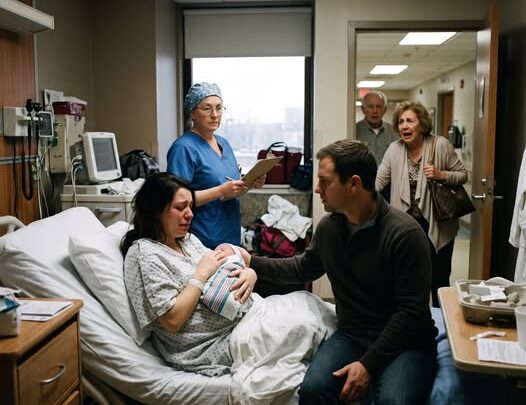
A few minutes later, a gentle knock sounded against the half-open door.
A nurse entered, pushing a small medical cart.
Her badge read Evelyn, RN.
She had silvering hair tucked beneath a scrub cap, wire-rimmed glasses, and the calm expression of someone who had spent decades caring for new mothers.
She took one look at my face.
“Blood pressure check, mama,” she said gently.
She placed the cuff around my arm and started the machine.
While it inflated, her eyes briefly moved toward the bedside table.
There were hospital pamphlets, a water pitcher, my phone, and a few personal belongings.
There were no flowers.
No cards.
No balloons.
No gifts from grandparents.
Then the door down the hallway opened.
Laughter drifted into my room.
Someone cheered. Another person clinked a glass against something.
Evelyn tilted her head.
“Is that your family in room 314?”
I nodded.
“My sister delivered this afternoon too.”
“And they haven’t visited you yet?”
I swallowed.
“They said they were tired.”
Evelyn looked at me.
I explained what my father had said about surviving Antarctica and not needing an audience.
For several seconds, she didn’t respond.
The blood pressure monitor beeped.
She looked at the reading and frowned.
“Your blood pressure is elevated, Adrienne.”
“It’s fine,” I said quickly. “I’m just emotional.”
“Postpartum recovery is important. You need rest, support, and a calm environment.”
I looked away.
“I don’t want to make a big deal out of it.”
Evelyn adjusted the cuff and checked the reading again.
Then she looked directly at me.
“You have just given birth. You are allowed to need people.”
Her words made my eyes fill again.
I had spent so many years being described as the strong one that I had almost forgotten I was allowed to be vulnerable.
Evelyn finished the check, wrote something in my chart, and placed the clipboard against her side.
Then she glanced toward the hallway.
“Well,” she said quietly, “I’m going to make sure everyone understands that you need appropriate support.”
Before I could ask what she meant, she walked out.
Micah and I exchanged confused looks.
We heard her footsteps moving down the corridor.
Then she stopped outside room 314.
There were two sharp knocks.
And she entered.
The Conversation That Changed the Hallway
At first, we couldn’t hear what was being said.
There was muffled conversation, followed by the sound of Evelyn’s firm voice.
Then my mother’s irritated tone drifted into the hallway.
“Is this about the cake? The nurse at the desk said—”
“No, Mrs. Weller,” Evelyn interrupted.
Her voice was clear enough for us to hear.
“I’m here because your other daughter is recovering from childbirth in room 312.”
Silence followed.
Evelyn continued.
“She’s experiencing emotional distress, and her blood pressure is elevated. She needs appropriate support and a peaceful recovery environment.”
My mother responded, but I couldn’t make out the words.
Then Evelyn spoke again.
“Your daughter has just delivered a healthy baby. It is important that her recovery and emotional well-being are treated seriously.”
The celebration in Brynn’s room seemed to quiet.
The laughter stopped.
A chair scraped against the floor.
Evelyn’s voice remained steady.
“I cannot make family members visit, but I can make sure that concerns affecting a patient’s care are documented and brought to the appropriate clinical team.”
That was when I heard my mother’s voice become defensive.
“We were going to visit her!”
Evelyn answered calmly.
“Then perhaps now would be a good time to do so.”
I looked at Micah.
He raised his eyebrows.
Neither of us said anything.
A few seconds later, hurried footsteps began moving toward my room.
My Mother Finally Appears
My bedroom door opened abruptly.
My mother stood in the doorway.
Her cardigan was slightly crooked, her cheeks were flushed, and she was clutching her designer handbag against her chest.
“Addie!”
She hurried toward the bed.
“Darling! Good heavens, why didn’t you tell us?”
I stared at her.
I had told her.
I had called her less than an hour earlier. I had explained that I had given birth and asked whether she and Dad were coming.
She had told me they were exhausted.
Now she was standing beside my bed as though the entire situation had resulted from a misunderstanding.
“We were just on our way,” she continued.
My father appeared behind her, looking uncomfortable and confused.
He was still holding an unopened paper plate from Brynn’s celebration.
For a moment, I simply watched them.
I looked at my mother, then at my father, and finally at Juniper.
My daughter was sleeping peacefully in my arms.
She didn’t know that her grandparents had spent nine hours celebrating another baby while barely acknowledging her existence.
She didn’t know that her mother had been waiting for them.
And she certainly didn’t know that the woman standing beside the bed had only hurried there after realizing that her behavior might become part of a hospital record.
I felt something change inside me.
The hurt was still there.
But the desperate need for their approval was beginning to disappear.
“Step back, Mom.”
My voice was quiet.
She stopped.
“Addie, sweetheart, I—”
“Please don’t.”
My father moved closer.
“Your mother was only trying to—”
I looked at him.
“Dad, you told me I should be able to manage one afternoon without an audience.”
He opened his mouth.
I continued.
“I wasn’t asking for an audience. I was asking my parents to meet their granddaughter.”
Neither of them answered.
The Boundary I Had Never Set Before
My mother looked down at Juniper.
“She is beautiful,” she whispered.
I nodded.
“She is.”
“Can I hold her?”
I looked at my daughter.
Then I looked back at my mother.
“Not right now.”
Her expression changed.
“What?”
“I need some peace. I’ve just given birth, and I’m exhausted. I don’t want to have this conversation while I’m recovering.”
She looked toward Micah, apparently expecting him to intervene.
He didn’t.
Instead, he moved closer to me and gently adjusted the blanket around Juniper.
I turned toward him.
“Micah, would you please ask them to wait outside?”
He nodded.
My mother looked stunned.
“Addie, you’re not seriously sending us away?”
I held her gaze.
“I am asking you to respect my wishes. I only want people in this room who came because they wanted to meet my daughter—not because they are worried about how the situation might look.”
For once, my mother had no immediate response.
My father lowered the paper plate.
Micah calmly opened the door and waited.
My parents stepped into the hallway.
He closed the door.
And the room became quiet.
For the first time that afternoon, I stopped watching the entrance.
What I Finally Understood About Being the Strong One
I spent much of my childhood being called independent.
Whenever Brynn struggled, my parents rushed to help her.
Whenever I struggled, they reminded me that I was capable of handling things myself.
If Brynn needed money, there was always a family conversation.
If I needed something, I was encouraged to solve the problem independently.
When she had difficulties at school, my parents rearranged their schedules.
When I received an academic award, they congratulated me over the telephone because they had other commitments.
When I accepted a research position in Antarctica, they told relatives how proud they were of my accomplishments.
But they never seemed particularly interested in what the work actually involved.
I had learned to accept the difference.
I told myself that being independent was a strength. I told myself that my sister needed more attention because she struggled more. I told myself that my parents loved us in different ways.
Perhaps some of that was true.
But becoming a mother changed the way I viewed everything.
I no longer wanted to spend my life trying to earn affection.
I didn’t want Juniper growing up believing that love had to be deserved through achievement, patience, or silence.
I wanted her to understand that she mattered simply because she existed.
And I wanted to show her that setting boundaries was not the same as being unkind.
The Beginning of a Different Family Tradition
That evening, Micah and I stayed with Juniper.
We talked about her name, her tiny fingers, and the way she had looked at him when he first held her.
He promised to learn every part of the baby-care routine, even the complicated breast pump attachment that had nearly defeated him earlier.
I laughed for the first time in hours.
Evelyn returned later to check my blood pressure and ask how I was feeling.
She reminded me that postpartum emotional changes can be intense and that I should tell the medical team if I experienced worsening distress or concerning physical symptoms.
I thanked her.
I didn’t know whether she understood how much her kindness had meant to me.
She had not solved my family relationships. She had not forced my parents to become different people.
But she had reminded me that I deserved care.
And sometimes that reminder is more powerful than people realize.
My parents did eventually return to the hallway, but I wasn’t ready to invite them back into the room.
I wanted time.
I wanted rest.
Most importantly, I wanted to enjoy the first hours of my daughter’s life without feeling that I needed to compete for anyone’s attention.
The following morning, when sunlight came through the hospital window, Juniper opened her eyes and stared at me.
I touched her tiny cheek.
“Welcome to the world, sweetheart,” I whispered.
Micah kissed the top of my head.
And for the first time, I wasn’t waiting for someone else to make the moment special.
It already was.
The Lesson I Want My Daughter to Remember
Years from now, Juniper may ask why her grandparents weren’t in the room when she was born.
I don’t know exactly what I will tell her.
I won’t need to make her hate them. I won’t need to exaggerate what happened or turn her childhood into a story about family conflict.
But I will tell her the truth in a way she can understand.
I will tell her that people sometimes disappoint us, even people we love.
I will tell her that being strong does not mean pretending something doesn’t hurt.
I will tell her that she never has to accept unequal treatment just to keep someone happy.
And I will tell her that family should be measured by more than photographs, celebrations, or matching holiday outfits.
Family is also about showing up.
It is about noticing when someone needs help.
It is about offering kindness when there is no audience and no reward.
My parents had spent nine hours in my sister’s room.
They had flowers, balloons, cake, and a celebration for their grandson.
My daughter had a hospital blanket, a sleeping father beside her, and a mother who was finally learning to stop begging for attention.
But she also had something more important.
She had two parents who loved her completely.
And that was enough to begin.
Because the greatest gift I could give Juniper was not a perfect family photograph. It was the knowledge that she would never have to make herself smaller to earn a place in ours.