News
I Lent My Neighbor Money for a Whole Year, but Her Final Letter Changed Everything
I Lent My Neighbor Money for a Whole Year, but Her Final Letter Changed Everything

I Thought My Neighbor Had Never Repaid Me—Then Her Letter Arrived
A fictional story about friendship, unanswered questions, and two little notebooks.
For a year, I lent my neighbor money whenever she asked.
Sometimes fifty dollars. Sometimes a hundred. Once, twenty dollars that she accepted with both hands, as though I had given her something fragile.
She always promised to repay me.
By the time she disappeared from the other half of our duplex, my notebook said she owed me $3,850.
Then a letter arrived.
The Woman With the Lavender Cardigan
My name is Joanne Mercer, although everyone calls me Jo.
I was fifty-eight when Edith moved in next door. My husband, Ray, had been gone for six years. My daughter, Kara, lived two towns away with her family.
I had spent thirty years working in an elementary-school office. I knew how to locate a missing permission slip, calm an anxious parent, and identify a child approaching my desk with a story that needed careful questioning.
None of that prepared me for Edith Lane.
She stepped out of a moving truck wearing a lavender cardigan and carrying a box marked:
KITCHEN STUFF — FRAGILE — PROBABLY
“You must be the neighbor,” she said. “Please tell me you don’t play the drums.”
The previous tenants had played them enthusiastically and without much concern for the hour.
“I was about to ask you the same thing.”
Edith laughed.
I liked her before she reached the porch.
Two Chairs at the Same End
Our duplex had a shared porch with a railing that divided it neatly in half.
Within a month, our rocking chairs stood together at one end.
Most evenings, one of us appeared with tea. The other brought something to eat.
Edith made lemon bars with a buttery crust and enough sharpness to keep them from being too sweet.
“I made these for myself,” she would announce. “But I suppose you can have one.”
“One?”
“Let’s see how you behave.”
She was sixty-eight, with short silver hair, a clear speaking voice, and a laugh that could turn her own terrible joke into an event.
On Sundays, we shared a crossword.
She knew rivers, composers, and opera singers. I handled television and most questions involving popular snacks.
Between us, we did reasonably well.
I had not realized how much I missed having someone nearby until I began looking forward to her footsteps.
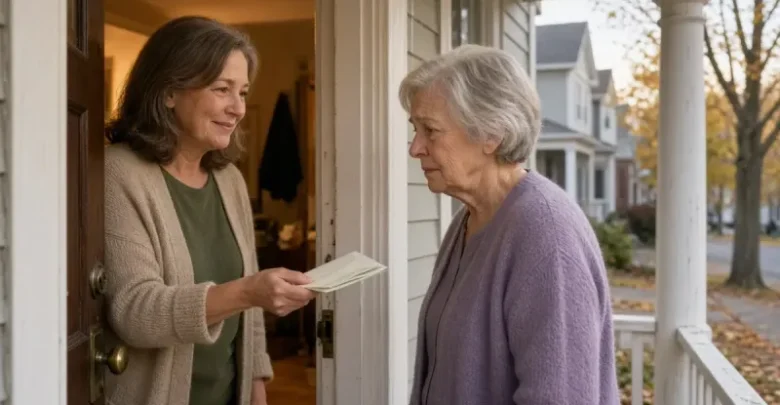
Illustration accompanying this fictional story.
The First Fifty Dollars
About two months after she moved in, Edith knocked on my front door.
That was unusual. We normally spoke across the porch.
She held her purse against her chest.
“Jo, I hate to ask, but my money hasn’t come through yet. Could you lend me fifty dollars until Friday?”
“Of course.”
She squeezed my hand.
“I’ll bring it straight back.”
Friday passed.
I did not mention it.
A few weeks later, she asked for a hundred dollars to cover an unexpected expense.
Again, she promised.
Again, I said yes.
At first, I assumed there was a temporary problem she would explain when she felt comfortable.
But the requests continued, and the explanation never came.
The Sunflower Notebook
After several loans, I bought a small spiral notebook.
It had a cheerful sunflower on the cover, which did not match my mood when I wrote in it.
I recorded dates and amounts.
Occasionally, I added a comment.
Again?
Then, on one particularly irritating afternoon:
AGAIN??
Underlined.
More than once.
I kept the notebook in the kitchen drawer beside the rubber bands and takeout menus.
I was not proud of resenting her. I also could not pretend the money meant nothing.
My income was limited. I had repairs to consider and bills of my own.
Meanwhile, Edith wore the same cardigan, drove the same old car, and rarely seemed to buy anything.
I could not understand where the borrowed money went.
A Question She Answered With a Joke
One evening, I tried asking.
“Edith, are you in some kind of trouble?”
She looked toward the street.
“What kind?”
“With money. Is there something you want to tell me?”
For a moment, I thought she would answer.
Instead, she turned back with a serious expression.
“Why did the scarecrow win an award?”
I sighed.
“Why?”
“He was outstanding in his field.”
She laughed.
I smiled because she was watching me, but the question remained between us.
Looking back, I understand that she was avoiding it.
At the time, I did not know whether she needed privacy, reassurance, or someone willing to insist.
I let the conversation move on.
Kara Finds the Drawer
My daughter discovered the notebook while looking for a rubber band.
She opened it.
Then she sat down.
“Mom.”
I recognized that tone.
Kara was an accountant. Numbers made her direct.
“How much has she repaid?”
I began straightening a dish towel.
“Mom.”
“Nothing yet.”
She looked through the pages again.
“You can care about someone and still ask what’s happening.”
“She’s my friend.”
“I know. I’m worried about you.”
I started to defend Edith, then stopped.
Kara was not asking me to stop being kind. She was asking me to consider what I could afford.
“Next time,” she said, “tell her you can’t keep lending without a plan.”
I agreed.
Then I practiced the sentence in the bathroom mirror.
The cat watched without offering encouragement.
The Sentence I Did Not Say
When Edith knocked again, I was ready.
At least, I thought I was.
Then I saw her face.
She looked thinner. There were shadows beneath her eyes, and her fingers trembled against the strap of her purse.
“I’m sorry,” she began.
“How much?”
The words came out before my rehearsed speech.
Later, I entered another hundred dollars in the notebook.
This time, I did not underline anything.
I wrote a question mark.
Something was wrong.
I wished she would trust me enough to say what.
The Helpful Mystery
That autumn, things began changing around my side of the duplex.
Leaves disappeared from the walkway.
The screen door stopped squeaking.
My tomato plants appeared beneath old sheets one cold morning.
I asked Tyler, the teenager down the street, whether he had raked the leaves.
“Ms. Jo, it was Saturday. I don’t get up early on Saturday.”
He sounded offended by the suggestion.
A few mornings later, I woke before dawn.
Through the front window, I saw Edith in my yard.
She wore a long coat and a lavender hat. She raked slowly, pausing now and then to rest.
My hand went to the door.
Then she looked toward my window, and I stepped back.
I was not sure why I let her continue without speaking.
Perhaps I understood that she wanted this small act to belong to her.
“Have Another Lemon Bar”
That afternoon, I asked her directly.
“Did you rake my leaves?”
She lifted her mug.
“What do you call a fake noodle?”
“Edith.”
“An impasta.”
“I know that one.”
“Then you should have answered faster.”
“Did you rake the leaves?”
She set down the tea.
“I thought your back might appreciate a morning off.”
I looked at her.
“Thank you.”
She nodded toward the plate.
“Have another lemon bar.”
It was not an explanation for the money.
Still, it was a glimpse of something I had been missing.
Grandma Edie
Edith joined us for Thanksgiving.
Kara remained cautious, but she welcomed her politely.
The boys needed no adjustment period.
Within minutes, Edith had taught them a card game that involved enough noise to make everyone briefly regret the decision.
By dessert, they were calling her Grandma Edie.
At Christmas, she brought small gifts and another plate of lemon bars.
Later, while we washed dishes, Kara leaned toward me.
“I like her.”
“I noticed.”
“I still think you need to discuss the money.”
“I know.”
Both things could be true.
Edith could be wonderful company and still owe me an explanation.
I was beginning to understand that friendship did not make uncomfortable questions disappear.
The Winter She Grew Quiet
During winter, Edith came outside less often.
When she did, she wrapped a blanket around herself.
She blamed the cold.
A friend sometimes collected her in a little blue car. Edith left early and returned tired.
“Visiting someone in the city,” she told me.
Her borrowing requests became smaller.
Fifty dollars.
Forty.
Once, twenty for the pharmacy.
By the end of those months, the notebook total had reached $3,850.
I looked at the figure for a long time.
I was worried about the money.
More than that, I was worried about her.
The Morning Without Music
Edith usually played old songs while making breakfast.
I could hear them faintly through the wall.
One March morning, there was silence.
I went onto the porch.
Her chair was gone.
So was the potted plant beside her door.
I knocked.
No answer.
Through the window, I could see an empty room.
I called the landlord. He confirmed that she had arranged to leave and had asked him not to make a fuss.
She had not left a message for me.
I stood on the porch waiting for her to appear around the corner.
Even after I went inside, part of me kept listening.
What Hurt More Than the Money
Kara found me at the kitchen table that weekend.
The notebook was open.
I expected a lecture.
Instead, she sat beside me.
“I’m sorry, Mom.”
“I don’t understand why she couldn’t say goodbye.”
Kara put an arm around my shoulders.
I tried to be angry about the loans. It seemed easier than admitting how much I missed her.
But whenever I decided she had simply used me, I remembered her standing in the cold with that rake.
The memory did not answer my questions.
It kept me from feeling certain about the harshest answer.
The Envelope From the City
A week after Edith left, a letter arrived from a law office.
I carried it into the kitchen and made tea before opening it.
The letter said Edith had died several days earlier while receiving hospice care.
She had named me in her will.
There was also a smaller envelope.
Pale blue.
My name appeared on the front in careful handwriting.
Jo.
I opened it with my thumb beneath the flap, trying not to tear anything.
A small piece of dried lavender slipped onto the table.
What She Had Not Told Me
Dear Jo,
I’m sorry about the goodbye I didn’t give you.
Before I moved to Birch Street, I learned that I had advanced cancer. I chose the duplex because it was affordable and within reach of the hospital.
I intended to keep to myself.
Then you laughed at my first joke, which was an unfortunate development for that plan.
I put the letter down briefly.
Then I continued.
She explained the medicines, the travel costs, and the months when ordinary bills exceeded what she had available.
The little blue car belonged to Marion, who drove her to appointments.
The visits in the city had been treatment days.
Edith had wanted to tell me.
Each time, she had imagined our porch becoming another place where everyone watched her carefully.
I wanted somewhere I could complain about the crossword instead of discussing how I felt.
That does not excuse making promises I couldn’t keep on Friday. You deserved clearer answers.
Her Own Notebook
The letter continued.
Yes, I raked the leaves.
I also dealt with the screen door and covered the tomatoes. I couldn’t watch you lose those after all the complaining you did about growing them.
I laughed, then cried harder.
I knew those things didn’t settle a loan. We never agreed that they would. I just wanted to do something for you while I worked out the rest.
Edith had kept records too.
Her brother had left her a modest inheritance. It had not been available when she first needed help, but funds had later come through.
She had made arrangements with her attorney.
My notebook says $3,850.
I hope yours agrees. If not, I expect you to argue with Mr. Bennett, and I have warned him that you might.
I’m leaving more than the amount I borrowed. The rest is a gift.
“Please Remember the Porch”
Near the end, her handwriting became less steady.
I left quietly because I was frightened of saying goodbye.
I told myself it would be easier for you. That was probably something I needed to believe.
You were entitled to know that I was leaving. I’m sorry I took away the chance for us to talk.
I read those lines twice.
Please don’t punish yourself for being frustrated with me. You had bills too. You weren’t wrong to keep track.
What I hope you remember is the porch.
The tea. The boys calling me Grandma Edie. You telling me about your day without deciding that my troubles made yours unimportant.
You gave me a place in an ordinary life when I needed one.
Thank you.
Love, Edith.
There was a final line beneath her name.
The lemon-bar recipe is with my notebook. Follow it properly. I know what you’re like with measuring cups.
Mr. Bennett’s Explanation
At the law office, Howard Bennett welcomed me into a room lined with bookshelves.
“She talked about you often,” he said.
He explained the estate process and the gift Edith had arranged.
Fifteen thousand dollars.
I stared at him.
“She didn’t owe me that much.”
“No. She described the balance beyond repayment as something she wanted you to have.”
I began objecting.
Mr. Bennett smiled.
“She anticipated this conversation.”
He did not hand me an instant solution to every question. There were documents and procedures to complete.
But he gave me a small box Edith had set aside for me.
Inside were recipes, pages of dreadful jokes, and a spiral notebook.
A daisy decorated its cover.
The Daisy and the Sunflower
Edith’s entries matched mine.
Dates.
Amounts.
The same uneven progress toward $3,850.
Between the figures, she had recorded other things.
Leaves cleared. Jo’s back still bothering her.
Screen door fixed.
Frost tonight. Cover tomatoes.
At the bottom of one page, she had written:
Must tell her soon.
I ran a finger beneath that sentence.
For months, I had wondered whether she thought about what she owed.
Here was the answer.
It did not erase the worry or make every decision fair.
It showed me that I had understood only part of what was happening next door.
Showing Kara
I took the letter and notebook to my daughter.
She read them at the kitchen table.
By the second page, she was crying.
“I said she was taking advantage of you.”
“You were worried about me.”
“I should have asked more.”
“So should I.”
We sat together for a while.
Then Kara picked up the notebook.
“She really did write everything down.”
“Yes.”
She wiped her face.
“You still needed limits, Mom.”
“I know.”
We did not have to choose between caring about Edith and acknowledging how difficult the situation had become.
I wished we could have reached that understanding while she was still there.
Edith’s Pantry
After the estate arrangements were complete, I used part of the gift for overdue expenses.
Kara helped me plan.
Then I paid a local carpenter to build a small pantry box near my front walk.
I stocked it with a manageable amount of food.
Soup.
Pasta.
Cereal.
Items people could take without explaining themselves to me.
Other neighbors began adding things.
Tyler painted EDITH’S PANTRY on the side in purple.
“Why purple?” I asked.
He looked at me as though the answer were obvious.
“Her sweater.”
I thanked him.
Then I went inside for a minute.
Lavender Along the Steps
The boys helped me plant lavender beside the porch.
With permission, we planted some on the other side too.
New neighbors moved into Edith’s half: a young couple with a baby and, thankfully, no drums.
I brought lemon bars.
They were not quite Edith’s.
I also brought a joke.
“Why don’t eggs tell jokes?”
The couple looked at each other.
“Why?”
“They’d crack each other up.”
Their polite laughter reminded me of my own first attempts to resist Edith’s humor.
A week later, the young mother asked whether I knew another one.
I did.
I had several pages.
What I Keep in the Drawer
The sunflower notebook still sits beside the takeout menus.
Edith’s daisy notebook rests next to it.
I keep them because neither tells the whole story alone.
Mine records the money I lent and the questions I did not know how to ask.
Hers records the same amounts, along with a neighbor quietly trying to care for me while hiding how much care she needed herself.
The loans were eventually repaid through her estate.
The friendship was never a debt to settle.
I miss her when I open the crossword. I miss her when someone tells a joke too badly to rescue.
Most evenings, I still take my tea onto the porch.
Sometimes a neighbor joins me.
When they do, I move the plate of lemon bars between us and make room.