News
My Wife Sold My Late Father’s Motorcycle for $55,000 Behind My Back — Then the Buyer Called in a Panic, and She Discovered What It Was Really Worth
My Wife Sold My Late Father’s Motorcycle for $55,000 Behind My Back — Then the Buyer Called in a Panic, and She Discovered What It Was Really Worth

My Wife Sold My Father’s Motorcycle Without Asking—Then the Buyer Called
A fictional story about family, betrayal, and the things we choose to preserve.
The Empty Space in My Workshop
I knew something was wrong before I reached the back wall.
The canvas cover lay folded over a chair. A few tools had moved from the bench. Where my father’s motorcycle should have stood, there was only bare concrete and an old, dark oil stain.
I stopped in the doorway.
For a moment, I wondered whether someone had moved it outside. Then I looked toward the open garage doors and saw the empty driveway.
Margaret appeared behind me.
“I sold it this morning.”
I turned slowly.
“You did what?”
“Fifty-five thousand dollars, Harold.” She smiled as though she had arranged a wonderful surprise. “A dealer came while you were at your appointment.”
I looked back at the floor.
My father’s 1952 Vincent Black Shadow had occupied that space for years. I could have walked to it in the dark.
Now it was gone.
A Celebration I Had Not Agreed To
Margaret followed me into the kitchen.
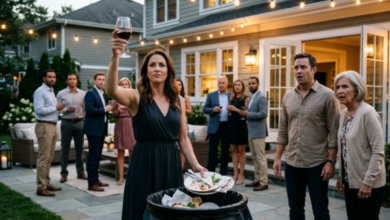
Her sister Beverly and Beverly’s husband, Trevor, were sitting at the table. There was an open bottle of champagne between them.
“Quite a day,” Trevor said.
I did not sit down.
“Where is it?”
“At a dealership in Asheville,” Margaret replied. “Honestly, Harold, you should be pleased. Think what we can do with that money.”
Beverly began talking about an Alaska cruise. Margaret mentioned the kitchen cabinets.
Trevor glanced toward the workshop.
“That building could bring in money too, with the right changes.”
They were discussing my belongings as though I had left the country and given them permission to settle my affairs.
I rested my hands on the back of a chair.
“Who signed the papers?”
Margaret’s smile faded.
Before she answered, the telephone rang.
The Call From the Dealer
Margaret picked up the receiver.
“Yes, this is Mrs. Whitfield.”
She listened.
Then her eyes moved toward me.
“What do you mean, questions about the title?”
I held out my hand.
The man on the line introduced himself as Marcus Kettering, the dealer who had collected the motorcycle.
He sounded worried.
After the sale, photographs of the Vincent had reached a collector who recognized it. Questions about its history had led Marcus to examine the documents again.
Police were now at the dealership, reviewing the transaction.
“Mr. Whitfield,” he said, “did you authorize your wife to sell this motorcycle?”
“No.”
“Did you sign the bill of sale or the transfer documents?”
“No.”
Behind me, the kitchen had gone quiet.
“I’m coming to Asheville,” I told him.
Then I put down the phone.
The Gift My Father Left Me
My name is Harold Whitfield.
I was sixty-eight when this happened, old enough to know that the things people call valuable are not always the things you would miss most.
My father gave me the Vincent on my twenty-first birthday.
After the guests had gone, he led me into the garage and pulled away its cover.
I thought he wanted help with something.
Instead, he put the keys in my hand.
“Look after it,” he said.
Along with the motorcycle came a trunk containing receipts, photographs, maintenance notes, and correspondence he had carefully saved.
Dad was not a man who explained his feelings in long speeches. He showed them by teaching me something, fixing what I could not fix, or checking my tires before a journey.
Giving me that motorcycle was one of the clearest things he ever said.
I had spent forty-seven years trying to honor it.
What Margaret Had Never Asked
The Vincent was more than an old machine, even by a collector’s standards.
Its history and documentation had attracted specialist attention. Three months before the sale, an appraiser had estimated its value between $420,000 and $470,000.
That was an estimate, not money in my account.
I had not decided to sell.
When I stood beside the motorcycle, I thought about Dad showing me how to work patiently. I remembered his hands, the smell of the garage, and the way he listened to an engine before reaching for a tool.
Margaret knew the motorcycle had belonged to him.
She also knew I had refused previous suggestions to sell it.
What she had never shown much interest in was why.
Over the years, she called it clutter, complained about the workshop, and asked what practical purpose any of it served.
I had mistaken her dismissal for a disagreement we could live with.
I had not imagined she would act behind my back.
Two Documents on a Desk
At the dealership, Marcus led me into an office.
A police investigator, Nora Faulkner, was waiting with copies of the sale documents. Jeffrey Pendleton, the collector who had recognized the motorcycle, was there too.
Marcus looked exhausted.
“The motorcycle is secure,” he told me. “Nobody has worked on it.”
Faulkner placed two pages in front of me.
Both carried my name.
Both carried a signature meant to look like mine.
“Did you sign these?” she asked.
“No.”
I explained the differences I could see. She took notes and asked about the ownership records I kept at home.
Nobody declared the matter solved on the strength of a glance. There were documents to obtain and accounts to compare.
But one fact required no investigation from me.
I had never agreed to the sale.
Seeing the Vincent Again
Marcus took me into the rear workshop.
The motorcycle stood beneath the lights, its black tank familiar enough to make my chest tighten.
I walked over and placed my hand on it.
For the first time since finding the empty space, I could breathe normally.
Jeffrey remained a few steps behind me.
“We wanted to make sure it hadn’t been sold on again,” he said.
“Thank you.”
It was all I could manage.
The Vincent was still intact. That mattered enormously.
But its presence did not make the papers in the office disappear. Nor did it explain how my wife had decided that my refusal could be replaced with a copied signature.
Margaret’s Explanation
When I returned home, Beverly and Trevor had gone.
Margaret was alone at the kitchen table.
“I didn’t know it was worth that much,” she said.
I took off my jacket.
“That isn’t the first thing we need to discuss.”
“Harold—”
“How did my signature get on those papers?”
She looked toward the window.
Eventually, she admitted using an old letter as a model. She had practiced copying my name. She had also copied my identification and told Marcus that illness prevented me from attending.
I sat down.
This had taken preparation.
There had been time to reconsider while finding the letter. Time while copying my identification. Time while arranging collection for the morning of my appointment.
“You could have asked me,” I said.
“You would have said no.”
“Yes.”
She began crying.
I remained at the table, looking at the woman I had been married to for thirty-six years.
For once, neither of us tried to fill the silence.
The Records Told a Longer Story
Over the following weeks, investigators reviewed the documents and messages connected to the sale.
The messages showed that Beverly had helped discuss the arrangement. Trevor had offered suggestions about how to present it to the dealer.
My attorney, Priya Sanderson, reviewed the motorcycle’s records and the documents concerning my father’s gift.
The process was slower than the afternoon when everything had come apart.
There were meetings, requests for information, and questions that needed careful answers.
I also began divorce proceedings.
Margaret said I was ending a marriage over a motorcycle.
I could not make her understand that the motorcycle had revealed a decision already made: she believed she could take something important to me because she did not think it should matter.
The copied signature made that decision impossible to overlook.
Bringing It Home
When the arrangements for its return were complete, Marcus brought the Vincent back himself.
I stood beside the trailer while he lowered the ramp.
We moved carefully, speaking only when we needed to.
Then its tires touched the workshop floor.
For a moment, I looked away.
“I should have verified everything directly with you,” Marcus said.
“Yes,” I replied. “You should have.”
He accepted that without an excuse.
I appreciated the apology, but I needed the mistake acknowledged plainly.
We positioned the motorcycle where it had always stood.
After Marcus left, I pulled a chair beside it and sat there until the light changed outside the window.
I did not work on anything that afternoon.
Consequences Without Celebration
The legal matters continued over the months that followed.
The forged paperwork and the unauthorized sale led to criminal proceedings. The people involved had to answer for their individual actions.
The divorce also moved forward. My attorney handled the evidence and the negotiations, including the records relating to the Vincent.
Eventually, the motorcycle remained with me.
There was no triumphant moment when a document arrived and everything stopped hurting.
Some evenings, I was angry. On others, I missed the familiar sounds of a shared household, even though I knew I could not return to what it had become.
I learned that relief and grief can occupy the same quiet kitchen.
Neither feeling meant I had made the wrong decision.
People Who Understood
Jeffrey invited me to a gathering of motorcycle enthusiasts in the mountains.
At first, I declined.
I did not want to spend a weekend retelling what had happened.
“Then don’t,” he said. “Bring the bike. Talk about that.”
So I went.
People asked about the records, the restoration work, and the things Dad had taught me. Someone wanted to examine an old service note. Another rider shared photographs of a machine his own father had owned.
For the first time in months, the conversation did not revolve around the sale.
I found myself enjoying the details again.
A question led to a story. That story reminded someone else of something. Soon we were sitting together long after I had intended to leave.
The Question Beneath the Questions
That afternoon, I realized why the gathering meant so much.
These people were interested.
They did not have to share every preference I had. They did not need to agree that I should keep the Vincent forever.
They simply understood that a person might care deeply about an object because of the life attached to it.
One man asked what Dad had been like as a teacher.
I told him about the time I rushed a job and had to start again.
“Did he get angry?” the man asked.
“No. He made coffee.”
We laughed.
I had not told that story in years.
Driving home, I thought less about the motorcycle’s appraisal and more about how good it had felt to speak without defending my interest.
Opening the Workshop
Gradually, I began inviting other people into the workshop.
A few younger enthusiasts came by with questions. Jeffrey joined us when he could. Later, Marcus offered to help organize some of the mornings.
At first, I was not sure how I felt about seeing him regularly.
But he kept showing up, listened, and treated the work carefully. Trust returned through those ordinary actions.
We read manuals, examined old components, and talked through problems.
I did not pretend to know everything.
When something was beyond my experience, we found someone who understood it better.
Mostly, I tried to pass on Dad’s patience.
“Look first,” I would tell them. “Then decide what needs doing.”
He would have recognized those mornings.
Eleanor and the Photographs
Eleanor arrived one spring carrying photographs of an old BSA Bantam.
She was a retired nurse. The motorcycle had belonged to her late husband and had been sitting unused for years.
“I don’t know whether it can be brought back,” she said.
“We can look.”
That became several weekends of work.
She asked questions, remembered more than she expected, and refused to stand aside when there was something she could help with.
When the engine finally ran, she put a hand over her mouth.
Neither of us spoke immediately.
I knew better than to interrupt.
Later, over coffee, she told me about the journeys she and her husband had taken when they were younger.
I listened.
Four Simple Words
Our friendship grew slowly.
We shared meals, went for short rides when the weather suited us, and became comfortable with stretches of silence.
One afternoon, Eleanor noticed a photograph of Dad beside the Vincent.
“What was he like?”
I stopped what I was doing.
It was such an ordinary question.
Yet I stood there for a moment before answering.
Then I told her about his rough hands, his terrible whistling, and the way he checked everybody’s vehicle before letting them leave.
I told her he was better at demonstrating love than describing it.
She looked at the photograph again.
“I think I would have liked him.”
“Yes,” I said. “I think you would.”
She had not asked what the motorcycle was worth.
She had asked about the person I missed.
What I Wanted to Leave Behind
After the divorce, I reviewed my plans for the future.
I wanted the Vincent’s documents preserved with the machine. I also wanted to support opportunities for younger people to learn practical skills.
An attorney helped me put those wishes into appropriate arrangements rather than leaving them as vague instructions someone might have to interpret later.
Thinking about that future felt different from worrying about what might be taken.
I was making choices again.
The motorcycle had been a gift entrusted to me. Eventually, I wanted someone else to understand that responsibility.
Until then, there was work to do, company to enjoy, and the occasional clear afternoon worth spending on the road.
The Space Is No Longer Empty
Sometimes I still remember walking into the workshop that October afternoon.
The folded cover. The moved tools. The pale space on the concrete.
For a few seconds, I can feel the shock again.
Then I look toward the Vincent.
It is there.
But the workshop around it has changed. There are extra chairs now. Cups sometimes wait beside the kettle. People come by with questions and stay longer than they planned.
My father gave me a motorcycle, along with the knowledge needed to care for it.
Years later, keeping that gift helped me recognize something else I needed: room for my interests, respect for my choices, and people willing to listen.
Eleanor understands that without sharing every feeling I have about an old engine.
When she asks about Dad, she waits for the answer.
And when I finish, she sometimes asks another question.