News
I Thought My Grandson Had Forgotten About Me, but His Graduation Speech Left Me Crying in Front of Everyone
I Thought My Grandson Had Forgotten About Me, but His Graduation Speech Left Me Crying in Front of Everyone

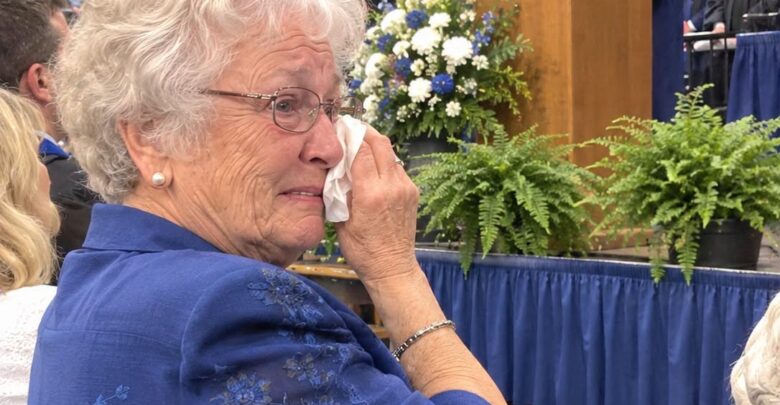
I Thought My Grandson Had Forgotten Me—Then He Saved Me a Seat
The Night Everything Changed
I raised my grandson, Kevin, after his parents died in a car accident.
He was four years old.
That evening, my son Michael and his wife, Rachel, had gone out together. Kevin stayed with me, coloring at the coffee table until he grew sleepy.
When the state trooper knocked, my grandson was asleep beneath a green afghan my mother had crocheted years earlier.
The officer glanced toward him before speaking.
“Mrs. Haley, I’m so sorry.”
I remember holding the doorframe. Beyond that, the night comes back in pieces: the officer’s lowered voice, the kitchen light, Kevin turning in his sleep.
I was fifty-eight. My husband, Harold, had died three years earlier. I worked in a school cafeteria, owned a modest house in Kettering, Ohio, and had a hip that already troubled me.
By morning, I was responsible for a little boy who would wake up asking when his parents were coming home.
“You’ll Be Seventy-Two”
Some people worried that I was too old to raise him.
My sister Doris said it directly while helping me wash casserole dishes after the funeral.
“Jo, you’ll be seventy-two when he finishes high school. What happens if you get sick?”
“I’ll make a plan.”
“Rachel’s sister has offered to help.”
“I know.”
Doris set a plate in the rack.
“You don’t have to prove anything.”
I understood her concern. There were sensible questions to answer, arrangements to make, and help I would need.
But Kevin knew my house. He knew which cupboard held his cup and which floorboard creaked outside the bathroom. He had already lost so much.
“I’m not proving anything,” I said. “I want him here.”
My name is Josephine Haley. Everybody calls me Jo.
And Kevin stayed.
The Warm Spot
I worked in the cafeteria during the day. Later, I took an evening job cleaning offices.
My neighbor, Mrs. Ortiz, watched Kevin when I worked late. She was a widow too, and she insisted that having someone to cook for did her good.
Most nights, she put him to bed before I came home.
Still, I often found him on the couch, wrapped in that green afghan, fighting sleep.
“Grandma,” he would whisper. “I saved you the warm spot.”
He would move over, leaving the cushion warm from his small body.
I sat beside him in my work clothes, tired enough that taking off my shoes felt like another job. He climbed into my lap, and I wrapped the afghan around us.
We sat quietly for a few minutes before I carried him to bed.
As he grew older, I reminded him that school mornings required sleep. Sometimes he listened. Sometimes I found him waiting anyway.
Eventually, he became too big to carry.
He never became too big to move over.
What We Could Afford
We had enough, although some months required careful counting.
There was plenty of spaghetti and grilled cheese. Clothes often came from secondhand shops. On weekends, we visited the library.
For his tenth birthday, Kevin wanted a game console his friends already owned.
I looked at the price, went home, and worked through the bills at the kitchen table.
The numbers did not leave room for it.
Instead, I found a used handheld game system with three games.
When he opened it, he looked at the box and then at me.
“It’s great, Grandma.”
I knew he had hoped for something else.
That made his kindness harder to bear.
But our life was not a collection of things we could not buy. We had pizza nights, summer baseball games, library books, and arguments about whose turn it was to choose a movie.
We had a home that belonged to both of us.
A Boy With Plans
Kevin was bright and curious.
He wanted to know why things moved, what made them stop, and whether taking them apart would help him understand.
Sometimes it did.
Sometimes I ended up with a broken appliance and a boy holding an unexplained screw.
His teachers encouraged him. He joined the academic team, worked hard in school, and took a weekend job bagging groceries.
He tried to give me part of every paycheck.
I put the money aside for him.
By his junior year, he had decided what he wanted.
“Mechanical engineering,” he said, spreading college information across the kitchen table.
“Have you thought about the cost?”
“I’m applying for scholarships. I’ll work too.”
I watched him straighten the papers into a neat pile.
Michael used to make that same small movement when he was concentrating.
The Letter We Read Together
Kevin’s college acceptance arrived during his senior year.
He opened it at the kitchen table, read the first lines, and looked up without speaking.
Then he handed it to me.
I began crying before I finished.
“Grandma,” he said, coming around the table. “It’s good news.”
“I know.”
But I was thinking about two people who should have been there. Michael should have been making proud, terrible jokes. Rachel should have been reading every line twice.
Kevin knelt beside my chair and held me.
“One day, you’ll watch me graduate,” he said.
“I certainly will.”
“Front row?”
“If they’ll let me.”
He smiled.
“We’ll make sure.”
The Memorial Scholarship
A few months later, another letter arrived.
This one came from a law firm.
It explained that Kevin’s education would receive funding through the Michael and Rachel Haley Memorial Scholarship.
He read his parents’ names aloud.
“Grandma, did you know about this?”
“I knew there were arrangements in their memory.”
He studied the page.
The award would cover his tuition and living expenses through college, subject to its terms.
“I don’t have to borrow all that money,” he whispered.
“No, honey.”
He had written scholarship essays about our life together. One described the warm spot on the couch.
When he asked whether that essay had helped him receive this award, I let him believe it might have.
It was not the full truth.
At the time, I told myself I was protecting him from a burden he did not need to carry.
Four Years of Phone Calls
College took him to Columbus, but it did not take him out of my daily life.
He usually called around seven-thirty. If I was still working, we spoke later.
Some conversations lasted a minute. Others continued until one of us noticed the time.
He told me about difficult classes, friends, internships, and a young woman named Priya.
For a while, he seemed unaware of how often her name appeared.
“How’s Priya?” I asked one evening.
“How did you know I was with her?”
“Because you’ve mentioned her four times since you called.”
He laughed.
During visits home, he fixed small things around the house and pretended not to notice when I packed too much food for his return trip.
Sometimes, after an evening cleaning shift, I found him on the couch under the afghan.
He would move over.
“Saved you the warm spot.”
What Happened in the Closet
A few weeks before graduation, Kevin came home for a visit.
He helped with a leaking faucet. We ordered our usual pizza. He talked about the engineering job he had accepted, which would begin later that summer.
Then he needed his birth certificate.
“It’s in the cedar box in my closet,” I told him.
He stayed upstairs longer than I expected.
When he returned, he went straight to the sink and filled a glass of water.
“Did you find it?”
“Yes.”
Something in his voice made me look up.
“Everything all right?”
“Just tired.”
He left earlier than planned the next morning.
His hug was brief.
For days afterward, I kept returning to that moment, trying to understand what had changed.
The Silence
At first, I blamed final exams.
Then his missed calls became a week of unanswered messages.
I sent a short text.
Hope you’re doing all right. Love you.
No reply.
Eventually, he answered.
“Kevin, thank goodness. Are you okay?”
A long silence followed.
“Did something happen?”
“Grandma, I can’t talk.”
“Did I do something?”
His next words came quickly.
“Please leave me alone.”
Then the call ended.
I stood beside the kitchen counter, staring at the phone.
Later, I baked his favorite cookies and mailed them with a note.
Whatever is wrong, we can talk. I love you.
The package came back unopened.
Mrs. Ortiz found me on the porch with the box in my lap.
She sat beside me without asking me to explain immediately.
That was one of the things she did best.
The Dress He Had Chosen
On graduation morning, I put on a navy dress with small white flowers.
Kevin had helped choose it for his high-school graduation.
“You look like a grandma in a movie,” he had said.
“Is that a compliment?”
“A very good one.”
I remembered that exchange while fastening the dress.
Mrs. Ortiz drove me to Columbus. I held a small bouquet of daisies throughout the journey.
Outside the ceremony, I stopped.
“He asked me to leave him alone.”
My neighbor looked toward the entrance.
“You can sit quietly. You don’t have to approach him.”
I nodded.
That felt like something I could manage.
Inside, I chose a seat near the back, beside an exit.
I had promised to watch him graduate.
I would keep the promise without making him speak to me.
My Grandson at the Microphone
I found Kevin among the graduates.
Even from a distance, I recognized the tilt of his head and the way he held his shoulders.
Then the student speaker was announced.
Kevin Haley.
My grandson stood and walked toward the stage.
I had not known.
He placed his notes on the lectern and looked toward the front seats.
After a pause, he began.
“My grandmother raised me after my parents died.”
My fingers tightened around the flowers.
“She worked in a school cafeteria. She cleaned offices at night. And when she came home, I used to tell her I’d saved her the warm spot on our couch.”
Mrs. Ortiz took my hand.
“I thought I understood what she had done for me,” he continued. “Recently, I learned there was something else.”
He looked down at his notes.
“And I handled learning it badly.”
The Envelope
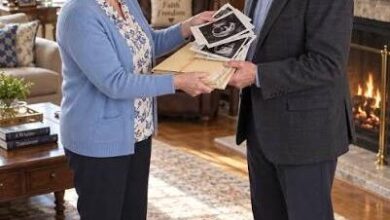
Kevin took an old envelope from inside his gown.
I recognized it before he held it up.
On the front, in my handwriting, were the words:
For Kevin, when you’re twenty-five.
“I found this while looking for my birth certificate,” he said.
The envelope had not been sealed.
Inside was a letter explaining what had happened to the settlement following his parents’ deaths.
One hundred and eighty-six thousand dollars had been placed in an education trust.
That trust had funded the memorial scholarship.
There had been no independent committee choosing him from a field of applicants. The money had been set aside for him.
I had planned to explain everything when he was older.
Instead, he had discovered it alone in my closet.
“I learned that she had protected this money for my education,” Kevin said. “And all I could think about was her coming home exhausted.”
His voice broke.
“I should have talked to her.”
What He Needed to Apologize For
Kevin stopped reading.
“Grandma, if you’re here, I’m sorry.”
I could hardly see through my tears.
“I was upset. I felt guilty. I kept thinking about what you might have done differently if you hadn’t worried so much about me.”
He took a breath.
“But that doesn’t excuse telling you to leave me alone. It doesn’t excuse sending the cookies back.”
The room was quiet.
“I was trying to arrange something for you. I told myself keeping it secret made the silence necessary.”
He shook his head.
“It wasn’t necessary. It was cruel.”
I had needed those words more than he could have known.
Not an explanation that made the hurt disappear.
An acknowledgment that it had happened.
A Conversation Beside My Seat
When his remarks ended, Kevin searched the audience.
Mrs. Ortiz raised her hand.
He saw us near the back.
With permission to step away briefly, he came down the aisle and knelt beside me.
“I’m sorry,” he said again.
I touched his cheek.
“Next time, talk to me.”
“I will.”
“The cookies were perfectly good.”
He laughed through his tears.
“I know.”
Then he took out another envelope.
“There’s money remaining in the trust,” he said quietly. “The administrator explained what happens when I graduate. I want to use part of what becomes mine to help you.”
I began shaking my head.
“Please hear me out.”
So I did.
Help I Could Choose to Accept
Kevin had gathered information about my remaining mortgage and the costs I might face if I pursued hip treatment.
He had spoken to the trust administrator about the remaining funds—approximately thirty-nine thousand dollars.
Nothing had been scheduled in my name. No one had agreed to treatment for me.
He had brought a plan.
“If you want to see your doctor about the surgery, I can help with costs,” he said. “And we can look at the mortgage together.”
“You need a start in life.”
“I have one.”
He glanced toward the graduates.
“That’s what today is.”
For a moment, I could not answer.
Then I said, “We’ll sit at the kitchen table and go through it.”
His shoulders relaxed.
“Together?”
“Together.”
Reserved for Grandma
Before returning to the ceremony, Kevin asked whether I would move to the front.
“I saved you a seat.”
He helped me stand and offered his arm.
Mrs. Ortiz followed with my flowers.
On the chair was a handwritten sign.
RESERVED — GRANDMA
Over its back lay my mother’s green afghan.
I stared at it.
“I brought it during my last visit,” Kevin said. “Mrs. Ortiz knew.”
My neighbor gave me a small, guilty smile.
Kevin placed the afghan around my shoulders.
Then he leaned close.
“Saved you the warm spot, Grandma.”
For a moment, I saw every version of him at once: the sleepy little boy, the teenager with college brochures, the young man standing beside me.
I sat down.
This time, when I cried, I did not wonder whether I had lost him.
Watching Him Graduate
Later, they called his name.
Kevin Michael Haley.
He walked across the stage, shook hands, and accepted his diploma cover.
Before stepping down, he found me in the audience.
He lifted it slightly.
I lifted the daisies.
That was enough.
Afterward, Priya hugged me while Kevin stood nearby, looking both proud and embarrassed.
“He talks about you all the time,” she said.
“He could have done a little more of that talking directly to me lately.”
“I know,” she replied.
Kevin nodded.
“I deserved that.”
Mrs. Ortiz arranged us for photographs. The afghan appeared in several of them because I forgot to take it off.
Learning to Receive
Over the following weeks, Kevin and I reviewed his offer carefully.
We spoke with the people who could explain the financial arrangements. I met with my doctor and decided how I wanted to proceed.
With help, I finally addressed the hip problem I had postponed for years.
Kevin was there during my recovery, before his new job began. He cooked the meals he knew best: spaghetti and grilled cheese.
He drove me to appointments and complained that I kept trying to tidy things.
“You’re supposed to rest.”
“I’m moving a cup.”
“An extremely demanding cup.”
At night, I sometimes joined him on the couch.
He moved over.
The old words never needed improving.
Another Front Row
A year later, Kevin called outside our usual evening hour.
“Priya and I are getting married.”
I sat down immediately.
“Oh, honey.”
“There’s something else,” he said. “We’d like you to spend more time with us. Maybe stay for a while and see how you like it.”
He described a room they were preparing.
Yellow, like my kitchen.
This time, he did not announce a decision for me. He asked.
I looked around the house where I had raised Michael and then his son.
There was a great deal to consider.
“Could I bring the afghan?”
Kevin laughed.
“I was counting on it.”
At the wedding, there would be another seat in the front row.
Another handwritten sign.
And something soft and green draped over the back.
I used to believe loving a child meant giving without letting them see how tired you were.
I understand it differently now.
There is room to care for someone and still accept care yourself. There is room to say that something hurt, even when you love the person who did it.
Kevin and I had more conversations to have.
But we were having them.
And wherever we sat next, we knew how to make room for each other.