Uncategorized
My Brother Sold Dad’s 51-Year-Old Watch for $40—Then We Discovered the Secret He Hid for 45 Years

The Watch That Brought Our Father’s Past Back to Life
My brother sold our father’s 51-year-old wristwatch for forty dollars.
At first, I thought it was simply another selfish decision from a man who had spent years putting his own needs ahead of everyone else’s. Dad had been gone for only three months, and the watch was one of the few possessions my mother still kept beside his reading glasses.
When it disappeared, Scott claimed he knew nothing about it.
Then we discovered he had sold it to a local shop for the price of a few drinks.
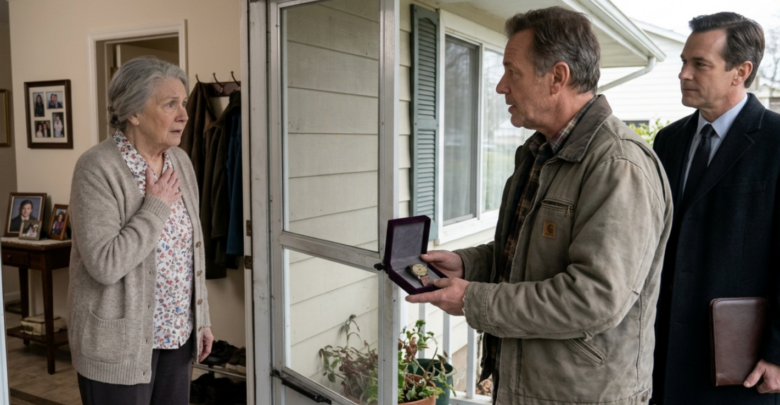
I was furious. My mother was heartbroken. Neither of us expected the shop owner to show up at our front door carrying a velvet box, an old handwritten note, and a lawyer who had been waiting decades for one particular condition to be met.
That was when we learned the watch had been hiding something far more important than its sentimental value.
It held the first clue to a secret our father had carried for forty-five years.
And the deeper we looked, the more we realized that the quiet man we thought we knew had once stood at the center of a mystery involving missing money, a vanished steelworker, and powerful people who apparently wanted the truth to remain buried.
A Message From My Father
My mother, Margaret Brennan, sat at the kitchen table with the watch in her trembling hands.
Its steel casing was scratched near the number eleven. Dad had made that mark decades earlier, when he slipped on icy steps while carrying a box of baby clothes into our first home.
He had always called it his first battle scar.
Mom traced the scratch with her thumb, tears gathering in her eyes.
Then she unfolded the note that had been hidden inside the watch.
“My dearest Margaret,” she read aloud. “If you are reading this, then I have either run out of time or finally found the courage to tell you what I should have told you years ago.”
She paused, struggling to breathe.
The letter continued.
Dad explained that he had protected something for forty-five years. It had never been meant for him alone. He had hidden the proof somewhere nobody would think to look, trusting that the watch he wore every day would eventually find its way back to his wife.
At the bottom of the note were six words:
The mill. Locker 214. Ask for Daniel.
Beneath them was a date.
September 17, 1981.
A lawyer named Mr. Cole, who had arrived with the shop owner, explained that Dad had contacted his predecessor’s law firm several months before his death. He had left instructions that certain documents should be delivered to Mom if the watch was recovered.
The lawyer had been unable to locate the original evidence. Until that morning, he had not known whether the watch would ever return.
Mom stared at him.
“What did my husband do?”
Mr. Cole answered carefully.
“I don’t believe this was about something he did, Mrs. Brennan. I believe it was about something he discovered.”
Those words changed everything.
Dad had spent more than thirty years working at North River Steel Works. He was an ordinary man in the eyes of our family: hardworking, practical, and careful with money. He repaired broken household items rather than replacing them and saved every useful screw in an old toolbox.
We had never imagined that his past might contain a secret serious enough to require a lawyer.
But the date on the note matched a document Mr. Cole had brought with him.
And the first page mentioned approximately $186,000 in missing funds.
That was a substantial amount of money in 1981.
Dad had never lived extravagantly. We grew up in a modest house, drove used cars, and spent our holidays camping. He had never behaved like someone who had been involved in a financial scandal.
According to the records, however, he had raised concerns about missing inventory, altered purchase orders, and suspicious payments at the steel mill.
He might have been the person who discovered the wrongdoing.
The lawyer showed us a letter written by a former employee named Daniel Whitaker.
One sentence stood out:
“Harold has the original ledger. If management discovers it, they will make certain neither of us works in this town again.”
Mom went pale.
She remembered Daniel. He had worked alongside Dad and visited our house several times when my brother and I were young. Then, one day, Dad told her that Daniel had left the company.
He never explained why.
Now we understood that the story had not ended when Daniel walked out of the mill.
It had only gone silent.
My Brother Knew More Than He Admitted
That evening, Scott called.
He sounded irritated when I answered.
“Are we still doing this?” he asked.
“You sold Dad’s watch.”
“I needed money.”
“You told Mom you didn’t know where it was.”
He insisted that he had been desperate, that the watch was old, and that everyone was making him look like a criminal.
When I told him about the note, his attitude changed.
I mentioned the steel mill, Locker 214, and Daniel Whitaker.
For several seconds, Scott said nothing.
Then he asked, “Where did you hear that name?”
I told him it was written in Dad’s note.
He quickly claimed that Dad had mentioned Daniel years earlier. Before hanging up, however, he warned me not to make accusations against people who were no longer around to defend themselves.
His reaction troubled me.
Why would my brother be worried about an old coworker he supposedly knew nothing about?
Later that evening, Mom opened Dad’s wooden toolbox. Beneath the screwdrivers and measuring tape, she found a faded photograph of three men standing outside the steel mill.
Dad was in the middle.
Daniel Whitaker stood beside him.
The third man was Robert Vale, who eventually became chairman of the company that owned the mill.
On the back, Dad had written their names and a sentence that made my stomach tighten:
The three of us knew the truth.
We now had three names, a date, a locker number, and a missing ledger.
We also had a brother who seemed increasingly afraid of what we might uncover.
When Mr. Cole arranged permission to visit the former mill, Scott sent me a message.
“Don’t go to the mill.”
I called him immediately.
He claimed it would be a waste of time. Then he said something that stayed with me.
“Sometimes the dead leave things behind because they don’t want anyone to know about them.”
I reminded him that Dad had specifically written down the locker number.
Scott raised his voice, then suddenly went quiet.
I knew he was hiding something.
But I didn’t yet know how much.
What We Found Inside Locker 214
The old steel mill stood beyond a row of bare trees, its brick walls dark beneath the gray sky. Much of the machinery had been removed, but a section of the original building remained.
Mr. Cole met us at the entrance with a representative from the property management company. After confirming permission to enter, we followed them through dusty corridors to the abandoned locker rooms.
Rows of dented metal lockers lined the walls.
Mom walked slowly, remembering how Dad used to complain that the lockers were too small to change clothes comfortably.
Then we reached number 214.
The lock was badly damaged. A maintenance worker removed it after the property representative confirmed that we were authorized to open the locker.
Inside were a pair of old work gloves, a small lunch tin, and a bundle wrapped in oilcloth.
The bundle contained a thick black ledger.
Beneath it was an envelope addressed to Mom.
“Read first,” Dad had written.
Her hands trembled as she opened it.
The letter explained that Dad had believed silence would protect his family. For decades, he had carried the burden alone, hoping that keeping the evidence hidden would prevent trouble from reaching our home.
But he also acknowledged the cost.
He had spent forty-five years carrying something that frightened him.
He had not preserved the ledger for revenge. He had kept it because one day someone might finally ask the right questions.
Mom lowered the letter.
“Open it,” she whispered.
Mr. Cole carefully examined the ledger. Its pages contained dates, invoices, payment records, and handwritten notes. Several entries referred to companies that no longer appeared to exist.
Then he stopped at a page dated September 17, 1981.
Three names appeared in the margin:
Harold Brennan.
Daniel Whitaker.
Robert Vale.
Below them was a note about funds being transferred and copies of records being retained. It also included an instruction to deliver the evidence to Harold if anything happened to Daniel.
We looked at one another in silence.
Then we discovered a newspaper clipping tucked inside the ledger.
Its headline read:
STEEL MILL EMPLOYEE REPORTED MISSING — POLICE SEEK INFORMATION
The man in the accompanying photograph was Daniel Whitaker.
The report was dated September 18, 1981.
One day after the date on Dad’s note.
We had gone to the mill looking for an explanation about missing money. Instead, we had found evidence connected to a man who had vanished more than four decades earlier.
Then I noticed a smaller photograph hidden behind the clipping.
It showed Dad, Daniel, and Robert Vale standing outside the mill. A woman in the background had been circled in red ink.
Beneath the photograph, Dad had written:
“Ask who signed the final payment.”
The signature beside the payment was Margaret Brennan.
My mother’s name.
Mom stared at the page in disbelief.
“I never worked at the mill,” she whispered. “I never signed anything for that company.”
Mr. Cole explained that the signature could have been forged, but it would require independent examination before anyone could draw a conclusion.
The woman in the photograph was Eleanor Vale, Robert Vale’s wife.
She had died in a car accident in 1983.
And according to the surviving records, she was the last person known to have seen Daniel Whitaker alive.
The Widow Who Never Stopped Looking
Mr. Cole located Daniel’s wife, Patricia Whitaker, through old newspaper archives and public records.
She was living in a small town two hours away.
When we arrived at her modest brick home, she was already in her late seventies. Her silver hair framed a face marked by decades of unanswered questions.
When Mr. Cole mentioned Daniel’s name, Patricia gripped the doorframe.
Then she invited us inside.
A photograph of Daniel holding their young daughter stood on a shelf near the fireplace.
Patricia touched it gently.
“I wondered when someone would finally come,” she said.
Mom apologized for not asking more questions after Daniel disappeared. Patricia told her she had nothing to apologize for. Neither woman had understood what was happening all those years ago.
Mr. Cole explained what we had discovered.
When Patricia saw the photograph from the ledger, her hands began to shake.
Daniel had worked in the mill’s purchasing department. Before he disappeared, he had discovered that money was being diverted through false invoices. Equipment was recorded as delivered even when it never arrived, and payments were approved for companies that appeared to have no legitimate operations.
According to Patricia, Daniel believed Robert Vale was involved.
The missing funds were not simply numbers on a page. Some of the money was supposed to pay for repairs and replacement safety equipment.
Workers had complained about defective machinery. Patricia’s own brother had lost two fingers in an accident that might have been prevented if the necessary repairs had been made.
Suddenly, the ledger meant more than financial misconduct.
It might help explain why workers had been put at risk, why Daniel had tried to preserve the evidence, and why Dad had been unwilling to forget what happened.
Patricia remembered the night before Daniel disappeared.
He had visited our house to meet Dad. Before leaving, he thanked her for the coffee she had served and told her that if anything happened to him, she should tell Harold he had done the right thing.
The following evening, Daniel never came home.
His car was eventually found near a rural road. There was no confirmed evidence of a collision, no body, and no clear explanation for his disappearance.
The original investigation had gone quiet.
Patricia had received an anonymous letter telling her that Daniel had left town and warning her to stop asking questions. She gave a copy to the police, but nobody identified its author.
Then, in 1984, she received a package containing a photograph of Daniel and an old brass key stamped with the number 214.
She had kept it for decades without knowing what it opened.
It was the key to the locker we had just opened.
Patricia also revealed that Daniel had once told her Eleanor Vale might be the only person inside the company willing to tell the truth.
After Eleanor’s death, Patricia had received the package.
We could not establish exactly why the key had been sent or who had sent it. But the discovery suggested that someone had wanted the evidence preserved, even after the people involved were gone.
The Truth Behind the Forged Signature
The investigation did not produce an immediate confession or a dramatic arrest.
Instead, it required weeks of patient work.
Mr. Cole helped arrange an independent examination of the ledger and contacted people who had worked at the mill. Investigators searched archived company records and revisited the original missing-person case.
The handwriting examiner concluded that several different people had written entries in the ledger. Some appeared consistent with Dad’s handwriting; others appeared consistent with Daniel’s.
The signature beside the final payment did not match Mom’s verified signatures.
It appeared to have been forged.
Investigators also found that a company named in the payment records had been registered shortly before the money disappeared. Its listed office address was vacant, and its bank account had been closed within months.
Records showed that Robert Vale had been authorized to approve certain payments.
The documents did not, by themselves, establish every detail of the suspected wrongdoing or prove what had happened to Daniel. But they provided important leads that had never been properly examined.
A former mill accountant, now in his eighties, had also retained copies of reports from 1981 because he feared he might eventually be blamed for transactions he had not approved.
One report contained a note about Dad:
“Employee refused to certify equipment delivery. Requested independent inspection.”
Another documented Daniel’s complaint about missing funds and safety equipment.
Both complaints had been marked as resolved, even though the underlying issues had apparently not been fully investigated.
Mom read the reports in Mr. Cole’s office.
“He never told me,” she whispered.
The lawyer suggested that Dad might have believed silence would keep his family safe.
Mom shook her head.
“But it didn’t protect him.”
For the first time, I understood how much our father might have sacrificed by refusing to approve something he believed was wrong.
He had not been a wealthy man or a powerful executive. He had been an ordinary worker who had challenged people with more influence than he possessed.
He had kept copies of the evidence.
He had refused to certify a false delivery.
And he had spent decades hoping the truth would eventually matter.
The Final Clue in Dad’s Notebook
Scott eventually admitted that Dad had spoken to him about Daniel years earlier.
When Scott was twenty-one, Dad had taken him to a diner near the highway. Scott had been in debt, and Dad was angry about the decisions he was making.
Instead of simply lecturing him, Dad told him that one mistake from his own younger years had nearly destroyed someone else’s life.
He warned Scott that some names belonged to a time when good people were forced to make terrible choices.
He also told him never to ask about Daniel Whitaker.
Scott had remembered the warning but never understood its significance.
After Dad’s funeral, Scott found an old notebook in the garage. He had considered throwing it away, but something stopped him.
Near the back was a list of names and dates.
One entry stood out:
“October 12 — Patricia. Find her before they do.”
The date was only two days before Dad died.
Dad had still been trying to find Daniel’s wife near the end of his life.
Scott admitted that Dad had also specifically instructed him to return the watch to Mom if anything happened to him.
Yet he had sold it for forty dollars.
“I was desperate,” he said.
“You were drunk,” I replied.
He looked down.
“Yes.”
For once, he didn’t blame anyone else.
His apology did not erase what he had done. It did, however, mark the first time he acknowledged the damage without making excuses.
I told him that if he truly wanted to honor Dad, he needed to stop hiding from the consequences of his choices.
The watch had brought us back to a mystery. But the way we treated one another while uncovering it would determine what kind of family we became afterward.
A Family Changed by the Truth
As investigators reviewed the evidence, Mom and Patricia formed an unexpected bond.
Both had spent years living with questions that no one had been willing or able to answer. They shared memories of two men who had worked together, trusted one another, and apparently tried to preserve evidence of wrongdoing.
We never received a complete explanation for every event surrounding Daniel’s disappearance. Some records were missing, and several people who might have clarified the story had died.
But the surviving documents helped restore Daniel’s place in the story.
He was no longer simply a name on an old newspaper clipping. He was a husband, a father, and a worker who had tried to raise concerns about suspicious transactions and unsafe equipment.
Dad’s actions also became clearer.
He had not kept the ledger because he wanted revenge. He had kept it because he believed the evidence mattered, even if he was afraid of what revealing it might cost.
That did not mean his silence had been harmless.
Mom wished he had trusted her enough to share the burden while he was alive. She wished he had allowed her to stand beside him rather than leaving her to discover the truth after his death.
But she also understood that Dad had grown up believing a man’s duty was to protect his family by keeping danger away from their door.
He had been brave in some ways and frightened in others.
He had made choices he regretted.
And he had tried, in the end, to leave his family a path toward understanding.
Scott slowly began rebuilding his life. He worked to pay his debts and stopped blaming his circumstances for every poor decision. Trust did not return overnight, but he began to understand that an apology mattered only when it was followed by change.
He never forgot the watch.
Neither did I.
The Watch Was Worth More Than Forty Dollars
On the anniversary of Dad’s death, Mom and I visited his grave.
We brought flowers and sat together for nearly an hour, remembering the man who had spent fifty-one years wearing the same watch.
Mom took it from her handbag and ran her thumb over the familiar scratch near the number eleven.
“Fifty-one years,” she whispered. “You wore this thing for fifty-one years, Harold.”
She smiled through her tears.
“And you still managed to surprise me.”
The watch no longer kept time reliably. Mom did not care. She kept it in its velvet box and sometimes wore it on special occasions, not to invite questions but to feel its familiar weight against her wrist.
One afternoon, I asked whether she wished Dad had told her everything while he was alive.
“Yes,” she answered immediately. “I wish he had trusted me enough to share the burden. But I understand why he thought he was protecting us.”
She took my hand.
“He didn’t always understand that sometimes the truth is what protects a family.”
I thought about the ledger, the old photographs, Patricia’s decades of uncertainty, and the quiet man who had refused to certify equipment he believed had never arrived.
Dad had not solved every mystery. He had not prevented every injustice. He had not lived without fear or regret.
But he had preserved evidence that might otherwise have disappeared.
He had left us a reason to ask questions.
And he had given two families a chance to confront a painful past instead of allowing it to remain buried forever.
As for Scott, he eventually learned that the watch had never been the most valuable thing Dad left behind.
The most valuable thing was the lesson it brought home: money could be replaced, possessions could be repaired, and relationships could sometimes be rebuilt—but trust required honesty.
Dad’s watch had spent fifty-one years measuring time.
In the end, it gave us something time alone could never provide.
The chance to face the truth, remember the people who deserved to be remembered, and begin making things right.
SEO Details
SEO title: My Brother Sold Dad’s Watch for $40—Then We Found His Secret
Meta description: A son sells his late father’s treasured watch for $40, but a hidden note leads his family to an old steel mill, a missing worker, and a decades-old mystery.
Suggested URL slug: brother-sold-dads-watch-hidden-secret
Focus keyphrase: father’s watch hidden secret
Suggested tags: Family Mystery, Father’s Legacy, Family Betrayal, Hidden Secrets, Emotional Story, Justice, Family Reconciliation
Facebook caption: He sold his late father’s 51-year-old watch for just $40. But when the shop owner discovered a hidden note, the family uncovered a secret that had remained buried for 45 years. What they found inside an abandoned steel mill changed everything they thought they knew about their father.
Editorial note: This is a dramatic narrative based on the supplied story. Before presenting it as a verified true account, independently confirm the historical names, dates, financial records, and disappearance-related claims. Avoid labeling it a documented news report without reliable evidence.