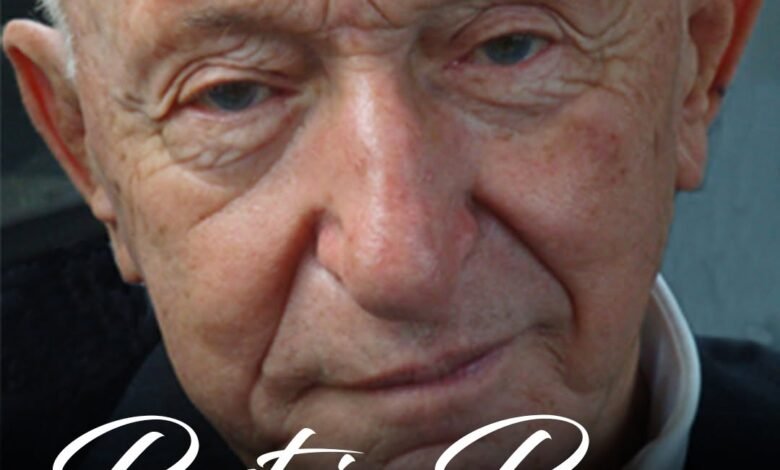
Yehuda Aharon Widawski, a Holocaust survivor whose life after the Second World War became closely connected with preserving the memory of Jewish communities in Poland, has died at the age of 107.
His life stretched across more than a century and included experiences that represented some of the darkest years of European history, followed by decades devoted to family, rebuilding, remembrance, and the preservation of Jewish cemeteries.
Widawski was born in 1919 in Turek, Poland, and later lived with his family in Łódź. His childhood and early adult years were disrupted by the rise of Nazi Germany and the German invasion of Poland.
Like millions of European Jews, he and his family were subjected to persecution, forced displacement, starvation, and imprisonment during the Holocaust.
His survival came at an enormous cost.
His parents and several of his siblings were murdered during the Holocaust. Widawski and his brother Yehoshua survived the selection process at Auschwitz-Birkenau and were later transferred to forced labor.
After liberation, Widawski returned to a world that had been transformed by war and genocide.
Instead of allowing the destruction he had witnessed to become forgotten, he eventually dedicated a significant part of his life to preserving the memory of those who had been killed.
His work included helping identify and restore thousands of Jewish graves across Poland.
A Childhood Interrupted by War
Yehuda Aharon Widawski was born in 1919 in Turek, a town in central Poland.
He later lived in Łódź, which before the Second World War had a large and important Jewish population.
Jewish life in cities and towns across Poland was diverse and deeply established. Families built homes, businesses, schools, religious institutions, cultural organizations, and communities that had existed for generations.
For young people such as Widawski, the future initially seemed to offer the ordinary possibilities of adulthood.
The German invasion of Poland in September 1939 changed that future.
Nazi Germany occupied large areas of Poland and introduced increasingly severe measures against Jewish residents. Jewish communities were subjected to discriminatory laws, confiscation of property, forced labor, deportation, starvation, and mass murder.
In Łódź, Jewish residents were forced into the Łódź Ghetto.
For Widawski and his family, the ghetto became part of an experience that would define the rest of his life.
Life Inside the Łódź Ghetto
The Łódź Ghetto was one of the largest Jewish ghettos established by Nazi Germany during the Holocaust.
People were confined to a restricted area under brutal conditions. Food was scarce, disease spread easily, and residents were subjected to forced labor.
Families faced constant uncertainty.
They did not know which relatives might be taken away next, whether they would receive enough food to survive, or what would happen if they became unable to work.
Despite those conditions, people in the ghetto attempted to preserve elements of community life and human dignity.
For Widawski, those years were also the beginning of a devastating separation from the life he had known before the war.
The family that entered the ghetto would not emerge from the Holocaust intact.
Deportation to Auschwitz-Birkenau
In August 1944, Widawski and his family were deported from the Łódź Ghetto to Auschwitz-Birkenau.
Auschwitz became one of the central sites of the Nazi concentration camp system and the mass murder of European Jews.
Upon arrival, deportees were subjected to a selection process.
Families could be separated within moments.
Some people were sent directly to their deaths, while others were temporarily selected for forced labor.
Widawski and his brother Yehoshua survived the selection.
Their parents and several siblings did not.
The loss of his immediate family would remain one of the defining tragedies of Widawski’s life.
Yet surviving Auschwitz did not mean the end of persecution.
He was transferred with his brother to another location where prisoners were used as forced labor.
Forced Labor and Survival
Widawski and Yehoshua were eventually sent to Friedland.
There, they were forced to work assembling aircraft parts.
Forced labor was an integral part of the Nazi camp system. Prisoners were exploited under dangerous and often inhumane conditions, with inadequate food, poor living conditions, and constant threats of punishment.
For Widawski, survival depended on circumstances that were largely outside his control.
He and his brother endured the final months of the war while Nazi Germany was increasingly under military pressure.
Then, in May 1945, Soviet forces liberated the camp.
For Widawski, liberation brought freedom but also an overwhelming reality.
The war had ended.
But most of the family he had known was gone.
Returning to Łódź After the War
After liberation, Widawski returned to Łódź.
The city was no longer the place he had left before the war.
Across Poland and throughout Europe, Jewish communities had been devastated.
Homes, businesses, synagogues, schools, cemeteries, and cultural institutions had been destroyed or severely damaged.
Millions of Jewish people had been murdered.
Survivors faced the difficult task of rebuilding their lives while carrying memories that were often impossible to describe.
Widawski eventually married and started a family.
His life began to take on a different direction.
Instead of allowing the years of persecution to define every part of his future, he built a family and continued living.
In 1950, he and his family immigrated to Israel.
They settled in Tel Aviv.
Building a New Life in Israel
Moving to Israel marked another major chapter in Widawski’s life.
After experiencing the destruction of European Jewish communities, he was able to establish a home and raise his family in a country that had become a new center of Jewish life.
The decades after the Holocaust brought new challenges and responsibilities.
For Widawski, however, the past never disappeared.
He continued to remember the people he had lost.
Years later, an important journey would transform that private remembrance into a long-term mission.
The Search for His Grandmother’s Grave
In 1978, Widawski returned to Poland.
His purpose was deeply personal.
He wanted to find the grave of his grandmother.
What he encountered during that search affected him profoundly.
Jewish cemeteries in many parts of Poland had been neglected, damaged, or destroyed during and after the war.
Some burial sites had become overgrown.
Others had suffered deliberate destruction.
Headstones had been displaced or disappeared.
For Widawski, these cemeteries were not simply old burial grounds.
They represented the people who had once lived in the towns and cities of Poland.
Every gravestone represented a name.
Every name represented a life.
Every cemetery represented a community.
His search for one family grave gradually became a much larger mission.
A Lifetime of Preserving Jewish Cemeteries
Widawski began working to identify and restore Jewish graves.
Over the years, his efforts expanded beyond his own family.
He traveled through Poland and became involved in projects dedicated to preserving Jewish burial sites.
He helped identify and restore more than 3,000 graves, particularly in Łódź.
The work required patience.
Cemeteries could contain damaged or partially buried stones. Some inscriptions were difficult to read. Historical records were incomplete. Years of neglect sometimes made it difficult to determine who had been buried where.
The work also required a deep understanding of the importance of names and places.
For Holocaust survivors, remembrance is not only about large historical numbers.
It is also about individuals.
A person had a name.
A person had parents.
A person had siblings, friends, neighbors, hopes, and plans.
Preserving a grave could therefore become an act of restoring a small piece of identity to someone whose life had been almost erased by persecution.
Why Cemetery Preservation Matters
The destruction of Jewish cemeteries during the Holocaust and the decades that followed created a lasting challenge for historians and communities.
When cemeteries disappear, an important connection to the past disappears with them.
Gravestones can provide information about names, dates, family relationships, occupations, and community history.
They can also demonstrate the existence of Jewish communities that once flourished in places where few Jewish residents remain today.
Widawski understood this connection.
His work helped ensure that future generations could see physical evidence of those communities.
The restoration of thousands of graves was therefore more than a preservation project.
It was part of a broader effort to protect historical memory.
Honored at Yad Vashem
Widawski’s commitment to remembrance eventually received international recognition.
In 2012, he was selected to light a torch during Israel’s official Holocaust Remembrance Day ceremony at Yad Vashem.
The ceremony is one of the most significant annual commemorations of the Holocaust in Israel.
For a survivor who had lost much of his family and later dedicated decades to preserving the memory of Jewish communities, the moment carried particular meaning.
Widawski had survived the concentration camp system.
He had rebuilt his life.
He had raised a family.
And he had spent decades ensuring that people who were murdered would not simply disappear from history.
His appearance at the ceremony represented not only his personal survival but also the survival of memory.
His Message About Survival
Widawski was asked what he considered his answer to the Nazis.
His response reflected a central theme of his life.
The Nazis had attempted to destroy Jewish communities and erase their future.
But Widawski survived.
He built a family.
He moved to Israel.
He continued working.
And he dedicated much of his later life to remembering those who had been killed.
His message was that the attempt to destroy his people had failed.
For him, survival was not merely a biological fact.
It was also the ability to continue living, building families, remembering the dead, and preserving a cultural and historical legacy.
A Life That Connected Generations
One of the most remarkable aspects of Widawski’s story was the number of historical eras his life connected.
He was born before the Second World War.
He experienced the Nazi occupation of Poland.
He survived the Łódź Ghetto and Auschwitz-Birkenau.
He endured forced labor.
He witnessed liberation.
He returned to a devastated Poland.
He immigrated to Israel in the early years of the country’s history.
He later returned to Poland to preserve Jewish cemeteries.
And he lived long enough to see Holocaust remembrance become an important part of education and public life around the world.
At 107, his life represented an extraordinary historical journey.
But his legacy was not measured only by his age.
It was measured by what he chose to do with the decades he was given.
Remembering the People Behind the Numbers
Holocaust history is often discussed through enormous numbers.
Millions of Jewish people were murdered.
Thousands of communities were destroyed.
Entire families disappeared.
Those numbers are essential for understanding the scale of the Holocaust.
But individual stories provide another way of understanding that history.
Widawski’s life reminds us that behind every statistic was an individual person.
There were grandparents.
Parents.
Children.
Students.
Workers.
Neighbors.
Friends.
People who had ordinary hopes for ordinary lives.
The graves Widawski helped restore gave some of those individuals a visible place in history.
President Herzog Recognizes His Contribution
President Isaac Herzog praised Widawski’s decades of work locating and restoring Jewish graves.
His life was described as an example of survival, remembrance, and rebuilding.
Those three ideas capture much of what made Widawski’s journey significant.
Survival was the first chapter.
He survived circumstances in which so many members of his family were murdered.
Remembrance became a responsibility.
Instead of allowing the passage of time to erase the memory of Jewish communities in Poland, he worked to preserve their physical traces.
And rebuilding became the final part of the story.
He created a new life in Israel, raised a family, and continued contributing to the preservation of history.
A Legacy Beyond 107 Years
Yehuda Aharon Widawski’s death marks the passing of another Holocaust survivor whose personal memories were connected directly to one of the defining tragedies of the twentieth century.
But his legacy extends beyond the years he lived.
It can be found in the graves that were identified.
It can be found in the cemeteries that received attention.
It can be found in the stories shared with later generations.
And it can be found in the family he built after the war.
His life demonstrates that remembrance can take many forms.
Some survivors became educators.
Others wrote books, spoke publicly, supported museums, or preserved documents.
Widawski chose another path as well: protecting the places where people were buried.
His work showed that remembering the past does not always require grand gestures.
Sometimes it begins with a single name on a gravestone.
Sometimes it begins with one family member searching for a grandmother’s grave.
And sometimes that personal search grows into decades of service to an entire community.
The Importance of Continuing His Work
As the number of living Holocaust survivors continues to decline, preserving historical records and personal testimonies becomes increasingly important.
Future generations will not have the same opportunity to sit across from survivors and hear their memories directly.
That makes archives, museums, cemeteries, photographs, documents, recordings, and educational programs increasingly valuable.
Widawski’s work offers a clear reminder of why these efforts matter.
History can be damaged not only through deliberate destruction but also through neglect and the simple passage of time.
Preservation requires people who are willing to notice what is disappearing and take action.
For decades, Widawski was one of those people.
A Story of Survival, Memory, and Renewal
Yehuda Aharon Widawski’s life began in Poland in 1919.
He endured persecution, imprisonment, forced labor, and the murder of members of his family.
He survived Auschwitz-Birkenau and liberation.
He returned to Łódź, married, raised a family, and eventually immigrated to Israel.
Decades later, he returned to Poland searching for his grandmother’s grave.
That search became a mission that lasted for years.
By helping identify and restore thousands of Jewish graves, Widawski ensured that many names and places remained visible to future generations.
His story is therefore not only about what happened to him.
It is also about what he chose to do afterward.
He chose to build.
He chose to remember.
He chose to preserve.
And he chose to make sure that the people who had been murdered could still be recognized as individuals with names and histories.
At 107, Yehuda Widawski leaves behind a remarkable legacy.
His life serves as a reminder that survival can carry a responsibility: to remember those who did not survive and to preserve their stories for people who come after.
As time moves forward, that responsibility becomes even more important.
The graves he helped restore remain physical reminders of communities that once existed, families that once gathered together, and individuals whose lives mattered.
His work helped keep those memories visible.
And that may ultimately be one of the most enduring answers to an attempt to erase a people from history: to continue living, to remember, and to make sure the names are never forgotten.