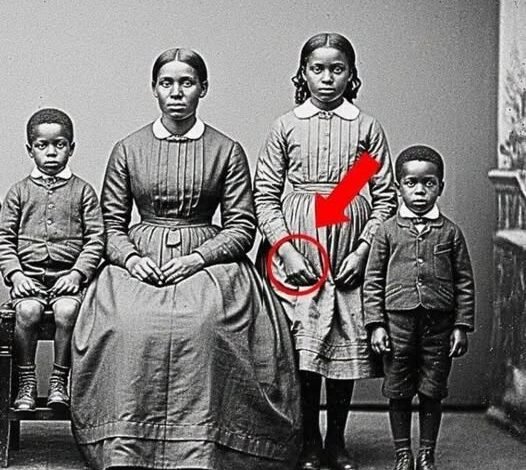
A family portrait taken in 1872 appears ordinary at first. A mother and her children sit in the formal arrangement expected of Victorian photography, dressed carefully and holding still for the camera. Then the eye moves toward the older daughter’s hand and notices what seems to be an extra hand resting where no hand should be.
That strange detail has helped the image travel far beyond the family album. Viewers enlarge the photograph, trace the arms, and try to decide whether another person was hidden just outside the frame. Some see evidence of something eerie. Others believe the explanation lies in the demanding photographic techniques of the nineteenth century.
Portrait photography in 1872 was very different from taking a quick picture today. Exposure times were longer, and even a small movement could leave part of a subject blurred, doubled, or oddly transparent. Photographers often used posing stands and hidden supports to help people remain still. Those devices were usually placed behind clothing or furniture, but an edge or padded support could sometimes appear in the final image.
Double exposure is another possibility. If a plate was exposed more than once, or if someone moved into or out of position while the shutter remained open, the result could preserve overlapping shapes. A hand is especially likely to look convincing because viewers recognize its outline immediately, even when the marks are incomplete.
Clothing can create its own illusion. Victorian sleeves, folded fabric, shadows, and the hands of two people placed close together may merge into a shape that looks anatomically impossible. Once someone points out an “extra hand,” the brain begins organizing every light and dark patch around that idea.
This is an example of pareidolia, the tendency to find familiar forms in ambiguous visual information. It is the same effect that makes people see faces in clouds or figures in the grain of wood. Pareidolia does not mean the viewer is careless. It is a normal feature of perception, and old photographs give it especially rich material because scratches, fading, contrast, and motion blur remove some of the information the eye expects.
The surviving image does not provide enough evidence for a definitive explanation. Without the original plate, notes from the photographer, or additional portraits from the same sitting, it is difficult to distinguish a support, a movement artifact, a clothing fold, or another technical accident. A dramatic interpretation may be entertaining, but it should not be presented as established fact.
What makes the photograph compelling is the tension between its calm surface and that unresolved detail. The family members could not have known that generations later strangers would study one small section of their portrait. To them, the session was likely a serious and expensive occasion meant to preserve their likenesses.
The image therefore offers two kinds of history at once. It shows how a family chose to present itself in the 1870s, and it reveals the limitations of early photographic equipment. The apparent hand may never receive a final answer, but it invites viewers to look more carefully at a picture that might otherwise have been forgotten.
A careful viewer can compare the direction of the light, the sharpness of the suspected fingers, and the position of the visible arms, but those clues remain interpretations of a reproduction. Copies shared online may have been cropped, compressed, sharpened, or color-adjusted, introducing details absent from the original print. The honest fascination of the portrait lies in that uncertainty. It is possible to enjoy the mystery while recognizing that a technical artifact is more plausible than a supernatural conclusion unsupported by the photograph itself.