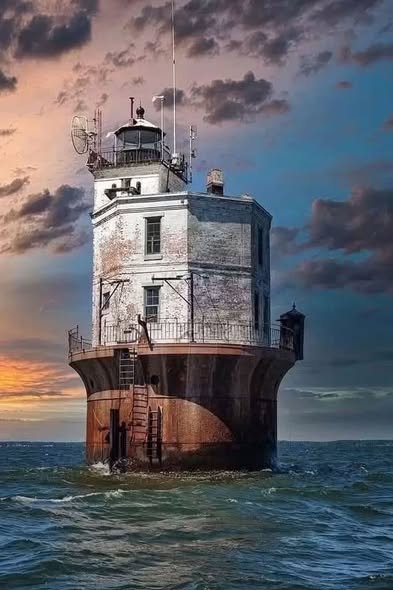
Smith Point Lighthouse: A Historic Chesapeake Bay Landmark With an Extraordinary Waterfront Lifestyle
A Once-in-a-Lifetime Opportunity on the Chesapeake Bay
Imagine waking up surrounded by water, watching boats travel across the Chesapeake Bay, and living inside a historic lighthouse that has stood at the mouth of the Potomac River for more than a century.
That is the extraordinary opportunity presented by Smith Point Lighthouse, a remarkable historic property located approximately 2.5 miles offshore from Reedville, Virginia. Built in 1897, this distinctive waterfront residence sits near the entrance to the Little Wicomico River and occupies an unforgettable position at the intersection of history, architecture, and the natural beauty of the Chesapeake Bay.
This is not a conventional waterfront house.
There is no traditional driveway, suburban street, or neighboring backyard. Instead, the property is surrounded by water and panoramic views, creating an environment that is fundamentally different from ordinary residential living.
The lighthouse has undergone a substantial restoration and renovation, completed between 2006 and 2009, that introduced modern conveniences while retaining numerous original architectural elements.
Today, the property offers approximately 1,500 square feet, four bedrooms, one full bathroom, a kitchen, living and dining areas, multiple levels, a watch room, and direct waterfront surroundings.
At the same time, this is a property that requires careful consideration. Repairs are needed to certain rails, appliances, windows, and watch-room floors, and the sale is offered as-is, where-is, with a Quit Claim Deed conveyance. A cash sale is required.
For the right buyer, however, few properties could offer a more unusual combination of history, location, privacy, and architectural character.
A Lighthouse Built in 1897
The story of Smith Point Lighthouse begins in the late 19th century.
Built in 1897, the lighthouse was constructed during an era when navigational structures were essential to maritime transportation along the Chesapeake Bay and its surrounding waterways.
The Chesapeake Bay has long been an important maritime environment, supporting commercial fishing, transportation, recreation, boating, and coastal communities.
A lighthouse positioned near the mouth of the Potomac River served a practical navigational purpose while also becoming part of the visual identity of the region.
More than a century later, Smith Point Lighthouse remains connected to that maritime heritage.
The United States Coast Guard continues to maintain the lighthouse lamp as an active aid to navigation, adding another important dimension to the property’s story.
The home is also listed on the National Historic Registry and is subject to applicable restrictions.
For anyone interested in historic preservation, maritime history, or unique American architecture, this makes the property particularly compelling.
An Unforgettable Location on the Water
Smith Point Lighthouse is positioned approximately 2.5 miles from the shore of Reedville, Virginia.
Its location at the mouth of the Potomac River provides an extraordinary vantage point over the Chesapeake Bay.
From the lighthouse, the surrounding water becomes the landscape.
Instead of looking toward neighboring houses, streets, or commercial buildings, residents can experience expansive views of the Bay and observe watercraft moving through the area.
The listing describes the location as one of the best places to watch a wide variety of boats and other vessels.
That creates a lifestyle centered around observation, nature, boating, fishing, weather, and changing water conditions.
Every day can look different.
The color of the water changes with the light. Clouds can transform the horizon. Sunrises and sunsets create constantly changing views, while passing boats provide movement across an otherwise peaceful landscape.
Chesapeake Bay Views From Every Direction
The property’s waterfront setting is arguably its greatest attraction.
The lighthouse provides Bay views and water access, with approximately 263 feet of listed frontage and deeded water rights.
A traditional waterfront property may offer a single view from a backyard or deck.
A lighthouse offers something fundamentally different.
Its elevated position allows occupants to look outward across the surrounding water from multiple levels.
The watch room provides an especially distinctive perspective.
From the upper portions of the structure, the horizon can become a defining feature of the interior experience.
For photographers, boat enthusiasts, bird watchers, maritime-history enthusiasts, and anyone who simply enjoys being near the water, this type of setting can be difficult to replicate.
The Restoration From 2006 to 2009
One of the most important chapters in the property’s modern history was its full restoration and renovation between 2006 and 2009.
Historic restoration projects require a delicate balance.
The objective is not necessarily to make an old structure look completely new. Instead, restoration can involve preserving historically significant features while introducing systems and amenities necessary for contemporary use.
At Smith Point Lighthouse, the renovation included the addition of a full kitchen, updated plumbing systems, insulation, hurricane-rated windows, and a new roof.
These improvements helped transform the historic structure into a livable retreat while maintaining much of its original character.
A Character-Filled Main Level
The main level contains the home’s kitchen, living area, dining space, and full bathroom.
The layout provides a practical gathering area where residents and guests can prepare meals, relax, dine, and enjoy the surrounding environment.
The interior retains a distinctly maritime and historic aesthetic.
Beadboard walls, brick walls, original trim, original stairs, and original doors contribute to the property’s sense of authenticity.
These details are particularly valuable in a historic building because they provide a direct visual connection to earlier generations.
Modern replacement materials can imitate historic design, but original elements have an authenticity that cannot easily be recreated.
The Updated Kitchen
The kitchen was added as part of the major restoration.
It includes cherry cabinetry, a breakfast counter, range, refrigerator, microwave, and portable dishwasher.
The kitchen provides the practical functionality necessary for extended stays.
For a property surrounded by water, having a well-equipped kitchen can be especially important because everyday routines are naturally different from those in a conventional home.
Preparing breakfast while watching boats pass by or enjoying a meal with family after a day on the water could become part of the property’s unique lifestyle.
Living and Dining Areas
The living and dining areas are designed as comfortable spaces for gathering.
The open arrangement allows occupants to move naturally between cooking, dining, and relaxing.
The original architectural details add warmth and personality to the rooms.
Vinyl plank flooring provides a practical surface for a waterfront environment, while beadboard and brick help maintain the historic character.
There is no fireplace, but the maritime setting itself becomes the home’s defining visual feature.
Large windows and the elevated position allow the Bay to function almost like a constantly changing piece of artwork.
A Full Bathroom on the Main Level
The main level includes one full bathroom with a shower stall.
The restoration introduced updated bathroom fixtures and a Lex San toilet and sink.
Given the property’s unusual location and utility systems, buyers should carefully review all plumbing, wastewater, water storage, and sanitation infrastructure as part of the due diligence process.
The property does not use a conventional municipal sewer connection.
Four Bedrooms Across Three Levels
The lighthouse offers four bedrooms distributed across multiple levels.
Three bedrooms are located on the second level, while the fourth bedroom is located one level higher in the watch room.
This arrangement creates a very different sleeping experience from a traditional single-family home.
The upper watch-room bedroom is particularly unusual.
Sleeping in a former lighthouse watch room surrounded by water views is an experience that few residential properties can offer.
The multi-level configuration also allows different areas of the house to serve distinct purposes.
The Watch Room
The watch room is one of the property’s defining features.
Historically, lighthouse watch rooms were associated with the observation and operation of maritime navigation.
Today, this upper-level space offers an opportunity to experience the property’s panoramic surroundings from an elevated position.
The current listing notes that repairs are needed to the watch-room floors.
Potential buyers should have those areas professionally evaluated, particularly because structural integrity and weather exposure are important considerations in a historic structure located offshore.
Original Trim, Doors, and Staircases
The property’s original trim, stairs, and doors remain part of its interior character.
Historic architectural details can provide a powerful sense of continuity.
Walking through a house built in 1897 while encountering original elements can create a connection to the property’s past that is difficult to achieve in modern construction.
For a future owner, preserving these components could be an important part of maintaining the lighthouse’s architectural identity.
A Waterfront Property Without Conventional Parking
One of the biggest differences between Smith Point Lighthouse and ordinary residential real estate is transportation.
The property has no conventional parking area because of its offshore location.
This means access and transportation logistics are fundamentally different from a typical house.
The listing references water access and the property’s relationship to Reedville and the surrounding Chesapeake Bay.
Prospective buyers should fully investigate transportation arrangements, dock access, boat requirements, weather considerations, emergency access, and any applicable maritime regulations before purchasing.
For someone already familiar with boating and waterfront properties, this may be an exciting part of the lifestyle.
For someone accustomed to conventional residential access, it represents a significant change.
A Private Maritime Lifestyle
Owning Smith Point Lighthouse is essentially an opportunity to embrace a maritime lifestyle.
Instead of driving home after work and walking through a suburban neighborhood, the journey to this property involves the water.
That physical separation creates an unusual degree of privacy.
The surrounding Bay becomes part of everyday life.
Weather patterns become more noticeable. Water conditions matter. Boats become part of the scenery. Wildlife can become easier to observe.
The property is particularly suited to someone who genuinely enjoys the water and is comfortable with the responsibilities associated with offshore ownership.
Watching Boats on the Chesapeake Bay
One of the pleasures specifically highlighted by the property description is the ability to watch watercraft traveling through the area.
The Chesapeake Bay is a dynamic maritime environment.
Depending on the season and conditions, residents may observe fishing boats, recreational vessels, working boats, and other watercraft moving through the surrounding waters.
For someone who enjoys boating, this can become one of the most rewarding aspects of living at the lighthouse.
The elevated position creates a natural observation platform.
Fishing and Outdoor Recreation
The property also includes a collection of items such as crab pots, tools, fishing tackle, and household items, according to the listing.
These inclusions reinforce the property’s connection to life on the water.
Fishing and crabbing can become natural recreational activities for an owner who enjoys Chesapeake Bay traditions.
However, prospective buyers should verify what equipment is included in the sale and understand any applicable local regulations, licensing requirements, seasons, and water-use restrictions.
Off-Grid Electrical Capability
Smith Point Lighthouse is designed with a portable generator to operate electrical fixtures.
This is an important feature for an offshore property where conventional utility infrastructure may not be available in the same way it is on the mainland.
The listing indicates that the property uses off-grid electricity and includes a generator.
Prospective owners should understand the capacity, condition, fuel requirements, maintenance schedule, and operational limitations of the generator and electrical system.
Off-grid living can provide independence, but it also requires a greater level of planning and maintenance than conventional utility service.
Water Storage and Treatment
The property includes a 550-gallon water tank and a plumbing system with approximately 250-gallon capacity, along with a Lex San electrolysis/wastewater treatment system.
These systems are important components of the property’s unique infrastructure.
Because the lighthouse does not have conventional public water or sewer connections, buyers should have all water-storage, plumbing, and wastewater systems professionally inspected.
Understanding how water is supplied, stored, treated, and used is essential for anyone considering long-term occupancy.
Hurricane-Rated Windows and Insulation
During the restoration, Marvin hurricane-rated windows were installed along with insulation.
These improvements are particularly relevant for a structure located in a coastal environment.
Offshore properties experience exposure to wind, salt air, moisture, storms, and changing weather conditions.
The installation of hurricane-rated windows represents an important improvement, although the current condition of the windows should be evaluated because the listing indicates that some repairs are still needed.
A Newer Roof From the Restoration
A new roof was also installed during the 2006–2009 restoration.
Roof condition is particularly important for any historic structure, and even more so for a building exposed to coastal weather.
The age and present condition of the roof should be independently verified during the inspection process.
Potential buyers should also investigate drainage, flashing, seals, structural components, and areas vulnerable to water intrusion.
Furnishings and Equipment Convey
Another interesting aspect of the sale is that numerous items convey with the property.
According to the listing, the sale includes furniture, two window air-conditioning units, two heaters, crab pots, tools, fishing tackle, and household items.
For a unique retreat like this, having furnishings and equipment already associated with the property could simplify the transition for a buyer.
However, the exact inventory should be confirmed in the purchase agreement and through the seller or listing representative.
National Historic Registry and Preservation Restrictions
The property’s inclusion on the National Historic Registry is an important consideration.
Historic designation can provide recognition and help preserve the character of significant structures, but it may also come with restrictions affecting modifications and restoration.
Potential buyers should obtain complete documentation regarding the property’s historic status and determine which federal, state, local, or other preservation requirements apply.
This is especially important if a buyer plans to replace windows, modify exterior components, alter the watch room, change railings, or undertake major renovations.
Repairs That Still Need Attention
Despite the extensive restoration completed between 2006 and 2009, the property is not presented as maintenance-free.
The listing identifies repairs needed to rails, appliances, windows, and watch-room floors.
These items should be carefully evaluated.
The cost of repairs can vary significantly depending on material availability, accessibility, labor requirements, historic-preservation standards, and the offshore location.
Contractor access may also present unique logistical challenges.
For this reason, buyers should obtain professional estimates wherever possible before finalizing a purchase.
Sold As-Is, Where-Is
The property is being offered “as is, where is” with a Quit Claim Deed conveyance.
This is an important distinction from a conventional residential transaction.
A prospective buyer should conduct extensive due diligence and understand precisely what is being conveyed.
Legal counsel familiar with real estate transactions and historic properties can help explain the implications of a Quit Claim Deed and identify any title, access, easement, or ownership considerations that should be reviewed.
Cash Sale Required
The listing specifies that a cash sale is required.
This means prospective buyers should be prepared to demonstrate the necessary funds and understand the financial requirements associated with purchasing and maintaining a unique historic offshore property.
In addition to the purchase price, buyers should consider insurance, transportation, boat access, maintenance, utilities, repairs, preservation requirements, and ongoing operating expenses.
More Than a House: A Piece of Maritime History
Smith Point Lighthouse is difficult to compare with ordinary real estate.
It is simultaneously a residence, a historic structure, a navigational landmark, and a waterfront retreat.
The property connects its owner to more than a century of Chesapeake Bay history.
Its brick walls, original trim, historic stairs, watch room, maritime location, and active navigational light all contribute to a story that began in the 19th century.
That history is perhaps the property’s most irreplaceable feature.
Who Might Be Drawn to This Property?
This lighthouse could appeal to several types of buyers.
A maritime enthusiast may appreciate its relationship with the Chesapeake Bay.
A historic-preservation enthusiast may value the opportunity to care for a 19th-century landmark.
A boating enthusiast could enjoy the waterfront environment and access to surrounding waterways.
An adventurous homeowner may be attracted to the privacy and unconventional lifestyle.
A collector of unique properties may see the lighthouse as an exceptionally rare addition to a portfolio.
Regardless of the buyer’s motivation, ownership requires a willingness to accept the responsibilities that accompany such a distinctive property.
A Lifestyle Defined by Water and Views
Perhaps the best way to understand Smith Point Lighthouse is to imagine daily life there.
Morning begins with water views.
The sounds of the Bay replace the traffic of a conventional neighborhood.
A meal in the kitchen can be accompanied by passing boats on the horizon.
An afternoon might involve fishing, crabbing, exploring the shoreline, or simply observing the changing weather.
Evenings can bring dramatic sunsets across the water.
At night, the historic lighthouse structure takes on another personality as the surrounding darkness emphasizes the importance of its navigational role.
This is a lifestyle built around the environment rather than separated from it.
Final Thoughts
Smith Point Lighthouse represents one of the most unusual residential opportunities available to someone seeking a historic property with a truly extraordinary setting.
Built in 1897, the lighthouse stands approximately 2.5 miles offshore from Reedville, Virginia, near the mouth of the Potomac River and the entrance to the Little Wicomico.
The approximately 1,500-square-foot property includes four bedrooms, one full bathroom, a kitchen, living and dining areas, three or more levels, and a distinctive watch room.
Its restoration between 2006 and 2009 introduced a number of modern improvements, including a cherry-cabinet kitchen, hurricane-rated windows, insulation, a new roof, updated water and wastewater infrastructure, and other amenities.
At the same time, the home retains original beadboard and brick walls, trim, doors, and stairs that preserve its historic atmosphere.
The property offers panoramic Chesapeake Bay views, waterfront access, approximately 263 feet of listed frontage, and an environment unlike almost any conventional home.
However, this is also a property that demands serious consideration.
Repairs are needed, the sale is as-is where-is, a Quit Claim Deed is used, and the transaction requires cash. Historic restrictions, offshore access, utility systems, weather exposure, maintenance requirements, and repair logistics should all be carefully investigated.
For a buyer who understands those responsibilities, however, Smith Point Lighthouse could represent something genuinely special.
It is not simply a place to live.
It is a chance to become the caretaker of a piece of Chesapeake Bay history while experiencing a private waterfront lifestyle surrounded by water, maritime activity, expansive views, and the unmistakable character of a historic lighthouse.
Properties like this rarely come along, and even fewer offer the combination of 19th-century history, active navigational significance, waterfront isolation, restored living space, and breathtaking Chesapeake Bay surroundings found at Smith Point Lighthouse.
From Zillow