The Scenario Explained in Simple Terms
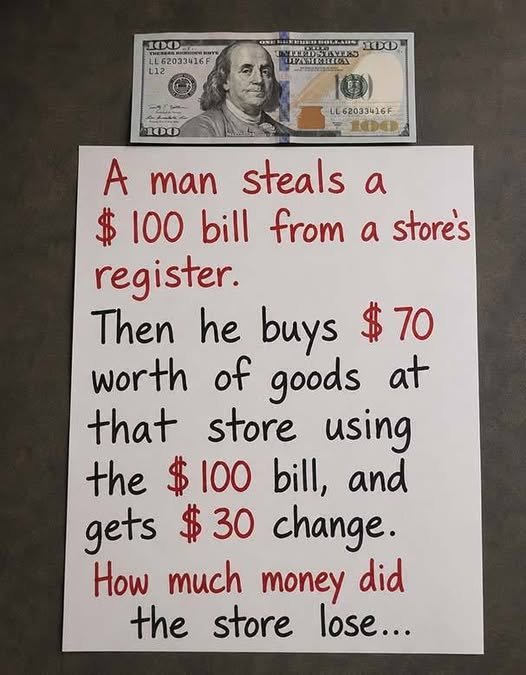
Imagine a retail store that operates normally, selling goods and handling cash transactions throughout the day. One day, an individual enters the store and takes a $100 bill from the cash register without permission. At this moment, the store has clearly suffered a loss of $100 in cash.
Later on, the same individual returns to the same store. This time, he behaves like a regular customer. He selects $70 worth of products and goes to the cashier to pay for them. Instead of using legitimate money, he uses the same $100 bill that he previously stole.
The cashier, unaware that the bill was stolen, accepts it as payment. Since the total purchase is $70, the cashier gives the customer $30 in change. After this transaction is completed, the customer leaves the store with both the goods and the remaining cash.
Now the key question is: How much money did the store actually lose in total after all events are considered?
Breaking Down the Events Step by Step
To understand the problem correctly, it helps to separate the events and analyze them individually rather than mentally mixing everything together.
1. The initial theft
At the beginning, the thief steals $100 from the register.
- Store cash decreases by $100
- No goods are involved yet
- Total loss at this moment: $100 (cash)
2. The purchase using the stolen money
Later, the thief returns and buys $70 worth of goods using the stolen $100 bill.
At this stage:
- The store receives back its own $100 bill (which restores cash balance temporarily)
- The store gives away $70 worth of merchandise
So at this moment, the store’s inventory decreases by $70.
3. The change given to the thief
Because the purchase was only $70, the cashier returns $30 in cash as change.
Now:
- Store cash decreases by $30
- Store inventory has already decreased by $70
Combining All Effects Together
To determine the final loss, we must combine what the store permanently lost after everything is completed:
- Merchandise loss: $70
- Cash loss (given as change): $30
Now add these together:
$70 + $30 = $100
So, the total net loss for the store is $100.
Why Many People Get the Wrong Answer
Even though the solution is straightforward when broken down, many people initially arrive at different answers such as $130, $170, or even $200. This happens because the story format encourages people to track the stolen money incorrectly.
Here are some common reasoning mistakes:
Mistake 1: Double-counting the stolen $100
Some people think:
- The store lost $100 initially
- Then lost $70 in goods
- Then lost $30 in cash
This leads to $200, which is incorrect because the original $100 is not an additional loss after being recovered in the transaction.
Mistake 2: Treating all money movements as separate losses
Others count every movement independently without considering recovery:
- Theft = loss
- Purchase = separate loss
- Change = separate loss
This ignores that the stolen $100 was reused and returned to the register.
Mistake 3: Getting distracted by the narrative
The story involves theft and customer behavior, which can make people focus more on the crime aspect rather than the actual financial outcome.
The Key Insight: What Actually Matters
The most important idea in solving this puzzle is to focus only on what the store permanently loses after everything settles.
A useful way to simplify it is this:
- The stolen $100 eventually returns to the register when used in payment
- Therefore, it cancels itself out in terms of final loss
- What remains missing is only:
- The goods given away ($70)
- The cash handed out as change ($30)
This approach removes unnecessary emotional or narrative distractions and focuses purely on final state accounting.
A Simpler Way to Imagine the Situation
Another helpful way to understand the problem is to ignore the theft entirely for a moment and think only about the final transaction.
Imagine the following:
A customer enters the store and receives:
- $70 worth of products
- $30 in cash
And leaves without paying anything of real value.
From the store’s perspective, this is clearly a $100 loss.
This mental model works because it eliminates confusion about where the original $100 came from and focuses only on what the store ends up missing.
Why the Stolen Money Does Not Change the Final Loss
One of the most confusing parts of the puzzle is the stolen $100 bill. Many people keep including it in calculations multiple times, but this is unnecessary.
Here is the correct interpretation:
- The $100 was stolen (temporary loss)
- The same $100 returned to the store when used for payment
- Because it returned, it cannot be counted as a final loss
In accounting terms, anything that is restored cannot be considered part of the net loss.
The Psychology Behind the Confusion
This puzzle is popular not because it is mathematically difficult, but because it exploits how human thinking works.
People tend to:
- Follow stories instead of isolating facts
- Track objects (like money) instead of net outcomes
- Assume every action adds a new loss
When information is presented in a narrative form, the brain naturally tries to “simulate” the events rather than calculate them logically. This often leads to overcomplication.
Another psychological factor is confidence. Because the math is simple, most people quickly assume they are correct without fully verifying their reasoning. When they later see a different answer, it creates strong debate and discussion.
Why This Type of Puzzle Becomes Popular Online
Logic puzzles like this spread quickly on social media because they:
- Appear simple but feel tricky
- Encourage debate in comment sections
- Give different answers depending on reasoning mistakes
- Create a sense of challenge and curiosity
People enjoy comparing answers and defending their logic, even when the final solution is straightforward. This makes such puzzles highly engaging and widely shared.
Step-by-Step Final Summary
To clearly summarize the correct reasoning:
- The thief steals $100 (temporary loss)
- The thief later uses that $100 to buy $70 in goods
- The store gives $30 in change
- The $100 returns to the register and is no longer lost
- The only permanent losses are:
- $70 in goods
- $30 in cash
Final Answer:
The store’s total loss is $100.
Conclusion: The Real Lesson of the Puzzle
Although this scenario is framed as a tricky math challenge, it is actually a lesson in careful thinking. The difficulty does not come from calculations but from how the information is presented. When the story is simplified and broken down into final outcomes, the confusion disappears.
The main takeaway is that complex wording can easily distract from simple logic. By focusing only on what is permanently lost, rather than how events unfold narratively, the correct answer becomes clear and consistent.
In the end, this puzzle serves as a reminder that many problems become much easier when we separate storytelling from actual data and analyze only the final, concrete results.