Uncategorized
My 13-Year-Old Son Took a Dishwashing Job—Then I Discovered Where His Paychecks Were Really Going

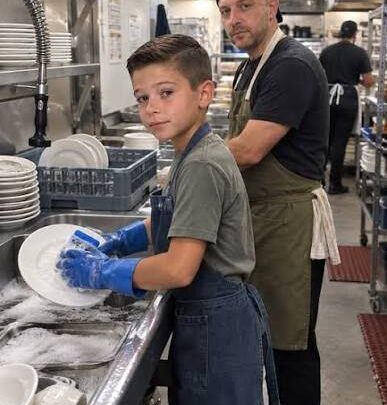
When my thirteen-year-old son Evan told me he had found a weekend dishwashing job, I thought I understood why he wanted to work.
He wanted a bicycle.
Not just any bicycle, either. For six months, he had been talking about one particular matte-black model with orange lettering. He had shown me pictures, compared prices, and even promised that he would save every dollar he earned until he could buy it himself.
I thought it was a harmless lesson in responsibility.
Then his boss called me.
And within minutes, I discovered that the story my son had been telling me about his paychecks was nowhere near the whole truth.
“Ma’am, you should probably sit down,” Sal told me over the phone.
My stomach tightened.
“Why? Did Evan do something wrong?”
There was a long pause.
“I honestly don’t know how to answer that.”
I gripped the edge of my desk.
“What does that mean?”
Sal sighed.
“Do you know what your son does with every paycheck?”
I frowned.
“He’s saving it.”
“For what?”
“A bicycle.”
Another pause.
Then Sal said quietly, “That’s not what the money is for.”
My heart dropped.
“What are you talking about?”
“He isn’t saving for that bike.”
Before I could ask another question, I heard shouting in the background.
Then I heard Evan.
“Please! Don’t tell my mom!”
Something crashed.
“Evan!”
I jumped to my feet.
“Sal, what’s happening?”
His breathing was heavy.
“Ma’am, you need to come down here.”
“What happened?”
“Your son tried to do it again.”
“Tried to do what?”
But the call ended.
I grabbed my keys and ran.
During the drive to the diner, my mind raced through every possibility. Had Evan stolen something? Had he gotten into a fight? Was somebody threatening him?
Then another thought hit me.
What if the cash I had occasionally seen in his room wasn’t really his?
By the time I reached the diner, my hands were shaking.
I pushed through the front door and hurried toward the kitchen.
Several employees were standing near the dishwashing area.
And there was Evan.
He stood in the middle of the room, pale and silent.
His backpack was open on the floor.
Papers, receipts, small packages, and envelopes were scattered everywhere.
I looked at my son.
Then I looked at the things surrounding him.
Nothing made sense.
“Evan?”
He wouldn’t meet my eyes.
“Mom…”
“What is all this?”
Nobody answered.
Then I noticed an envelope.
My name was written across the front.
MOM.
I picked it up with trembling hands.
“What’s inside?”
Evan swallowed.
“Open it.”
I tore the envelope.
Inside were handwritten notes.
The first one began:
For Mrs. Alvarez.
I read the page.
It was a short message written in Evan’s uneven handwriting.
He had written that he knew she was having trouble paying for groceries and medicine. He had included money and asked her not to tell me because he didn’t want me to worry.
I read the next note.
Then another.
Then another.
Each was addressed to a different person.
An elderly man.
A single mother.
A family struggling with heating costs.
Someone who needed medication.
Someone who needed school supplies.
Someone who needed food.
I looked at Evan in disbelief.
“Who are these people?”
His eyes filled with tears.
“People who need help.”
Sal nodded.
“Some are regular customers. Evan started noticing things.”
I looked back at my son.
“And you were giving them your paychecks?”
“Not all of them.”
“Then where did the rest go?”
He lowered his head.
“The bicycle?”
He shook his head.
“No.”
The truth finally settled over me.
The bicycle had never been the goal.
It had been the explanation.
A simple story that made his weekend job sound normal.
A story that kept me from asking why a thirteen-year-old boy seemed so determined to work.
I sat down.
“Evan, why didn’t you tell me?”
His answer was almost a whisper.
“Because you would have stopped me.”
I couldn’t deny it.
He was thirteen.
He should have been riding bikes with friends, playing video games, complaining about homework, and asking me for snacks every twenty minutes.
He shouldn’t have been worrying about other families’ electricity bills.
He shouldn’t have been carrying money around town.
And he definitely shouldn’t have been doing any of it secretly.
“What happened today?” I asked.
Evan looked at Sal.
Sal sighed.
“This morning, Evan came in early. He said he needed to drop something off.”
“Where?”
“The back entrance.”
“Why?”
Sal hesitated.
“Because he thought someone was following him.”
My heart stopped.
I turned toward my son.
“Someone was following you?”
Evan nodded.
“I didn’t know who.”
“Why didn’t you tell me?”
“Because I thought you’d make me stop.”
“You were being followed!”
“I know.”
His voice cracked.
“I know, Mom.”
I immediately pulled him into my arms.
He was still my little boy.
No matter how grown-up he had tried to act, he was still thirteen.
After a moment, I pulled away and looked at his face.
There was a small cut above his eyebrow.
I hadn’t noticed it before.
“Who hurt you?”
“Nobody.”
“Evan.”
He looked away.
“I fell.”
Sal shook his head.
“He was trying to get away from someone.”
I felt a wave of anger and fear.
“Who?”
“We don’t know yet.”
Then Sal picked up a receipt.
“There is something else.”
I took it.
It wasn’t from a grocery store or pharmacy.
It was from a pawn shop.
My stomach tightened.
“What did he sell?”
Sal looked at Evan.
Evan reached into his pocket.
Slowly, he pulled out a small plastic bag.
Inside was a silver watch.
I recognized it immediately.
My husband’s watch.
The last watch he had worn before he died.
I had kept it in a drawer for three years.
I had told Evan never to touch it.
My voice disappeared.
“You sold your father’s watch?”
Evan began crying.
“I was going to buy it back.”
“How much did you get?”
“Two hundred dollars.”
I closed my eyes.
“For the families?”
He nodded.
I didn’t know whether to be angry or heartbroken.
Finally, I pulled him close.
“You don’t have to fix everything.”
He cried against my shoulder.
“I thought I did.”
“No.”
I held him tighter.
“That’s what parents are supposed to do.”
For a few minutes, nobody spoke.
Then Sal said something that changed everything again.
“There’s still the man who followed him.”
I looked up.
“Who is he?”
“We don’t know.”
Then he told us that Evan had recently found a small black notebook behind the diner.
Evan pulled it from his backpack.
Inside were names, dates, amounts, and addresses.
Beside several names was the same strange symbol.
A small orange circle.
“What does that mean?” I asked.
“I don’t know.”
“Who wrote it?”
“I didn’t.”
He turned the notebook around.
“It was already there.”
Then someone knocked on the back door.
Three slow knocks.
Everyone froze.
Knock.
Knock.
Knock.
Sal looked toward the door.
“Nobody should be back there.”
He approached cautiously and looked through the window.
His expression changed.
A teenage girl stood outside.
She looked about sixteen.
Her hair was soaked from the rain, and she held a cardboard box against her chest.
When she saw Evan, she immediately started crying.
“You shouldn’t have come,” Evan whispered.
“I had to,” she replied.
Her name was Mia.
She told me that Evan had been helping her family for months.
Her mother had lost her job. Her younger brother had asthma. There were weeks when they had struggled to afford food and medicine.
Evan had overheard them talking about their situation at the diner.
He had quietly started helping.
“He wouldn’t let us pay him back,” Mia said.
I looked at my son.
“Why?”
He shrugged.
“Because they needed it.”
Mia then told us something far more frightening.
Someone had started asking questions about Evan.
Where he worked.
Where he lived.
Who his mother was.
She had seen the person once.
A man.
About forty.
Wearing a jacket with an orange circle on it.
I immediately looked at the notebook.
The same symbol.
Then Sal went pale.
“I’ve seen that jacket.”
“Where?”
“Here.”
He explained that a man had been coming into the diner for months. He usually ordered coffee and stayed for a long time.
Then I asked Evan what the man had said to him.
“He asked why I was working.”
“What did you tell him?”
“That I wanted a bicycle.”
My stomach sank.
“What else?”
“He asked how much I made.”
I stared at my son.
“And you told him?”
“Once.”
The room became silent.
Then I remembered the envelope.
The one with my name on it.
I picked it up.
“Evan, what’s in the rest of this?”
He hesitated.
“It’s for you.”
I opened it.
Inside was a letter.
His handwriting was unmistakable.
He apologized for lying about the bicycle.
He explained that he really had wanted one, but after his father died, he became increasingly worried about me.
He had seen me sitting at the kitchen table late at night, studying bills.
He had heard me crying.
And he had decided that if he could help other people, maybe life would become a little easier for everyone.
One sentence stopped me completely.
I know I’m only thirteen, but sometimes I don’t feel like a kid anymore.
I lowered the letter.
Evan was crying across the room.
I finally understood.
He hadn’t been trying to deceive me because he didn’t love me.
He had been trying to protect me because he loved me too much.
But there was one final secret.
The money wasn’t all in the diner.
Evan led us to a storage room.
Behind several boxes was a small metal cash box.
Inside were dozens of envelopes.
Each had a person’s name written on it.
“These are the rest,” Evan said.
I stared at the money.
“How much is here?”
“Almost everything.”
“Almost?”
His face changed.
“The last envelope is gone.”
“Where?”
He hesitated.
“I gave it to the man.”
My heart stopped.
“What man?”
“The man with the orange jacket.”
Sal stepped forward.
“Why?”
“He said he could get it to the families faster.”
I looked at Mia.
She shook her head.
“We never asked him for anything.”
Then I understood.
The man wasn’t simply interested in Evan’s money.
He was interested in the people Evan was helping.
The notebook contained names.
Addresses.
Amounts.
Families who were vulnerable.
Evan had unknowingly created a map.
And someone else had been watching.
That night, headlights appeared outside the diner.
A dark vehicle stopped near the back entrance.
A man stepped out.
Dark jacket.
Rain dripping from his shoulders.
And on his chest was the orange circle.
Evan grabbed my hand.
“That’s him.”
The man didn’t enter.
Instead, he placed something on the wet pavement and walked back to his car.
Sal waited until the vehicle disappeared.
Then he opened the door.
It was an envelope.
My name was written on it.
I opened it.
Inside was the missing money.
Every dollar.
And one sentence:
Your son reminded me what I had forgotten.
We later learned that the man’s name was Daniel Mercer.
He had once worked with a local charitable organization that helped families facing hardship. After the organization closed, he had continued helping people privately.
He had initially followed Evan because he suspected something was wrong.
Then he discovered the truth.
Evan wasn’t stealing.
He wasn’t involved in anything criminal.
He was simply a young boy trying to help people who were struggling.
Daniel returned the money because he realized that Evan’s intentions were genuine.
But the experience taught all of us something important.
Kindness without guidance can become dangerous.
Evan had a good heart, but he was still a child.
He needed adults around him who could help him turn that kindness into something safe and sustainable.
I made him one promise.
He would never have to carry that responsibility alone again.
Months later, we finally bought the bicycle.
Matte black.
Orange lettering.
Exactly the one he had wanted for so long.
When Evan rode it down our street for the first time, I stood on the porch and watched him disappear around the corner.
The bicycle had been the excuse.
The money had been part of the story.
The mysterious man had been another piece.
But the real story was about a thirteen-year-old boy who had lost his father and decided that kindness was something worth carrying forward.
He had tried to become responsible before he was ready.
He had tried to protect his mother.
He had tried to help strangers.
And he had learned that doing good doesn’t mean doing everything alone.
That evening, Evan came home with muddy shoes and a huge smile.
He leaned the bicycle against the porch.
Then he looked at me.
“Mom?”
“Yeah?”
“Do you think Dad would have liked it?”
I looked at the bicycle.
Then at my son.
“I think he’d have been proud of the person riding it.”
Evan smiled.
And for the first time in three years, I looked at the empty chair at our dinner table and felt something besides grief.
I felt gratitude.
Because somehow, through a thirteen-year-old boy, the best parts of his father had survived.
And maybe that was what Evan had really been trying to save all along.