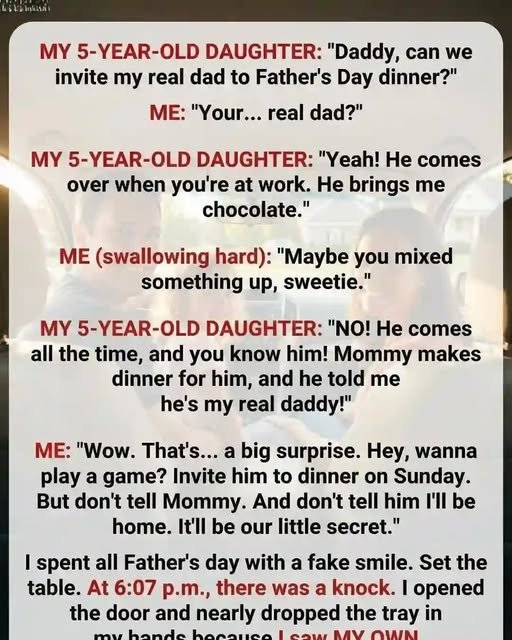
There was no ominous music, no sudden drop in temperature, and no warning sign when my world shifted on its axis. It happened on a Tuesday, amidst the mundane clatter of dinner prep and the smell of sautéing onions. Lily, my six-year-old daughter, was coloring at the kitchen island, her legs swinging rhythmically against the cabinet.
Her voice didn’t carry a shred of drama. She asked the question the same way she might ask for a glass of milk or wonder aloud if it was going to rain. It slipped into the room as a simple, undeniable fact of her existence—a detail she assumed I already possessed.
“Daddy, for the Father’s Day surprise dinner game, do we set a place for Paul, or does he sit in the watching chair again?”
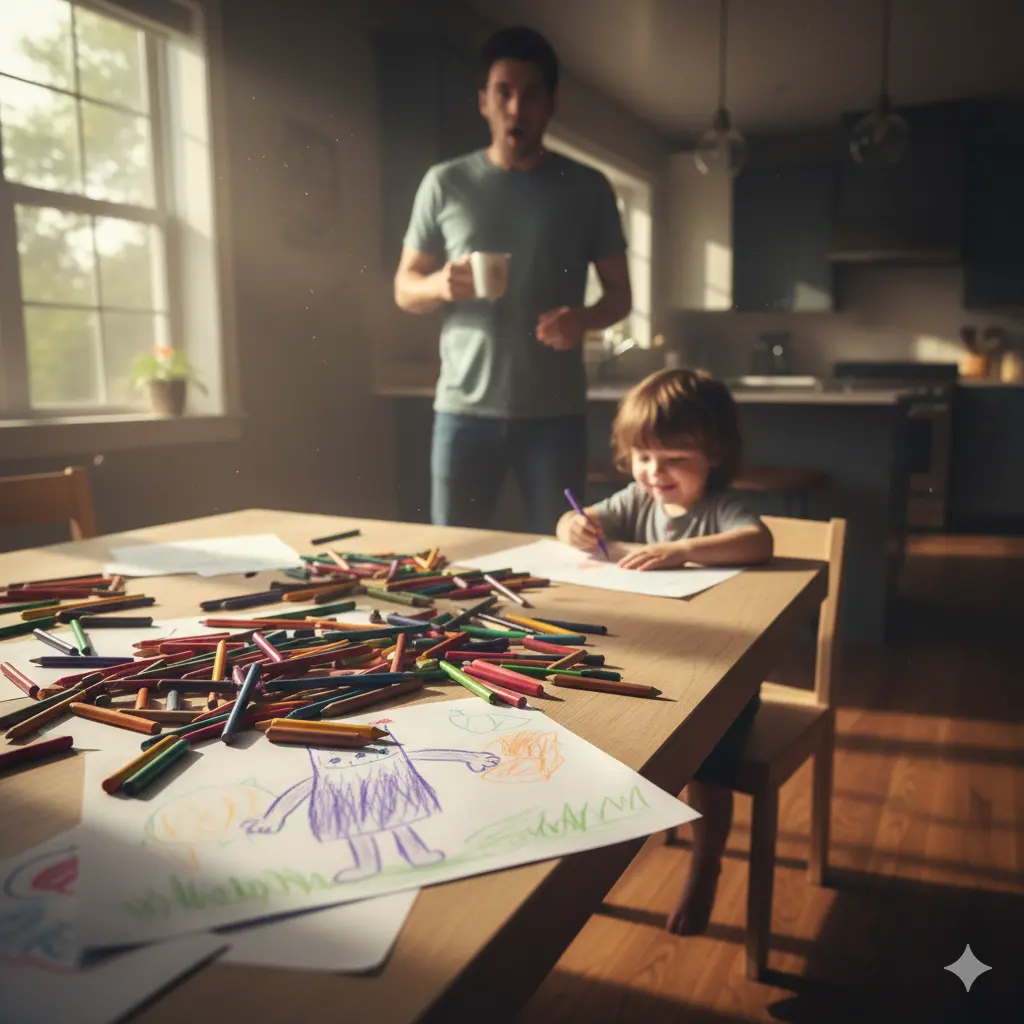
Sometimes the biggest truths are hidden in the smallest, most innocent questions.
The spatula in my hand didn’t drop, but my stomach did. It felt as though the floor had tilted five degrees to the left, throwing my equilibrium off just enough to make me dizzy. Paul? The name hung in the air, foreign and yet disturbingly familiar in her tone.
I turned the stove off. I forced a smile that felt too tight on my face and guided her gently, asking one careful question after another. I was navigating a minefield, trying desperately not to let her see that my heart was hammering against my ribs like a trapped bird. Her innocence had become a mirror, reflecting a massive gap between the world she lived in and the one I believed we shared.
The Shadow in the House
As she spoke, the scattered little details of the past year began to arrange themselves into a picture I hadn’t wanted to see. She described familiar hugs. She spoke of easy conversations about cartoons I didn’t watch. She mentioned quiet visits that, I realized with a sick sinking feeling, always took place when I was working late, running errands, or out of town for conferences.
She talked about someone who knew her favorite storybook character by name. Someone who had helped her with the diorama school project I thought she had finished with her mother. Someone who had been in our home, drinking from our glasses, sitting in our chairs.
There was zero hesitation in her storytelling. To Lily, this wasn’t a scandal; it was just part of her Tuesday. In that moment, the crushing realization hit me: I was the only person living in the incomplete version of our family. I was the outsider in my own home.
The Knock at the Door
When the knock finally came that evening, a strange, suffocating stillness settled over the house. It wasn’t the rhythmic knock of a delivery driver or the friendly rap of a neighbor. It was hesitant. Apologetic.
I opened the door to find a man standing on our step. He looked nothing like a villain. He looked terrified. A mixture of dread and deep apology was written across his face. His hands shook slightly at his sides, and his eyes kept lowering to the welcome mat and then lifting again, as if he were trying to gather enough oxygen to speak.
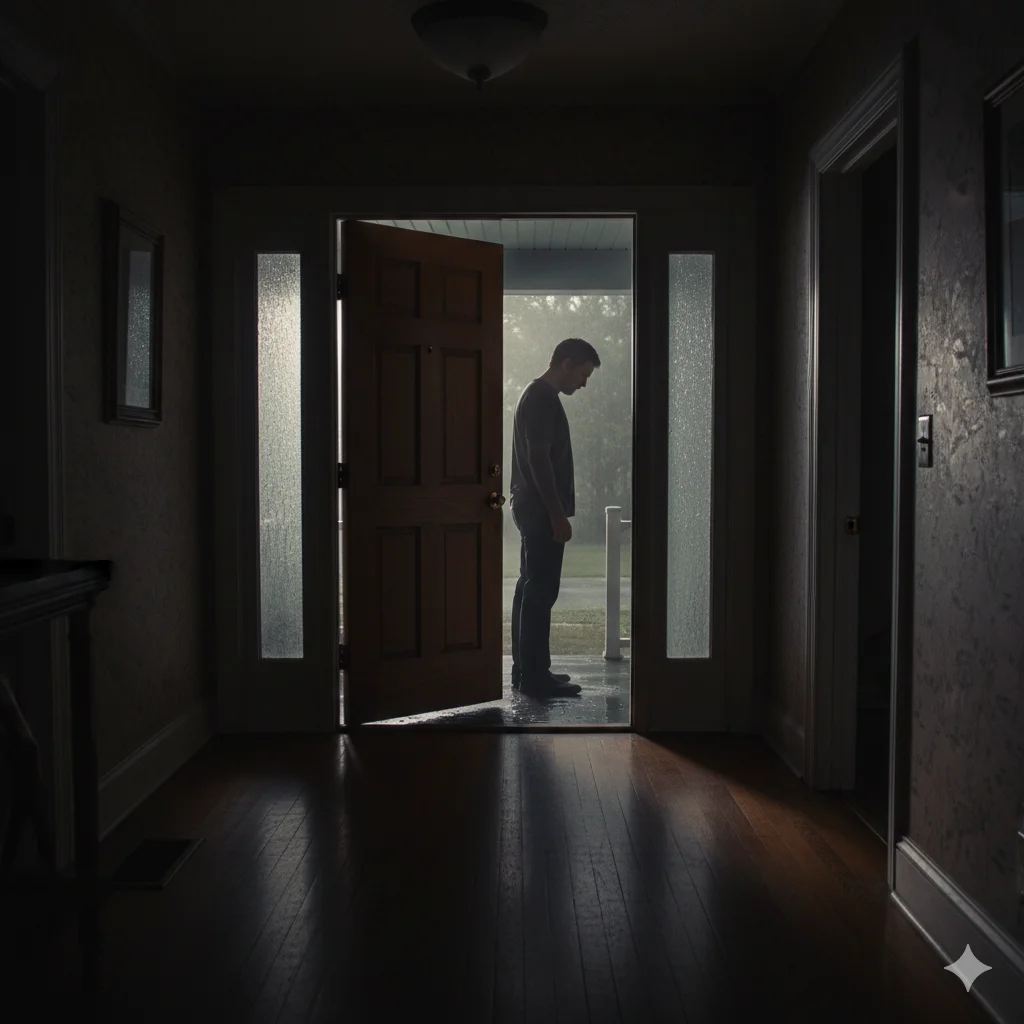
He didn’t come to challenge me; he came because the silence had finally broken.
This was not a man who had come to challenge me for my territory. This was someone who clearly never expected this moment to arrive. In that instant, looking at his fear, I understood that the secret hadn’t been born out of malice or cruelty. It had been allowed to grow simply because no one wanted to disturb the fragile, comfortable peace we had all built.
The Weight of Three Adults
The conversation that followed was surreal. It was gentle, almost painfully polite, conducted in hushed tones in the living room while Lily slept upstairs. We sat at the table—three adults carrying the heavy, dusty weight of choices made years before my daughter was even born.
I learned the truth. I learned about an old relationship of my wife’s that had ended quietly but never truly severed. I learned about a biological connection that they had mutually promised to keep “simple” to avoid confusion, to let our lives move forward without the complication of a third parent. But biology has a way of pulling at the seams. Over time, the promise to stay away had eroded into secret visits, and the silence had felt safer than the truth.
It hurt to hear it. God, it hurt. But the pain was clear and manageable, a dull ache rather than a jagged wound. It was the pain of complexity, not hatred.
Redefining the Role
In the days that followed, I had to bury my ego. My focus had to remain entirely on Lily. Whatever shock or betrayal I felt had to stay in the background, a shadow puppet I couldn’t let her see. She needed steadiness, not the turmoil of adult regrets.
I kept our routines exactly as they had always been, rigid and religious. Bedtime stories every night, complete with the funny voices. Our silly, made-up songs while brushing teeth. Pancake Saturdays with entirely too much syrup and a kitchen full of laughter. I wanted her to feel the ground beneath her feet was solid rock, no matter what shifting sands the adults were trying to traverse.
Then came the moment that mattered more than biology.
One evening, as she climbed into my lap with her worn, ratty blanket, she looked up at me with wide, searching eyes. She asked the question that had likely been brewing in her small mind since the “dinner game” slip-up.
“Are you still my daddy?”
Fatherhood isn’t found in DNA; it is found in the decision to stay.
Her voice trembled just a little, a vibrato of fear that broke my heart. The answer didn’t come from my head. It rose from a place deeper than pride, deeper than fear, and deeper even than the hurt I was still untangling.
I pulled her close, wrapping my arms around the life I had helped shape.
“Yes,” I told her, my voice steady. “And not just yes for now. Yes for always.”
In that quiet embrace, I understood something I had never quite put into words before. Fatherhood does not survive through biology or through making perfect choices. It survives through presence. It survives through forgiveness. And most of all, it survives through the quiet, daily decision to stay, to love, and to be the one who makes the pancakes on Saturday morning.
Note: All images used in this article are AI-generated and intended for illustrative purposes only. This work is inspired by real events and people, but it has been fictionalized for creative purposes. Names, characters, and details have been changed to protect privacy and enhance the narrative. Any resemblance to actual persons, living or dead, or actual events is purely coincidental and not intended by the author.